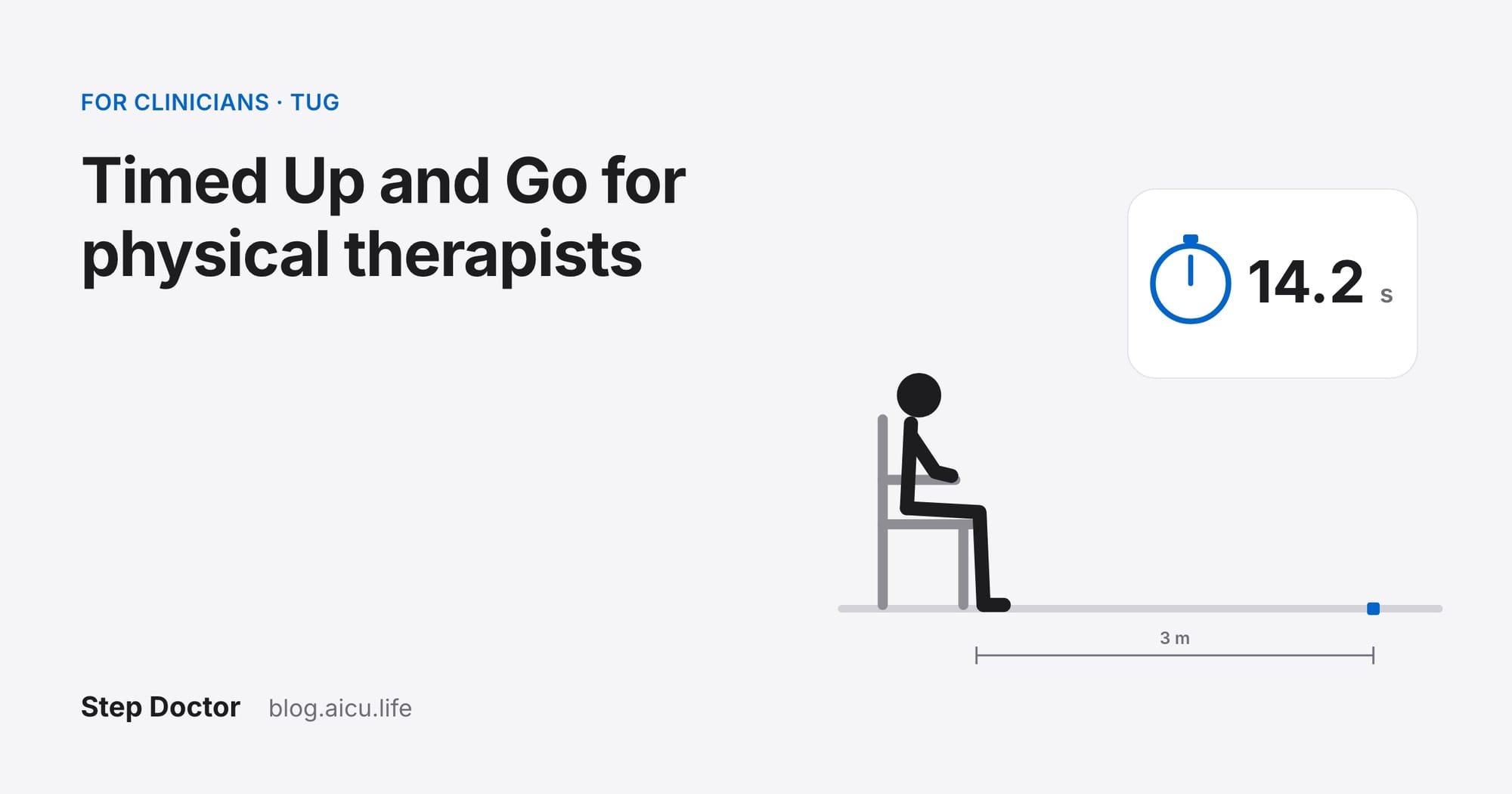
The Timed Up and Go (TUG) test uses a walk of 3 metres (9.8 feet): the person stands up from an armchair, walks 3 m, turns, walks back and sits down again, and you time the whole thing in seconds (Podsiadlo & Richardson, 1991). The US CDC's STEADI form puts the line "3 meters, or 10 feet" away (CDC STEADI). This page covers the distance and set-up, what "TUG" stands for, how it differs from the older Get Up and Go test and the 8-foot up-and-go, and what the time means.
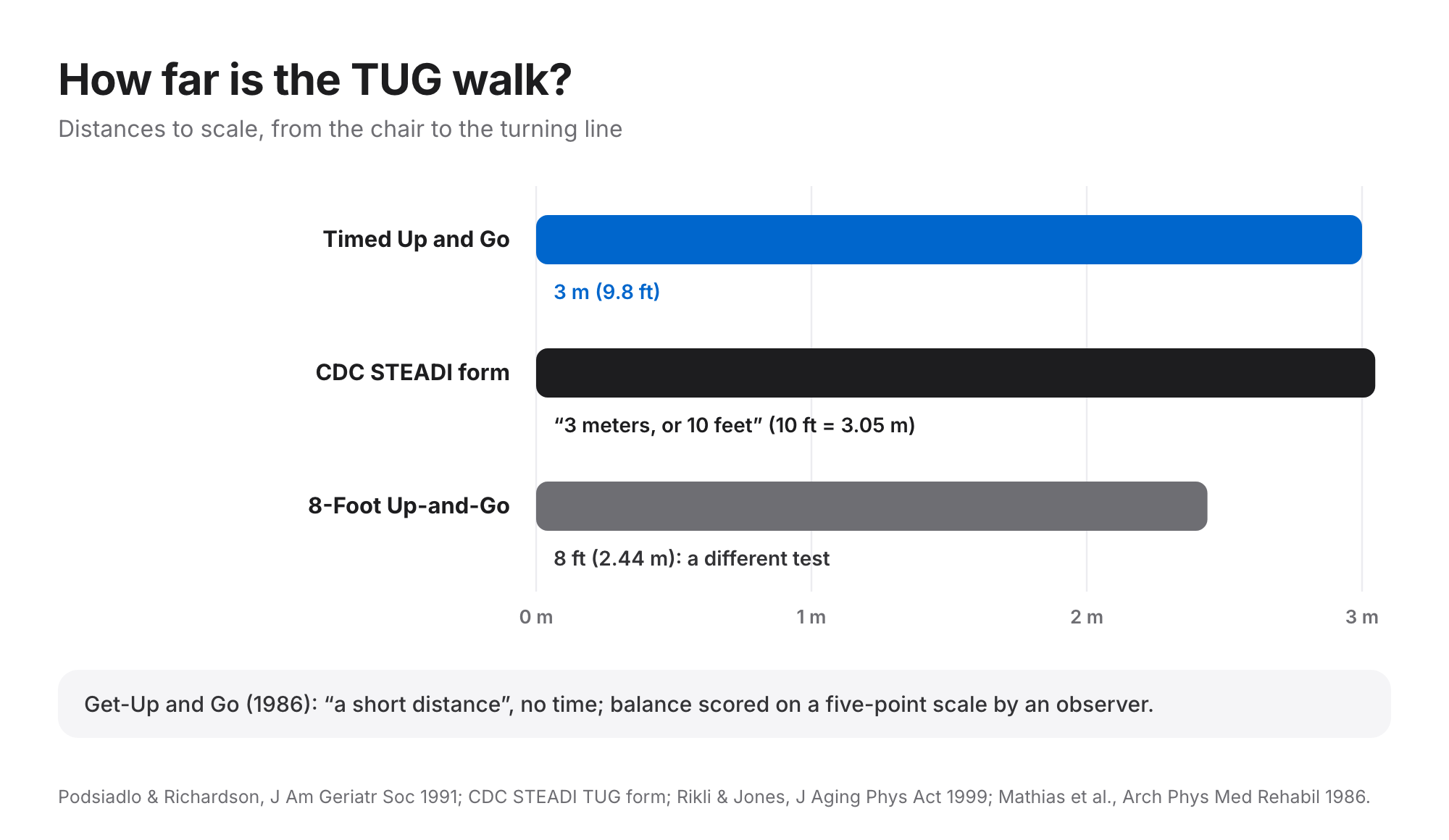
How long is the TUG walk?
- 3 m out to a line on the floor, a turn, and 3 m back: about 6 m of walking plus standing up, turning and sitting down. That's the distance in the original paper (Podsiadlo & Richardson, 1991).
- 10 feet is the rounded US version on the CDC STEADI form. 10 ft is 3.05 m, 5 cm longer than 3 m. That makes almost no difference to a time, but use the same distance every time you repeat the test.
- The chair: a standard armchair with a back. A widely used protocol based on the original paper gives a seat height of 46 cm and an arm height of 67 cm (Shirley Ryan AbilityLab protocol).
- Shoes and aids: regular footwear, and a walking aid if the person normally uses one (CDC STEADI).
How to run it
- Sit back in the chair. Mark a line 3 m (10 ft) away.
- Say: "When I say 'Go', stand up from the chair, walk to the line on the floor at your normal pace, turn, walk back to the chair at your normal pace, and sit down again."
- Start timing on the word "Go". Stop when the person sits back down (CDC STEADI).
Stay next to anyone who might be unsteady. STEADI also asks you to watch how the person moves: a slow, tentative pace, loss of balance, short strides, little or no arm swing, steadying themselves on walls, shuffling, turning "en bloc", or not using a walking aid properly. Our TUG guide for physical therapists covers trials, timing rules and documentation, and the free TUG score sheet has the script and a log.
Get Up and Go vs Timed Up and Go
"Get up and go" is often used as another name for the TUG, but the original Get-Up and Go test (Mathias et al., 1986) was not timed. Patients stood up from a chair, walked "a short distance", turned, came back and sat down, and observers scored their balance on a five-point scale. A commonly used version scores 1 (normal) to 5 (severely abnormal), with 3 or more suggesting a fall risk (UCLA GWEP).
Podsiadlo and Richardson made it a timed test over a fixed 3 m. In 60 older day-hospital patients, the time was reliable between and within raters and tracked balance (Berg Balance Scale, r = −0.81), gait speed (r = −0.61) and daily activities (Barthel Index, r = −0.78) (Podsiadlo & Richardson, 1991). A time in seconds is easier to compare between visits than an observer's score, which is why the timed version is the one in common use.
Not the same: the 8-foot up-and-go
The Senior Fitness Test includes an 8-foot up-and-go: the walk is 8 ft (2.44 m) instead of 3 m (Rikli & Jones, 1999). It looks almost the same, but a shorter walk gives a shorter time, so its norms can't be used for a 3 m TUG, and TUG norms can't be used for it. Check which test a cut-off belongs to before comparing.
What the time means
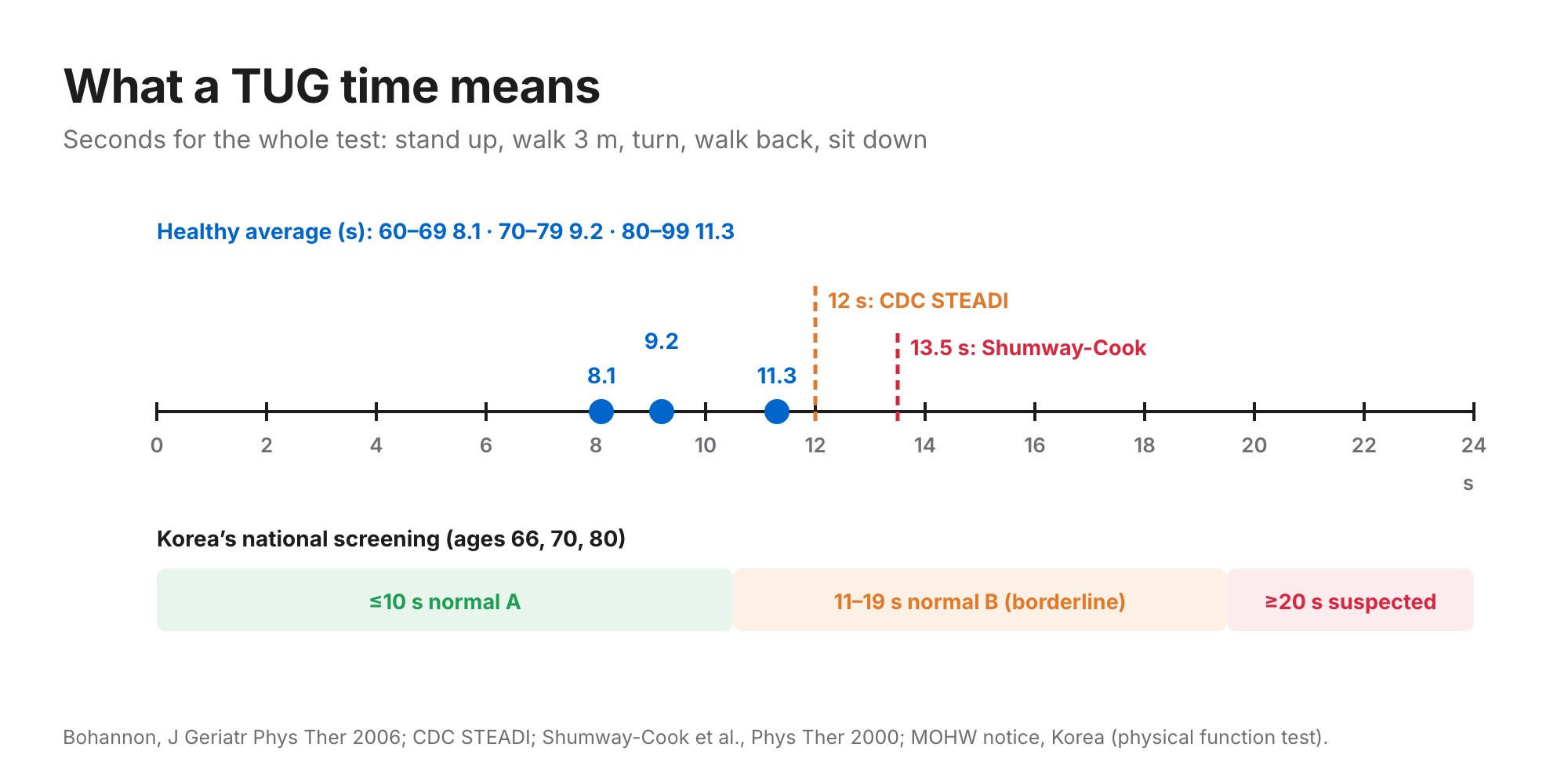
- Healthy averages: 8.1 s at 60–69, 9.2 s at 70–79 and 11.3 s at 80–99 (Bohannon, 2006).
- 12 s or more: at risk of falling in the CDC STEADI screen (CDC STEADI).
- 13.5 s or more: separated community-dwelling older adults who had fallen in a study of 30 people (Shumway-Cook et al., 2000).
A slow time makes falls more likely, but a fast time doesn't rule them out, so the TUG shouldn't be used on its own to predict falls (Barry et al., 2014). Age norms, MCID and condition-specific cut-offs are in our TUG normal values guide and TUG cut-offs by condition.
Questions
What is the distance for the Timed Up and Go test? 3 metres (9.8 feet) from the chair to a line on the floor, then back, so about 6 m of walking in total. The CDC STEADI form says "3 meters, or 10 feet".
What does TUG stand for? Timed Up and Go. The person gets up from a chair, goes 3 m and back, and sits down, and the whole thing is timed in seconds.
Is the Get Up and Go test the same as the TUG? Not quite. The original Get-Up and Go test (Mathias et al., 1986) was scored by an observer on a five-point scale with no stopwatch. The TUG (Podsiadlo & Richardson, 1991) times the same movements over a fixed 3 m.
What is the difference between the TUG and the 8-foot up-and-go? The 8-foot up-and-go from the Senior Fitness Test uses a 2.44 m walk instead of 3 m, so its times are shorter and its norms aren't interchangeable with the TUG's.
What is a normal TUG time? Healthy adults average 8.1 s at 60–69, 9.2 s at 70–79 and 11.3 s at 80–99 (Bohannon, 2006). The CDC STEADI screen treats 12 s or more as at risk of falling.
Step Doctor times the TUG from a phone video, splits it into six phases (stand up, walk out, turn, walk back, turn to sit, sit down) and keeps each test in a PDF report. Read more about the Timed Up and Go in Step Doctor, or get it on the App Store or Google Play.
Step Doctor supports screening and monitoring. It doesn't diagnose, and results should inform, not replace, the judgement of a healthcare professional.