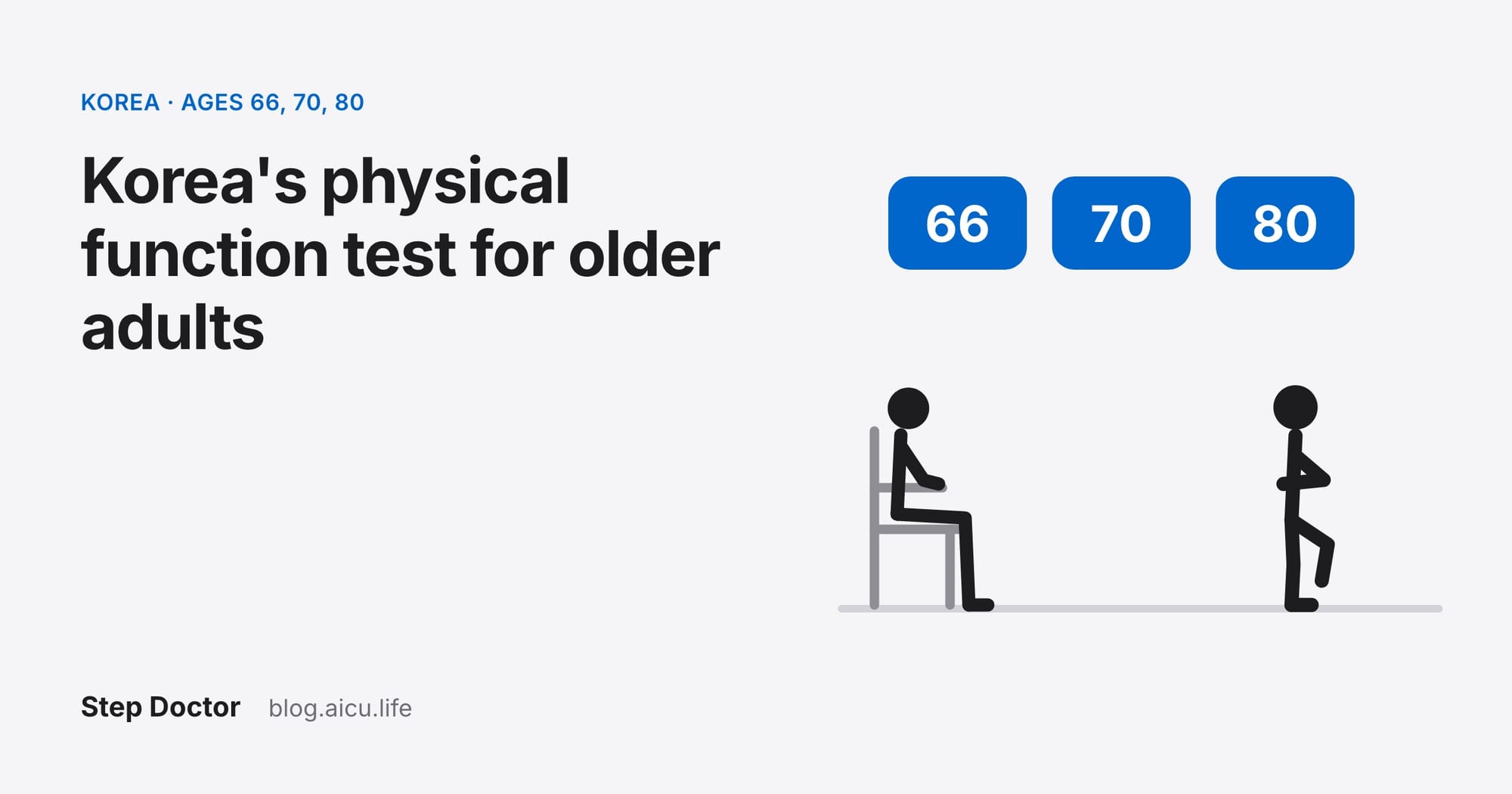
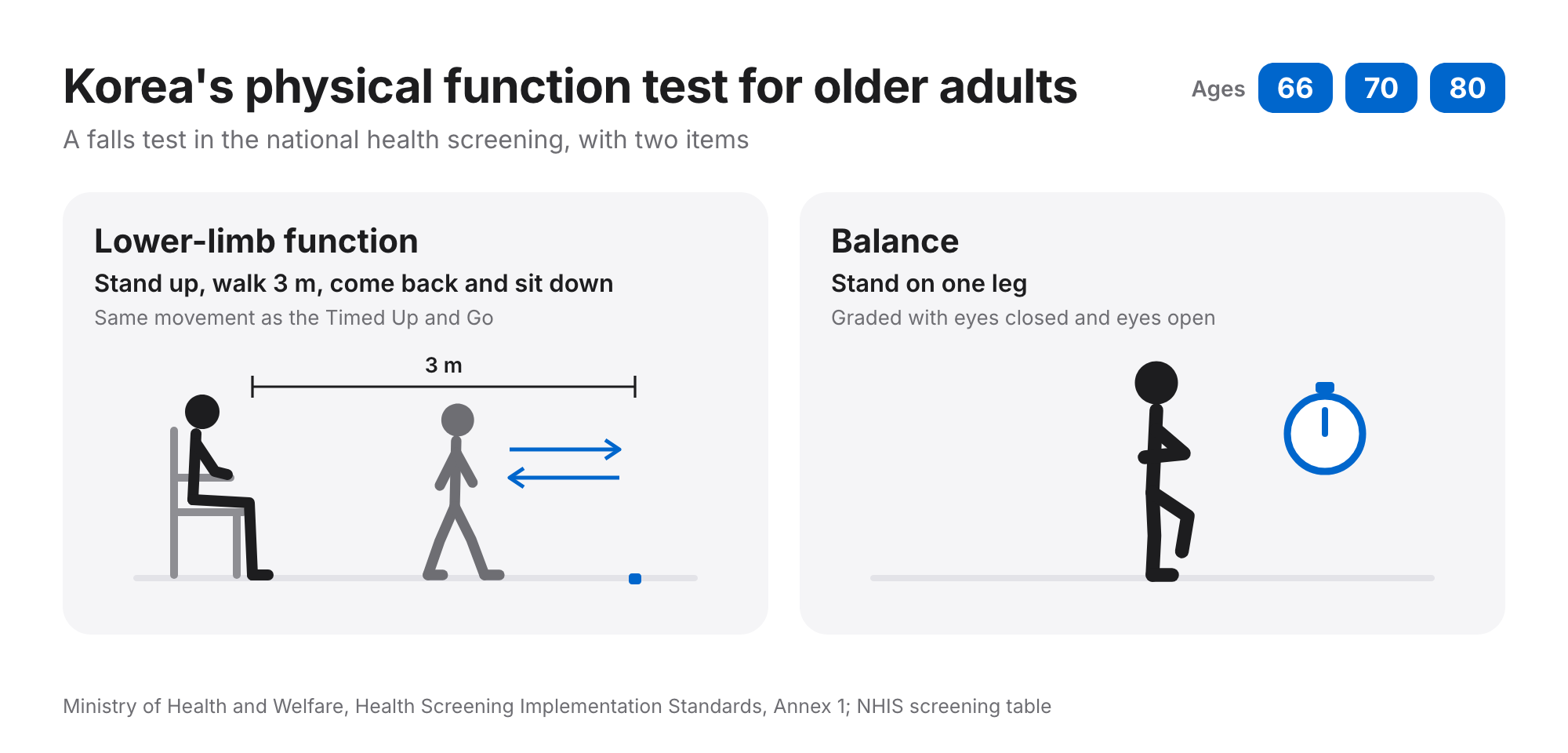
Korea's national health screening includes a physical function test for older adults (노인신체기능검사) at ages 66, 70 and 80. Age 66 is also the "life-transition" health check (생애전환기 건강진단) that marks the start of later life. The test is a falls check with two items: lower-limb function, in which the person stands up from a chair, walks 3 metres, comes back and sits down, and balance, in which they stand on one leg. Results are graded Normal A, Normal B (borderline) or Suspected disease. This guide sets out who is tested, the items, the method and the grading criteria from the Ministry of Health and Welfare's official notice and the National Health Insurance Service, with the research that helps put a result in context.
Who is tested, and when
In the National Health Insurance Service (NHIS) table of screening items, the physical function test for older adults is listed for ages 66, 70 and 80. The same ages apply in the general health screening and in the life-transition screening for Medical Aid recipients aged 66 and over, who are screened every two years (NHIS, Medical Aid life-transition screening). Annex 1 of the Ministry of Health and Welfare notice that sets the screening items and methods, the Health Screening Implementation Standards (건강검진 실시기준), also lists general screening participants aged 66, 70 and 80.
Items and method
Annex 1 groups the test as a "falls test" and defines the two items as follows (Ministry of Health and Welfare, Health Screening Implementation Standards; our translation):
| Item | Method in the notice | Better-known name |
|---|---|---|
| Lower-limb function | "Measured by having the person stand up, walk 3 m, come back and sit down" | Timed Up and Go (TUG) |
| Balance | "Measured by having the person stand on one leg" | One-leg stance test |
The notice doesn't specify the chair height, the instructions, the number of trials or when to start and stop timing. To compare a person with themselves on a later test, the tester has to fix these conditions and keep them. The most widely used international methods are:
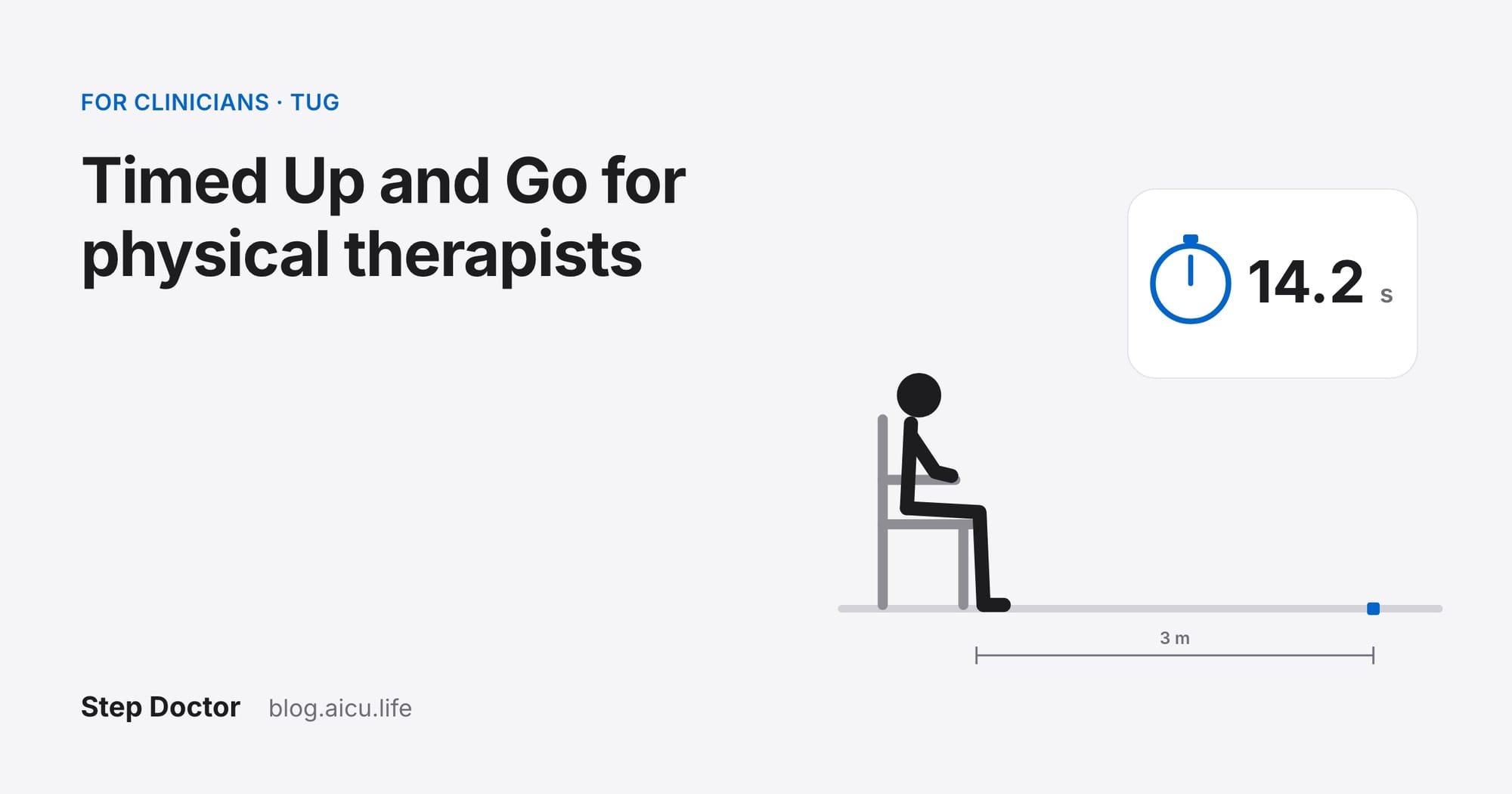
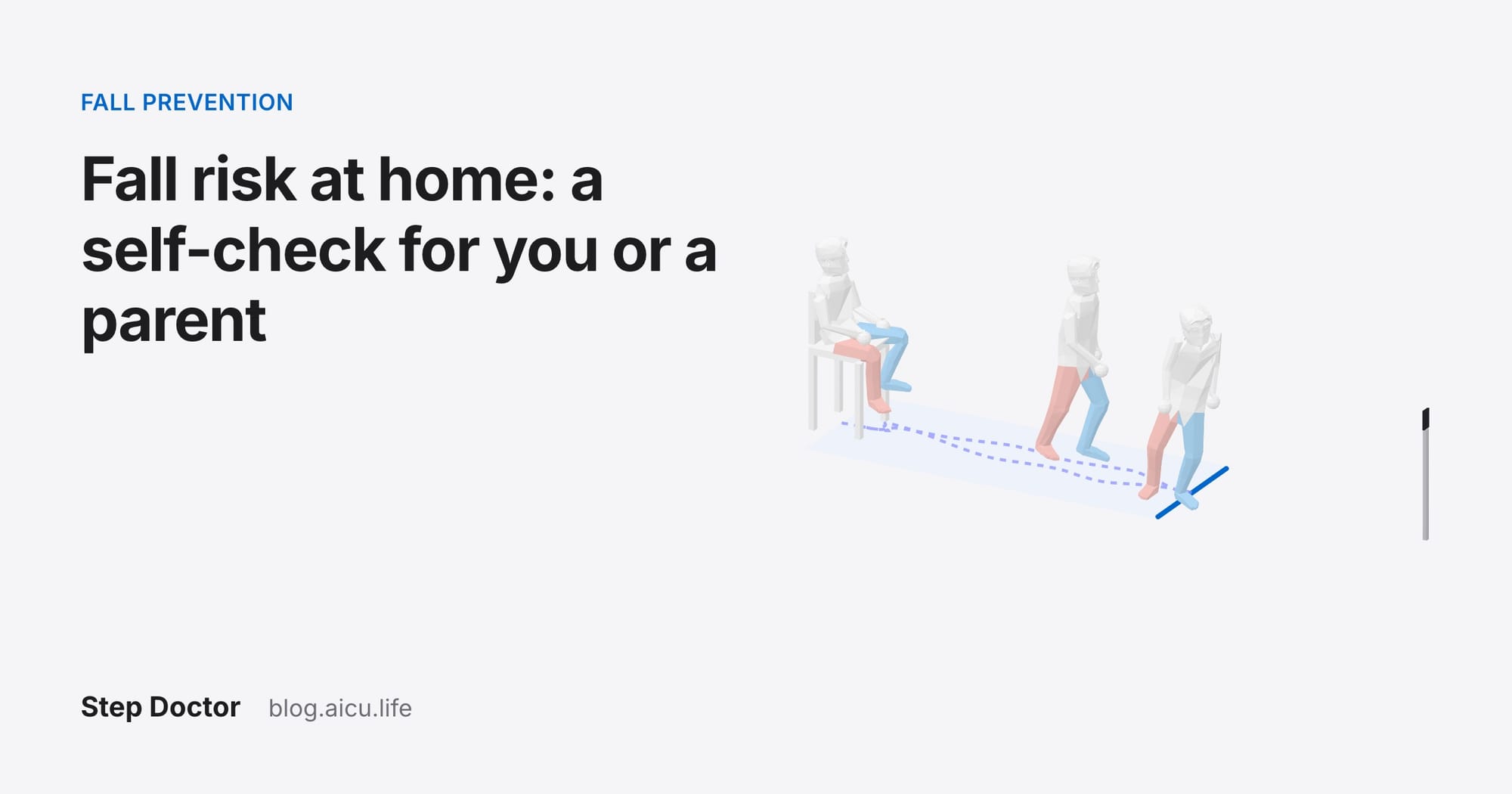
- Lower-limb function (TUG): sitting back in a standard armchair, in regular footwear and with the usual walking aid, the person stands up on "Go", walks at a normal pace to a line 3 metres away, turns, walks back and sits down. Timing starts on "Go" and stops when they're seated again (CDC STEADI). The chair, script and number of trials are covered in Timed Up and Go for physical therapists.
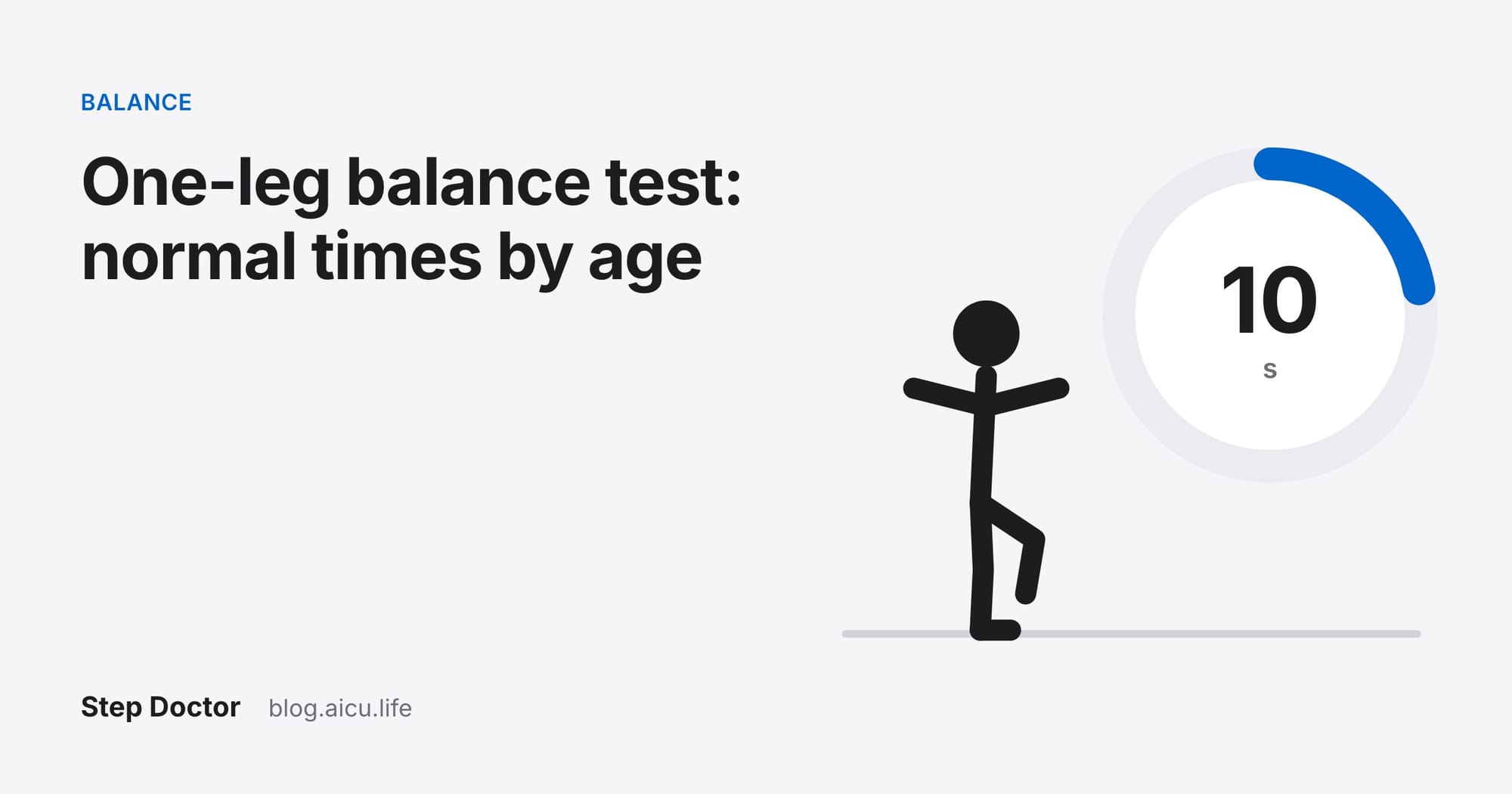
- Balance (one-leg stance): the most cited age norms come from a study in which people stood barefoot with arms crossed, the raised foot near but not touching the standing ankle, for up to 45 seconds; the clock stopped if the raised foot touched down, the standing foot shifted or the arms uncrossed. The best of three tries was used, with eyes open and closed (Springer et al., 2007). For setting it up safely, see one-leg stance times by age.
Grading criteria
The criteria are in Annex 4 of the notice, "Result criteria for the general health screening and the Medical Aid life-transition screening" (Ministry of Health and Welfare Notice No. 2026-6, in force from 7 January 2026).
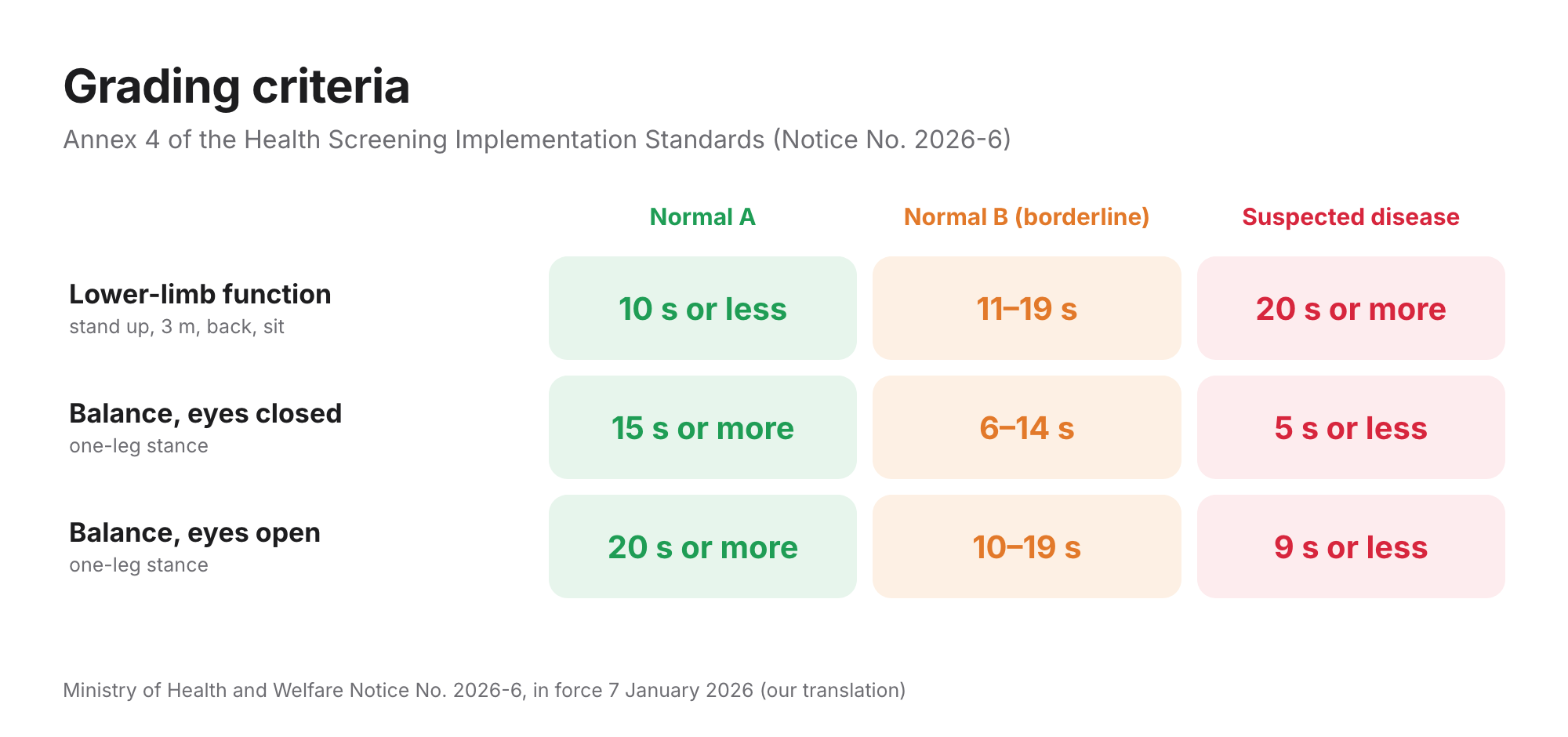
| Item | Normal A | Normal B (borderline) | Suspected disease |
|---|---|---|---|
| Lower-limb function (stand up, walk 3 m, come back, sit) | 10 s or less | 11–19 s | 20 s or more |
| Balance, eyes closed (one-leg stance) | 15 s or more | 6–14 s | 5 s or less |
| Balance, eyes open (one-leg stance) | 20 s or more | 10–19 s | 9 s or less |
Shorter is better for lower-limb function and longer is better for balance. The same annex defines the grades:
- Normal A: in good health on the screening results.
- Normal B (borderline): no health problem, but self-care and preventive steps such as changes to diet, habits or environment are needed.
- Suspected disease: may develop into a disease, so follow-up tests or an accurate diagnosis and treatment at a specialist institution are needed.
The table uses whole seconds (for example 10 s or less, then 11–19 s). The notice doesn't say how a time such as 10.4 s is rounded.
Putting a result in context
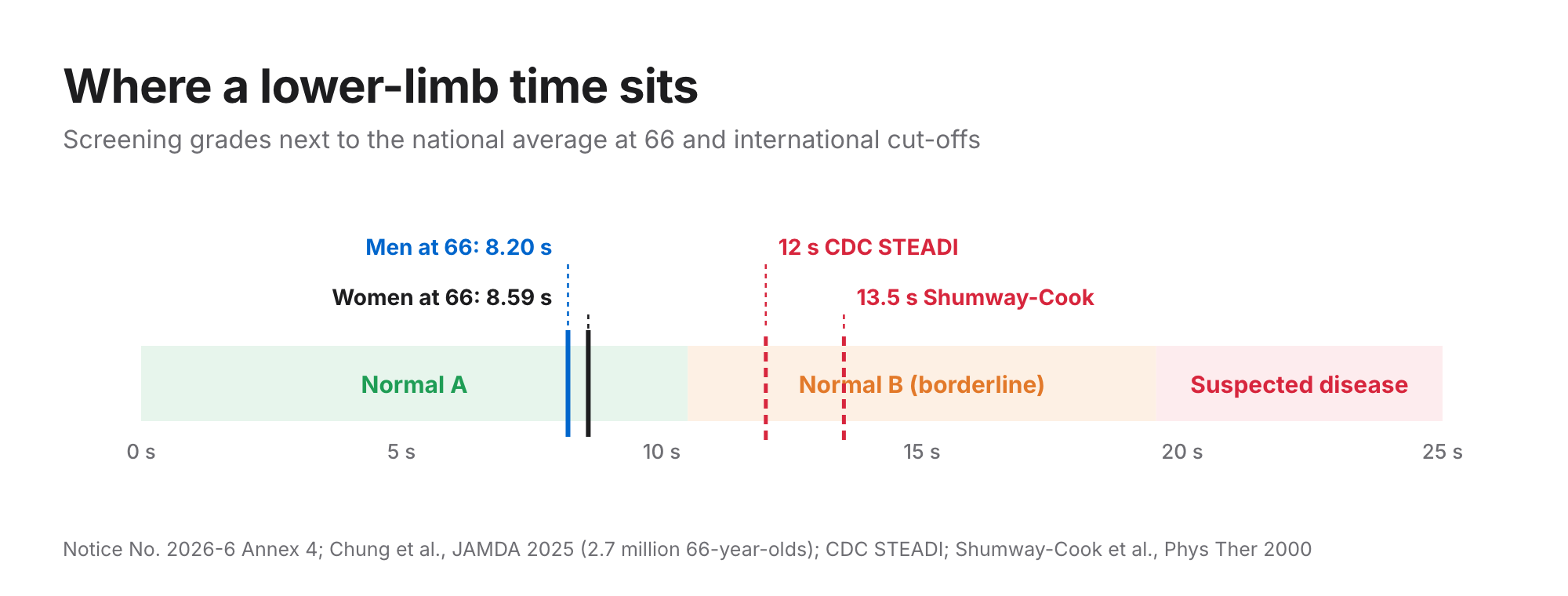
National averages at 66. In about 2.7 million 66-year-olds screened from 2008 to 2017, the average TUG was 8.20 s in men (SD 3.33) and 8.59 s in women (SD 3.30), and the average one-leg stance was 20.39 s in men (SD 9.19) and 18.26 s in women (SD 8.72) (Chung et al., 2025). Men did slightly better on both, and both improved over the nine years. The abstract doesn't say whether the one-leg stance was done with eyes open or closed, so take care when comparing it with a row of the grading table.
A 10-second threshold in research. A study of 66-year-olds screened in 2007–2008 defined a TUG of 10 s or more as abnormal. Over a mean of 5.7 years it wasn't associated with cardiovascular events or cardiovascular death in the whole group, but in women it went with a higher risk of cardiovascular death (adjusted hazard ratio 2.90) (Son et al., 2020). That's an association, not a cause.
International fall-risk cut-offs. The CDC's STEADI treats a TUG of 12 s or more as at risk for falling (CDC STEADI), and 13.5 s was proposed for community-dwelling older adults (Shumway-Cook et al., 2000). The Normal B band of 11–19 s includes times above both. Healthy adults average 8.1 s at 60–69, 9.2 s at 70–79 and 11.3 s at 80–99 (Bohannon, 2006). Cut-offs for specific conditions are in TUG cut-offs by condition.
One-leg stance by age. Healthy adults standing with eyes open and arms crossed (best of three) averaged 32.1 s in their 60s, 21.5 s in their 70s and 9.4 s at 80–99; with eyes closed, 4.4, 3.1 and 1.9 s (Springer et al., 2007). In healthy adults over 60, being unable to stand on one leg for 5 seconds went with about twice the risk of a fall with injury (Vellas et al., 1997).
Using it in a public health centre or clinic
- A grade isn't a diagnosis. Normal B or Suspected disease is a reason to look more closely at falls and mobility. A meta-analysis also concluded that the TUG shouldn't be used on its own to identify people at high risk of falls (Barry et al., 2014).
- Record the conditions. Chair, distance, footwear, walking aid, number of trials, and for the one-leg stance the eye condition and hand position, so that the next screening or reassessment can be compared.
- Add walking speed. A usual walking speed under 0.6 m/s makes poor health and function more likely (Studenski et al., 2011), and it needs only 4 or 10 metres of floor. See the clinic gait speed test.
- Exercise reduces falls. In a Cochrane review of trials in older people living in the community, exercise reduced the rate of falls by 23%, and programmes based mainly on balance and functional exercises by 24% (Sherrington et al., 2019).
Questions
At what ages is Korea's physical function test for older adults done? At 66, 70 and 80 in the national health screening. Age 66 is the life-transition health check, and the Medical Aid life-transition screening includes the test at the same ages.
What does Korea's physical function test include? A falls test with two items: lower-limb function (stand up from a chair, walk 3 m, come back and sit down, the same movement as the Timed Up and Go) and balance (standing on one leg).
What are the cut-offs in Korea's physical function test? Lower-limb function: 10 s or less is Normal A, 11–19 s Normal B (borderline), 20 s or more Suspected disease. Balance with eyes open: 20 s or more Normal A, 10–19 s Normal B, 9 s or less Suspected disease; with eyes closed: 15 s or more, 6–14 s and 5 s or less.
What does a Normal B (borderline) result mean? The notice defines it as no health problem but a need for self-care and preventive steps. A lower-limb time of 11–19 s includes times at or above the CDC STEADI fall-risk cut-off of 12 s, so it's worth starting balance and strength exercise and retesting the same way.
Step Doctor times the Timed Up and Go and its phases and measures walking speed from a phone video with voice cues, and keeps each result in a PDF report, so the same tests can be repeated and recorded between screenings. Its results don't replace the national screening grades. Read more about the Timed Up and Go in Step Doctor, or get it on the App Store or Google Play.
Using this with patients? Request early clinic access.
Step Doctor measures and records movement tests. It doesn't diagnose, and results should inform, not replace, the judgement of a healthcare professional.