The Timed Up and Go (TUG) is quick to run, which is exactly why it drifts: a lower chair here, a different walking aid there, a second trial on one visit and three on the next. Each of these changes the time a little, and the change you're trying to detect is often only a second or two. This guide is the clinic version of the test: a standard setup, the instructions to read aloud, when to start and stop the clock, what to watch for, which cut-off fits which patient, how much change is real, and a documentation line you can copy.
Standard setup
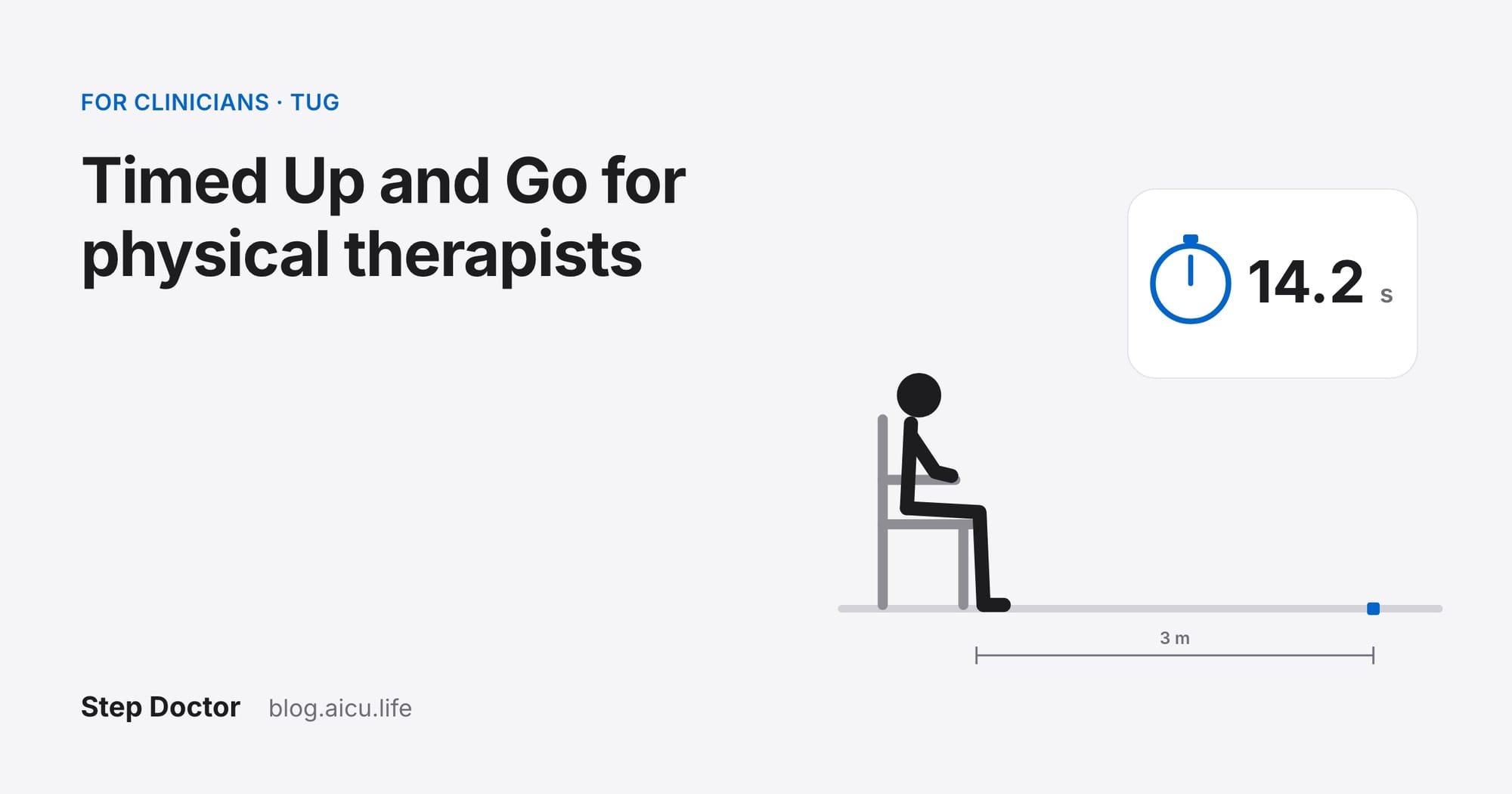
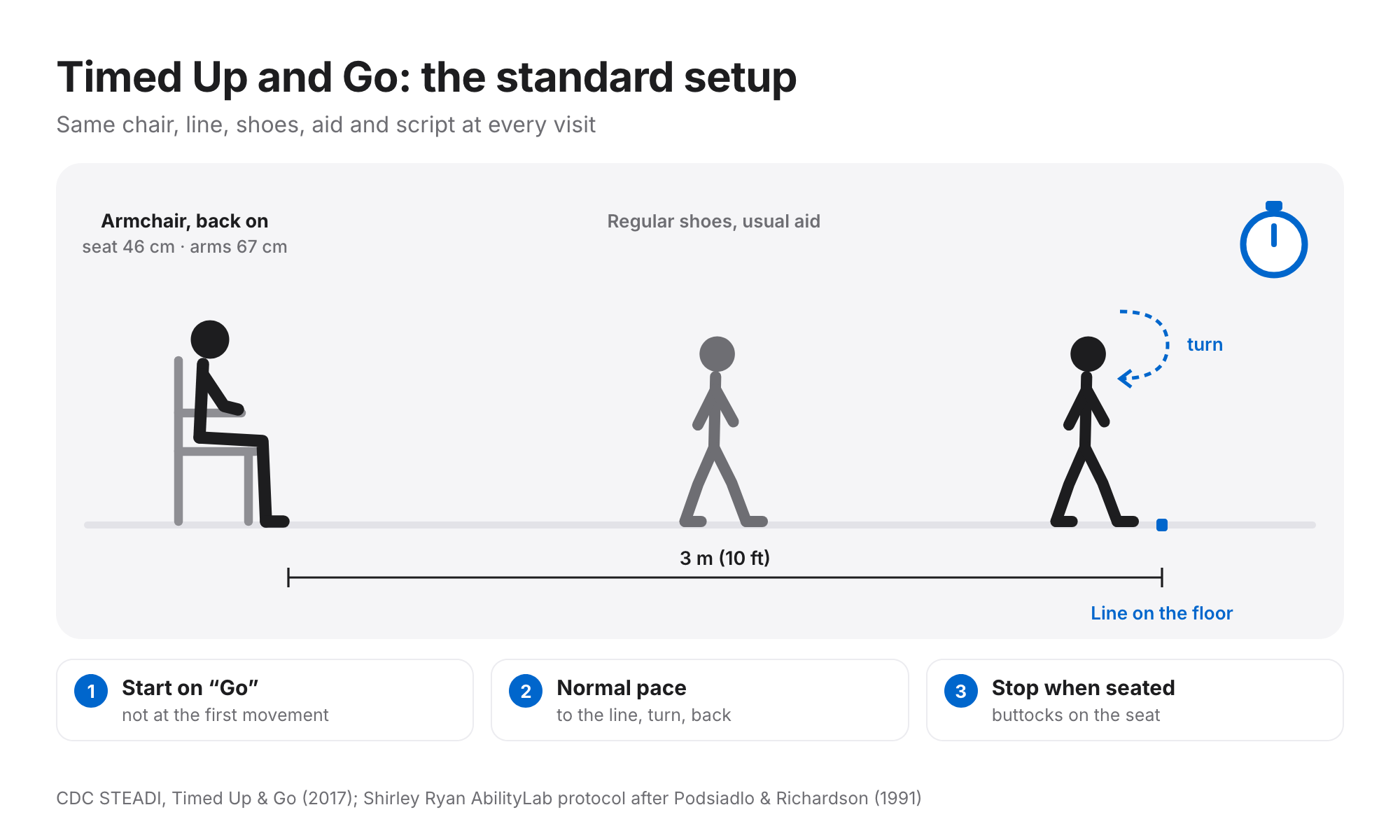
The TUG was introduced as a timed version of the Get-Up and Go test: the patient "rises from an arm chair, walks 3 meters, turns, walks back, and sits down again" (Podsiadlo & Richardson, 1991). Keep these the same at every visit:
- Chair: a standard armchair with a back. A widely used protocol derived from the original paper specifies a seat height of 46 cm and an arm height of 67 cm (Shirley Ryan AbilityLab protocol). Push it against a wall so it can't slide.
- Starting position: back against the chair and arms resting on the armrests. If the patient walks with an aid, keep it nearby, not in their hands.
- Course: a line on the floor 3 metres (10 feet) away (CDC STEADI). A taped line gives the same turning point every time.
- Footwear and walking aid: the patient's regular footwear and their usual walking aid, if needed (CDC STEADI). Write down which aid and on which side.
- Safety: stay by the patient throughout (CDC STEADI). Walk slightly behind and to one side so you don't set the pace.
The instructions to read aloud
The CDC STEADI form gives a short script. Read it the same way every time:
"When I say 'Go,' I want you to: 1. Stand up from the chair. 2. Walk to the line on the floor at your normal pace. 3. Turn. 4. Walk back to the chair at your normal pace. 5. Sit down again."
"Normal pace" matters. The protocol derived from the original paper asks for a comfortable and safe walking speed. Encouragement such as "as fast as you can" turns it into a different test, and its times can't be compared with usual-pace values.
Demonstration, practice and number of trials
Demonstrate the test once before timing (Shirley Ryan AbilityLab protocol). Protocols differ on what comes next, so choose one and keep it:
- One timed trial is what the CDC STEADI form records.
- The fastest of three timed trials is the standardized TUG used by Kristensen and colleagues, which was highly reliable between raters in older adults referred to physiotherapy (Kristensen et al., 2019).
If a patient is unsure of the course, an untimed walk-through is reasonable; note it in the record. The point is consistency: if you plan to judge change against a published minimal detectable change, use the same protocol as the study that produced it.
When to start and stop the clock
- Start on the word "Go" (CDC STEADI), not when the patient starts to move.
- Stop when the patient is seated again with their buttocks on the seat (Shirley Ryan AbilityLab protocol).
- Record the time in seconds to one decimal place.
What to observe
The time is only half the result. The STEADI form asks you to watch postural stability, gait, stride length and sway, and to tick any of these:
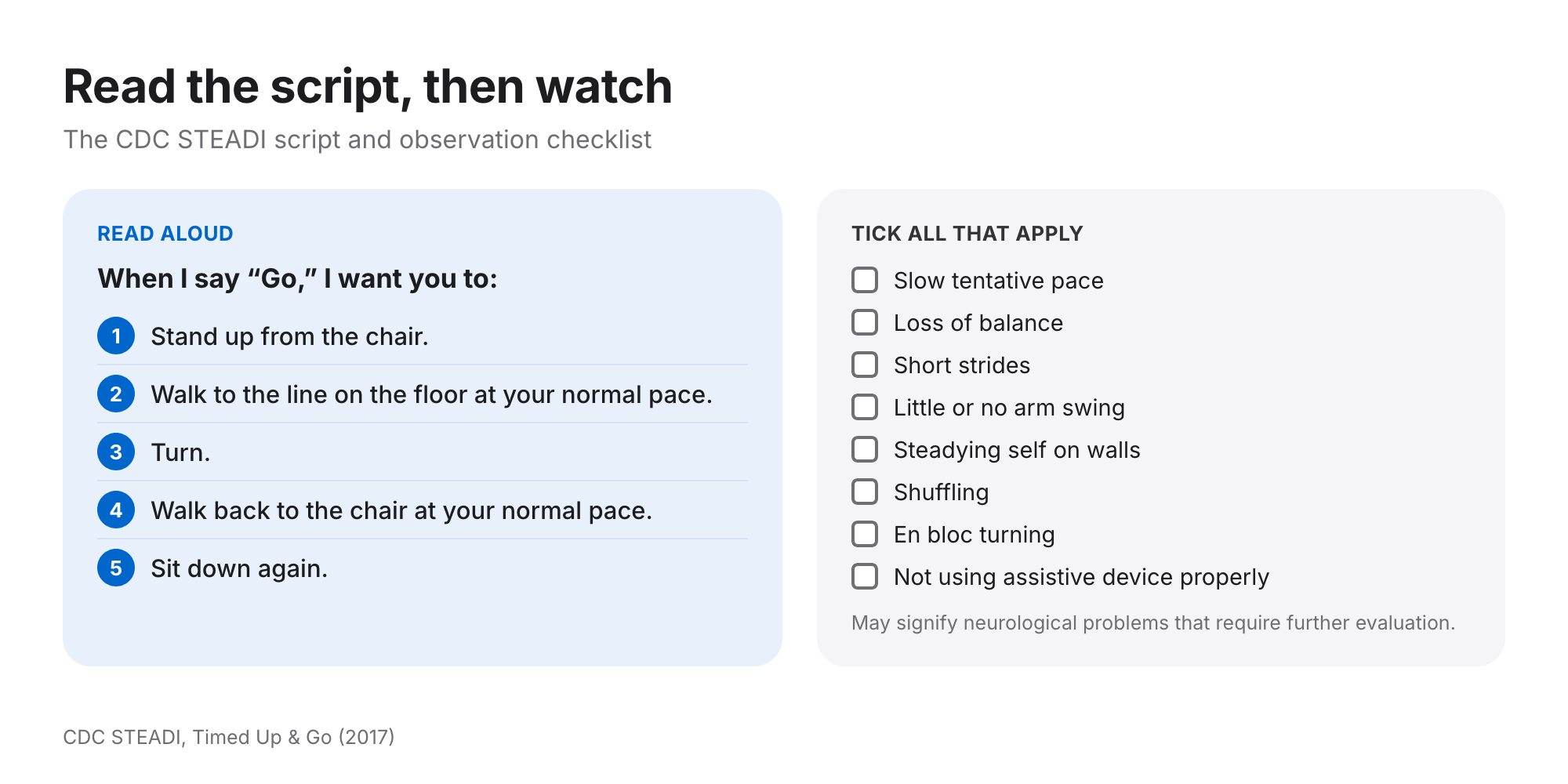
- Slow, tentative pace
- Loss of balance
- Short strides
- Little or no arm swing
- Steadying self on walls
- Shuffling
- En bloc turning
- Not using the assistive device properly
The form adds that these changes may signify neurological problems that require further evaluation. Also note where the time goes: a slow rise, a hesitant turn and a slow walk point in different directions, even when the total is the same.
Cut-offs by population
Use the cut-off from the study that looks most like your patient, and read a time above it as higher risk, not a diagnosis.
| Who | Time | What it showed | Source |
|---|---|---|---|
| Healthy older adults | 8.1 / 9.2 / 11.3 s | Average at 60–69, 70–79 and 80–99; slower than the upper 95% confidence limit (9.0, 10.2, 12.7 s) is worse than average | Bohannon, 2006 |
| Older adults, fall-risk assessment | ≥ 12 s | "At risk for falling" | CDC STEADI |
| Community-dwelling older adults | ≥ 13.5 s | Identified people with 2 or more falls in the past 6 months with 87% sensitivity and specificity (15 fallers, 15 non-fallers) | Shumway-Cook et al., 2000 |
| Parkinson's disease | 11.5 s | Proposed cut-off for fallers vs non-fallers in 2,097 people, moderate accuracy | Nocera et al., 2013 |
| After stroke | 15–19 s | Range of cut-offs across studies, modest accuracy | Matsumoto et al., 2024 |
| After hip fracture, at discharge | ≥ 24 s | Predicted falls in the following 6 months | Kristensen et al., 2007 |
One caution applies to all of them. Pooled across studies of community-dwelling older adults, a time of 13.5 s or more was better at ruling falls in than ruling them out (sensitivity 31%, specificity 74%), and the authors conclude that the TUG shouldn't be used on its own to identify people at high risk of falls (Barry et al., 2014). Korea's national health check grades the TUG with its own bands; see Korea's physical function test for older adults. The full list, with test variants, is in TUG cut-offs by condition, and the age norms in TUG normal values by age.
How much change is real: MDC and MCID
The minimal detectable change (MDC) is the smallest change larger than measurement error; the minimal clinically important difference (MCID) is the smallest change patients experience as meaningful. Both depend on the population and the protocol:
| Population | Value | Source |
|---|---|---|
| Older adults referred to physiotherapy, outpatient (fastest of 3) | MDC95 1.8 s | Kristensen et al., 2019 |
| Older adults referred to physiotherapy, in hospital (fastest of 3) | MDC95 4.6 s | Kristensen et al., 2019 |
| Knee osteoarthritis (age 45–70) | MDC 1.1 s | Alghadir et al., 2015 |
| Parkinson's disease | MDC 3.5 s | Huang et al., 2011 |
| Alzheimer's disease | MDC90 4.1 s | Ries et al., 2009 |
| Hip osteoarthritis, after physiotherapy | Important improvement 0.8–1.4 s | Wright et al., 2011 |
| After lumbar spine surgery | MCID 3.4 s on average | Gautschi et al., 2017 |
In practice, a change of a second or less is within measurement error in all of these studies. For an older outpatient tested with the fastest of three trials, a change of 1.8 s or more is likely real.
How to document it
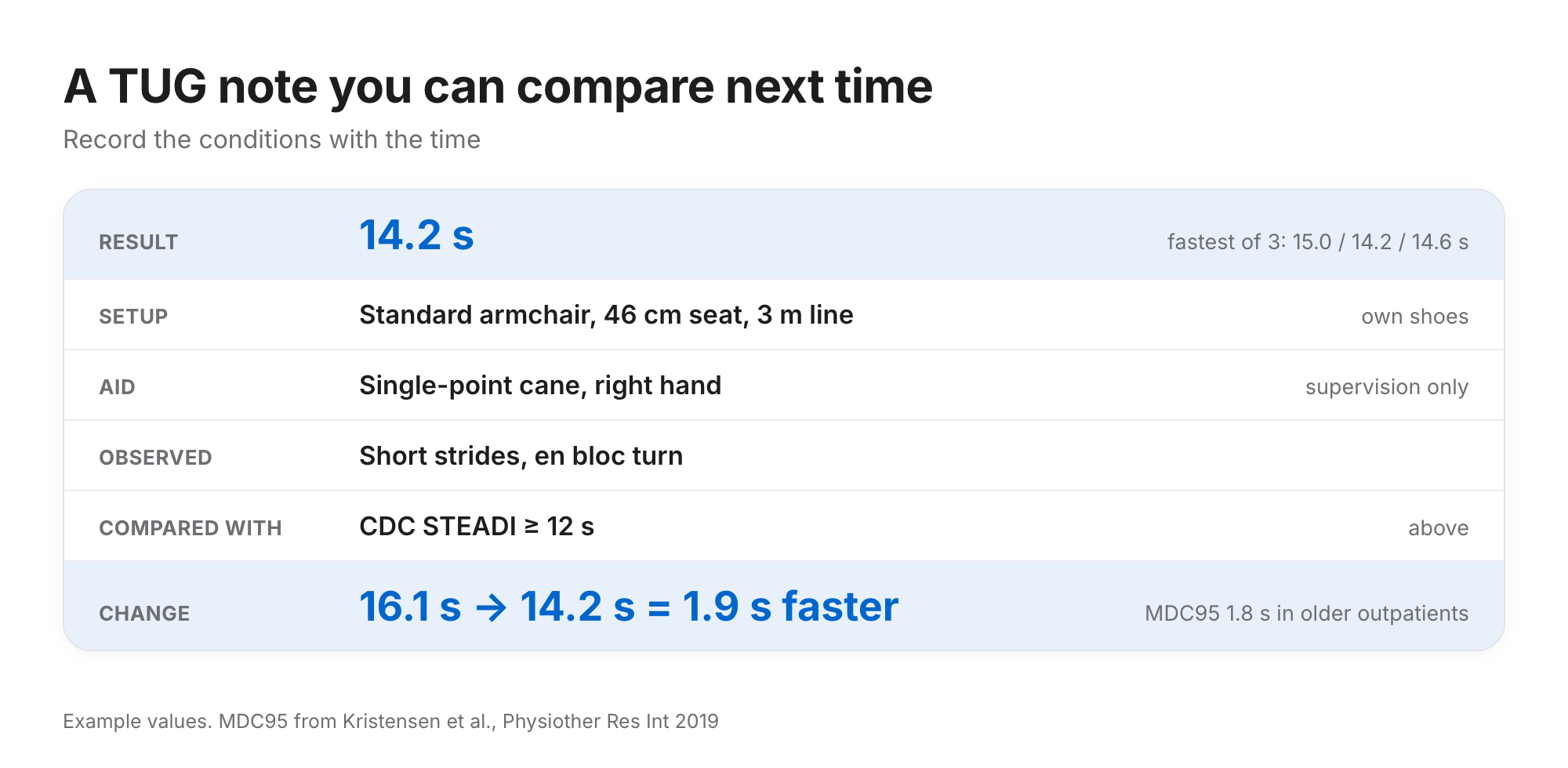
A TUG time without its conditions can't be compared later. Record the setup with the result:
- Date and time of day
- Chair (seat height, arms), distance, footwear
- Walking aid and hand, level of assistance or supervision
- Protocol: demonstration, practice, number of trials and which one is reported
- The time, the observations ticked, and the reference you compared it with
- Change since last time, against the MDC for that population
A sample line:
TUG 14.2 s (fastest of 3: 15.0 / 14.2 / 14.6 s). Standard armchair, 46 cm seat, 3 m line, own shoes, single-point cane in the right hand, supervision only. Observed: short strides, en bloc turn. Above the CDC STEADI 12 s cut-off. Previous 16.1 s on 5 Oct: 1.9 s faster, above the MDC95 of 1.8 s for older outpatients (Kristensen et al., 2019).
For paper records, the free TUG score sheet has the script, an observation checklist and a repeat log on two A4 pages.
Questions
What chair should I use for the TUG? A standard armchair with a back. A protocol derived from the original paper uses a seat height of 46 cm and an arm height of 67 cm. Use the same chair at every visit.
What do I say to the patient during the TUG? The CDC STEADI script: "When I say 'Go,' I want you to stand up from the chair, walk to the line on the floor at your normal pace, turn, walk back to the chair at your normal pace and sit down again."
When do I start and stop timing the TUG? Start on the word "Go" and stop when the patient is seated again with their buttocks on the seat.
How many TUG trials should I do? The CDC STEADI form records one timed trial; the standardized TUG uses the fastest of three timed trials. Pick one, demonstrate first, and use the same protocol every time.
What is the minimal detectable change for the TUG? It depends on the population: 1.8 s in older outpatients and 4.6 s in older adults in hospital using the fastest of three trials (Kristensen et al., 2019), 3.5 s in Parkinson's disease (Huang et al., 2011).
Step Doctor times the TUG and each of its phases from a phone video with voice cues, and keeps every result in one place with a PDF report, so repeat tests are easy to compare. Read more about the Timed Up and Go in Step Doctor, or get it on the App Store or Google Play.
Using this with patients? Request early clinic access.
Step Doctor measures and records movement tests. It doesn't diagnose, and results should inform, not replace, the judgement of a healthcare professional.