The Timed Up and Go (TUG) is one of the most widely used mobility tests in the world. It takes about a minute and needs only a chair: stand up, walk 3 metres, turn, walk back and sit down. This guide covers how to do the test, what the times mean by age, and why timing each part of it, the instrumented TUG or iTUG, shows more than the total alone.
What is the Timed Up and Go test?
The TUG was introduced in 1991 as a quick test of basic functional mobility in older adults (Podsiadlo & Richardson, 1991). In one short sequence it combines several things we do every day: rising from a chair, walking, turning and sitting down. That makes it a common part of falls screening, including the US CDC's STEADI program.
How to do the TUG
- Use a standard chair with a back. Sit with your back against it.
- Mark a line 3 metres (about 10 feet) in front of the chair.
- On "Go", stand up, walk to the line at your usual pace, turn around, walk back and sit down.
- Time runs from "Go" until you are seated again. Wear your usual shoes and use your walking aid if you normally do.
Have someone nearby for safety, especially if you are unsteady.
Normal TUG times by age
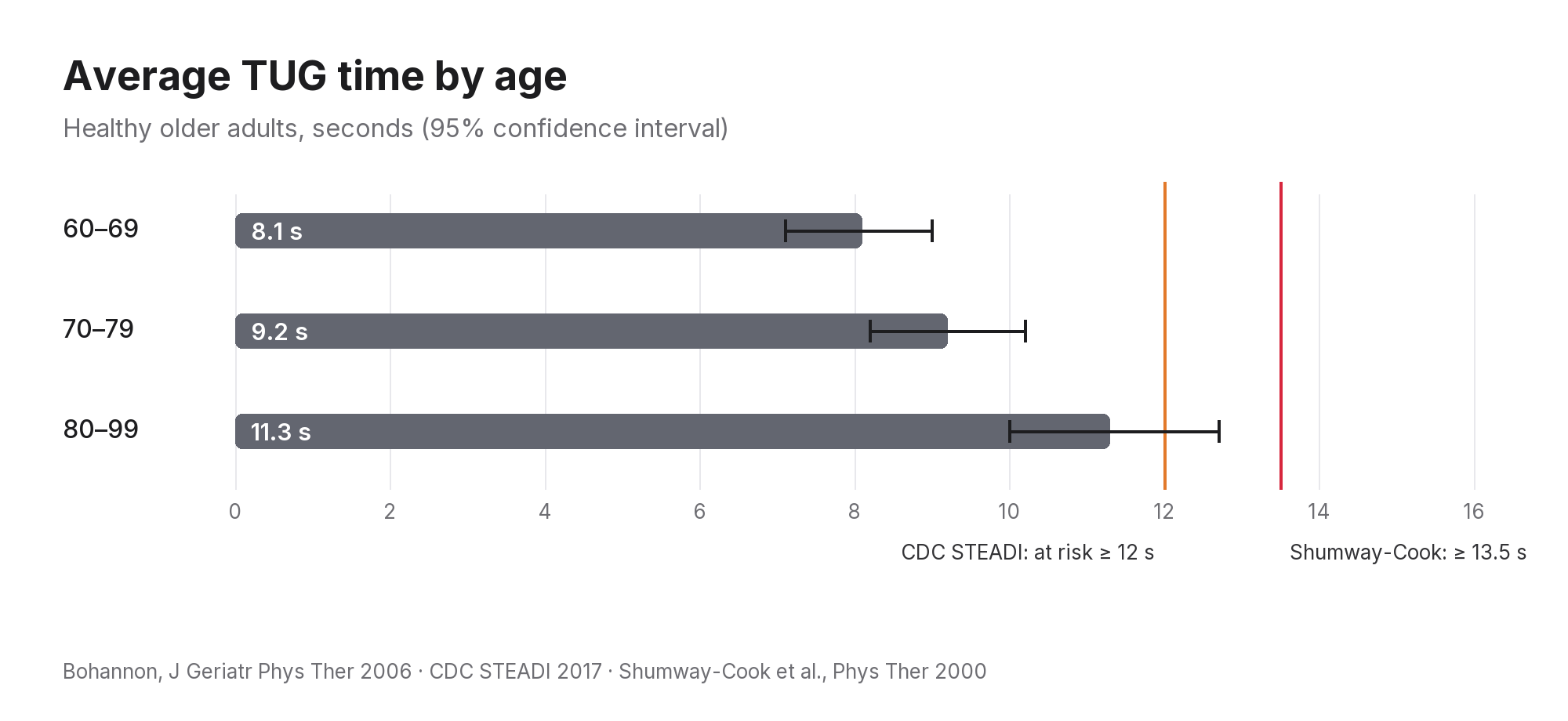
A meta-analysis of healthy older adults gives these average times (Bohannon, 2006):
| Age | Average time | 95% confidence interval |
|---|---|---|
| 60–69 | 8.1 s | 7.1–9.0 s |
| 70–79 | 9.2 s | 8.2–10.2 s |
| 80–99 | 11.3 s | 10.0–12.7 s |
A time above the upper limit for your age group can be read as slower than average.
What does a slow TUG time mean?
Two cut-offs are widely used:
- 12 seconds or more: "at risk for falling" in the CDC's STEADI screening (CDC STEADI).
- 13.5 seconds or more: identified community-dwelling older adults who had fallen with 87% sensitivity and specificity in a study of 30 people (Shumway-Cook et al., 2000).
Later pooled data add an important caveat: a slow time makes falls more likely, but a faster time does not rule them out (sensitivity 31%, specificity 74%), so the TUG should not be used on its own to predict falls (Barry et al., 2014). A TUG result is a screening signal to discuss with a healthcare professional, not a diagnosis.
The instrumented TUG: why the phases matter
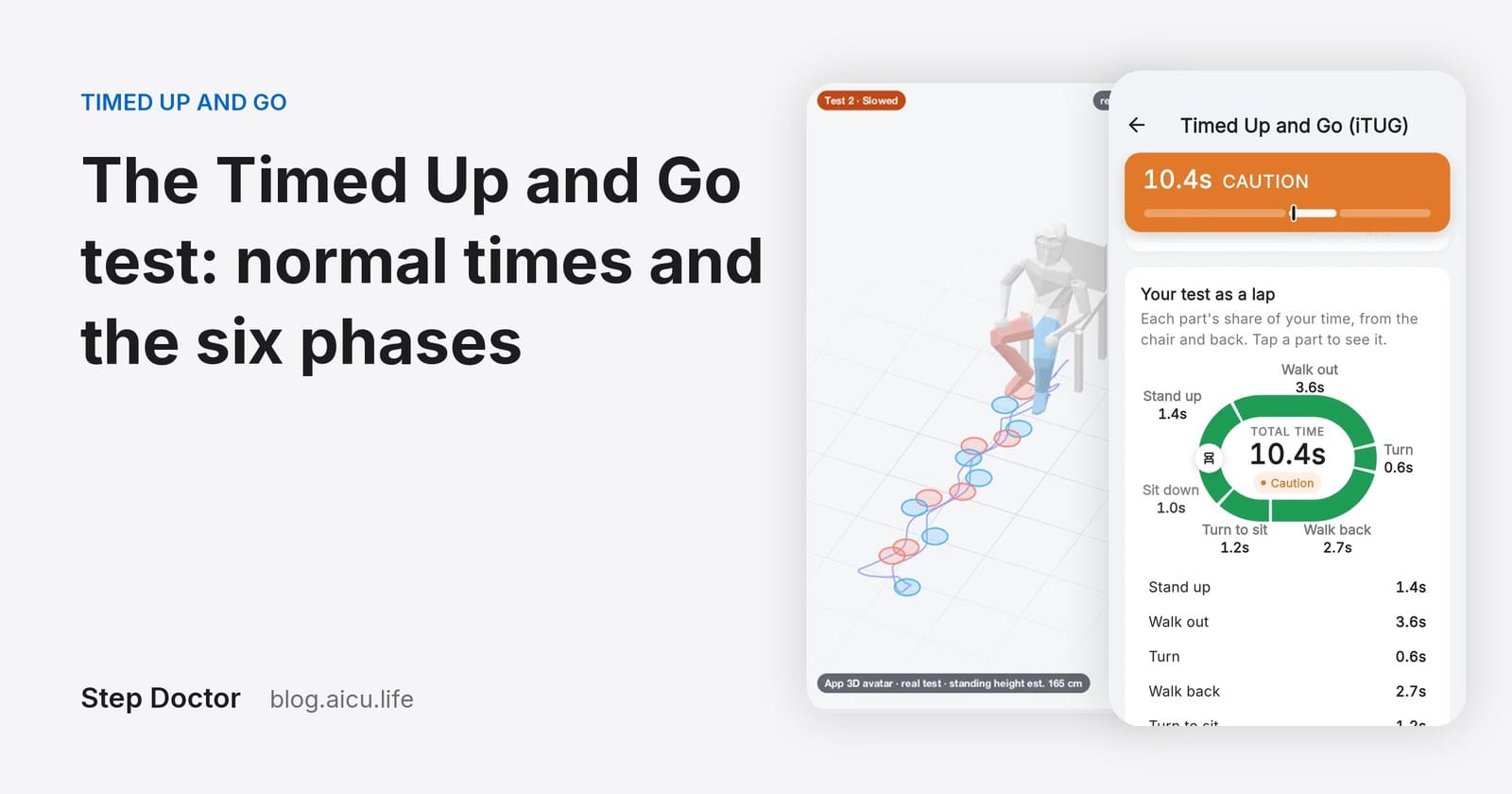
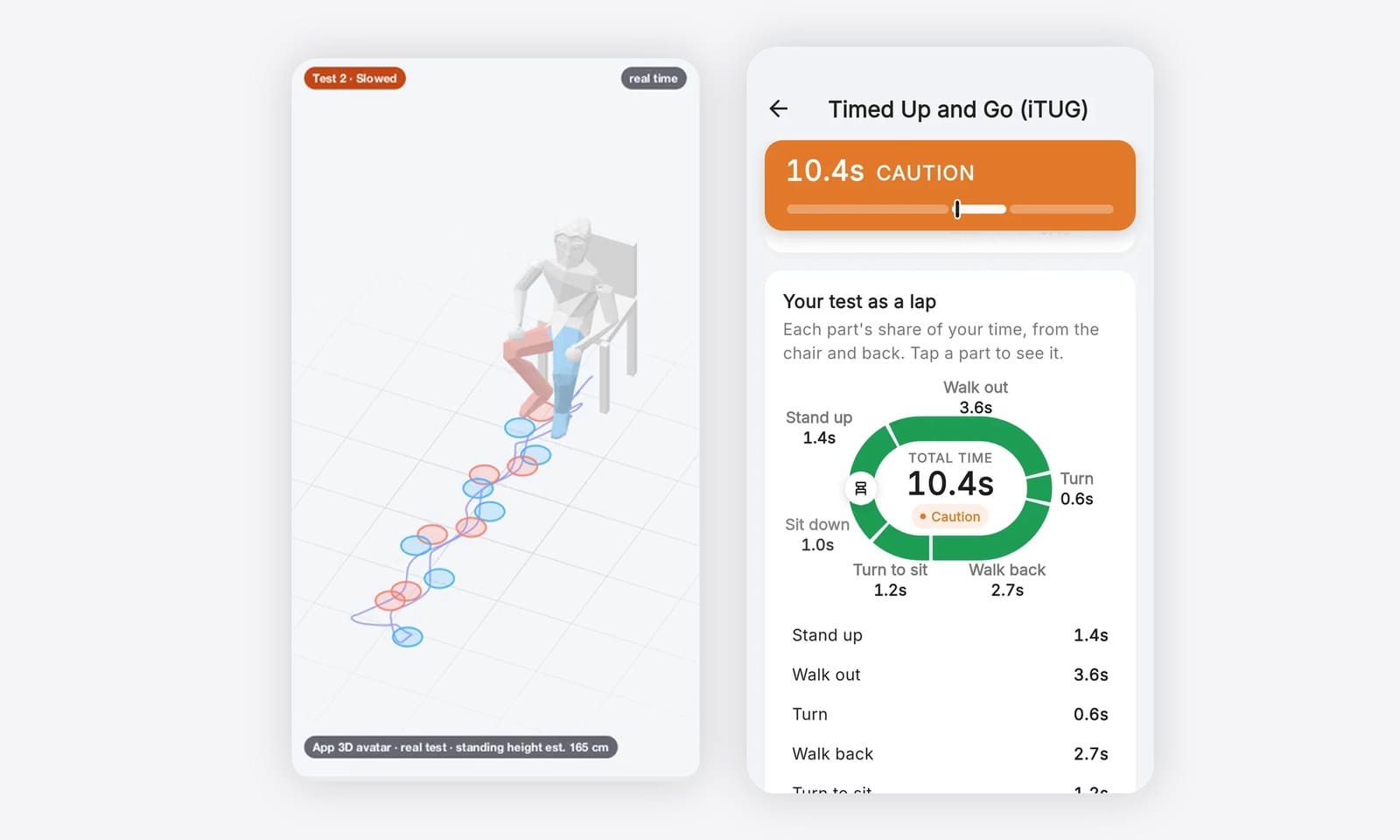
Two people can both take 12 seconds and lose that time in very different places. One rises slowly from the chair; another walks well but slows right down in the turn. The instrumented TUG measures each part separately. Step Doctor splits the test into six phases:
- Stand up from the chair
- Walk out to the turning point
- Turn
- Walk back
- Turn to sit in front of the chair
- Sit down
Each phase is compared with the instrumented TUG reference values of Mirelman et al. (2014), from older adults without cognitive impairment: typical up to the study's mean plus one standard deviation, slower up to two, much slower beyond. The study timed both walks together, so the walk grades are approximate.
See it: two real tests, phase by phase
The clip shows two real iTUG tests recorded with Step Doctor and replayed on the app's 3D avatar, in real time: a typical 9.8-second test, then a slowed 19.6-second test where standing up and both walks are much slower.
Doing the TUG hands-free with a phone
Step Doctor runs the whole test with voice cues, so nobody has to hold a stopwatch:
- Place the chair and the phone. Stand the phone facing the chair about 5 metres away; you walk about 3 metres of that floor. Voice prompts help you find the right spot.
- Sit and wait for Go. Once you're seated in place, the recording starts and a voice says Go.
- Walk, turn at the cue, come back. A turn cue tells you when to turn. Walk back and sit down at your usual pace.
- See the result: the total time and its band, the six phase times with their grades, a 3D replay and a PDF report.
Questions
What's a good TUG time? Healthy older adults average 8.1 to 11.3 seconds depending on age. Step Doctor bands the total at under 10 seconds, 10 to 13.4 seconds and 13.5 seconds or more.
Can I do the test on my own? Yes, with the voice guide. Having someone nearby for safety is always a good idea.
How often should I repeat it? Repeating it in the same way, for example every few weeks, shows change over time better than one result. Ask your care team what fits your situation.
Related: gait analysis at home, SPPB scoring and how Step Doctor measures movement.
More on the test in Step Doctor: Timed Up and Go (iTUG). All the reference values above, with sources, are on the reference values page. Download Step Doctor from the App Store or Google Play.
Step Doctor supports screening and monitoring. It doesn't diagnose, and results should inform, not replace, the judgement of a healthcare professional.