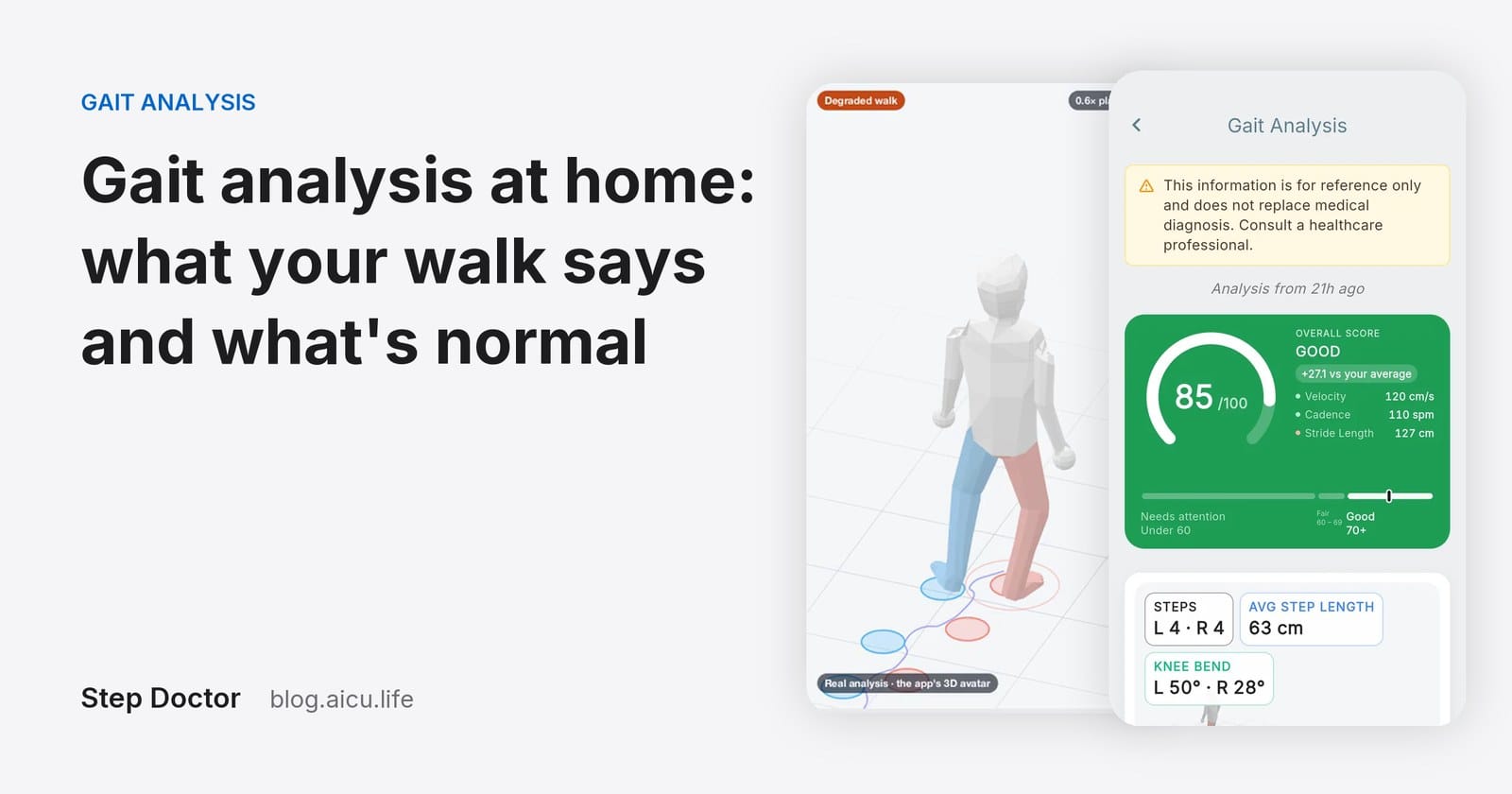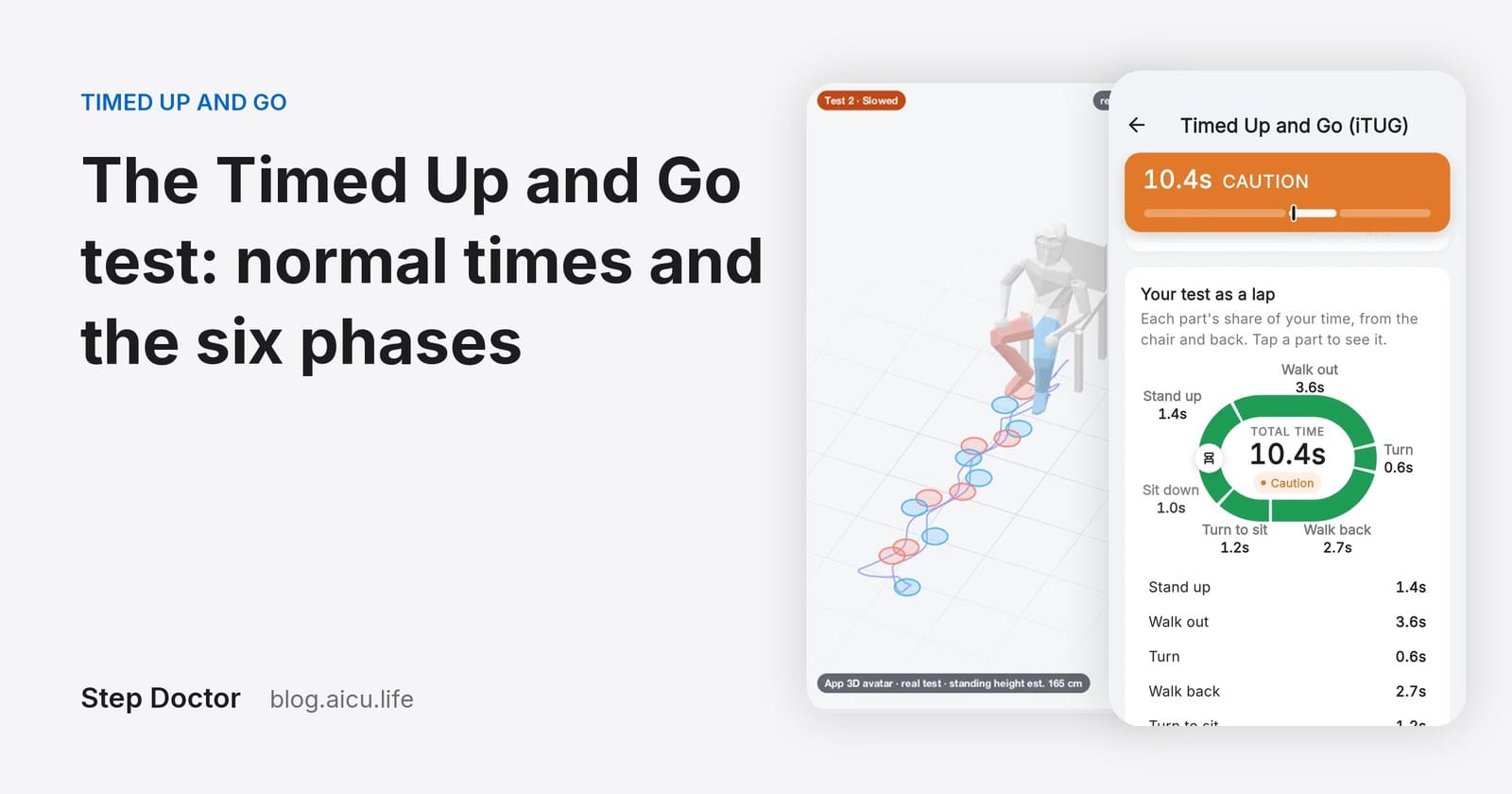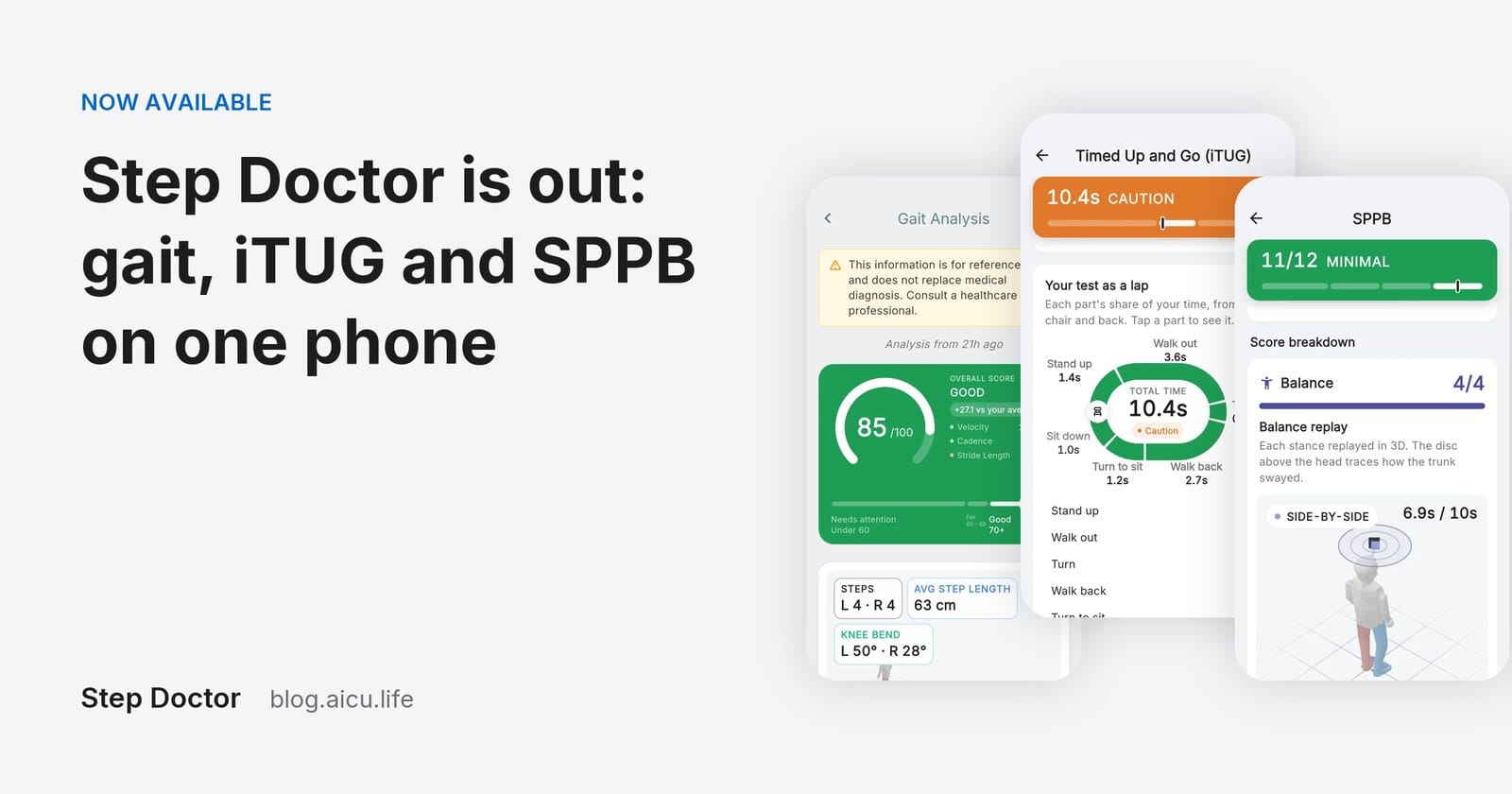
Phones can now turn a short video into walking speed, step length and cadence. The obvious question is whether those numbers are right. "Accurate" isn't a single number, though: it's a set of comparisons against a reference, read with the right statistics. This article explains how gait measurement is validated, what the published studies of camera and phone tools actually found, and what to look for before trusting any app, ours included.
Accurate compared with what?
Every validation compares a new tool with a reference measured at the same time, on the same people:
- Optical motion capture. Reflective markers on the body and several infrared cameras. The lab reference for joint angles and full 3D movement.
- Pressure-sensing walkways such as GAITRite or Zeno. Every footfall on the mat is recorded, which makes them the usual clinical reference for speed, cadence and step length. GAITRite itself agreed closely with motion capture in adults after knee replacement (ICC 0.92–0.99 for averaged speed, cadence, step length and step time; Webster et al., 2005).
- Body-worn sensors. Inertial units on the feet or trunk. Useful references outside the lab, but a step further from direct measurement.
Which reference a study used matters as much as its result: agreeing with another estimate is weaker evidence than agreeing with a walkway or motion capture.
Two questions every validation answers
Do the two methods rank people the same way? That's reliability, usually reported as the intraclass correlation coefficient (ICC). A widely used guide reads ICC below 0.5 as poor, 0.5–0.75 as moderate, 0.75–0.9 as good and above 0.9 as excellent, and asks for those bands to be applied to the ICC's 95% confidence interval, not just its point estimate (Koo & Li, 2016).
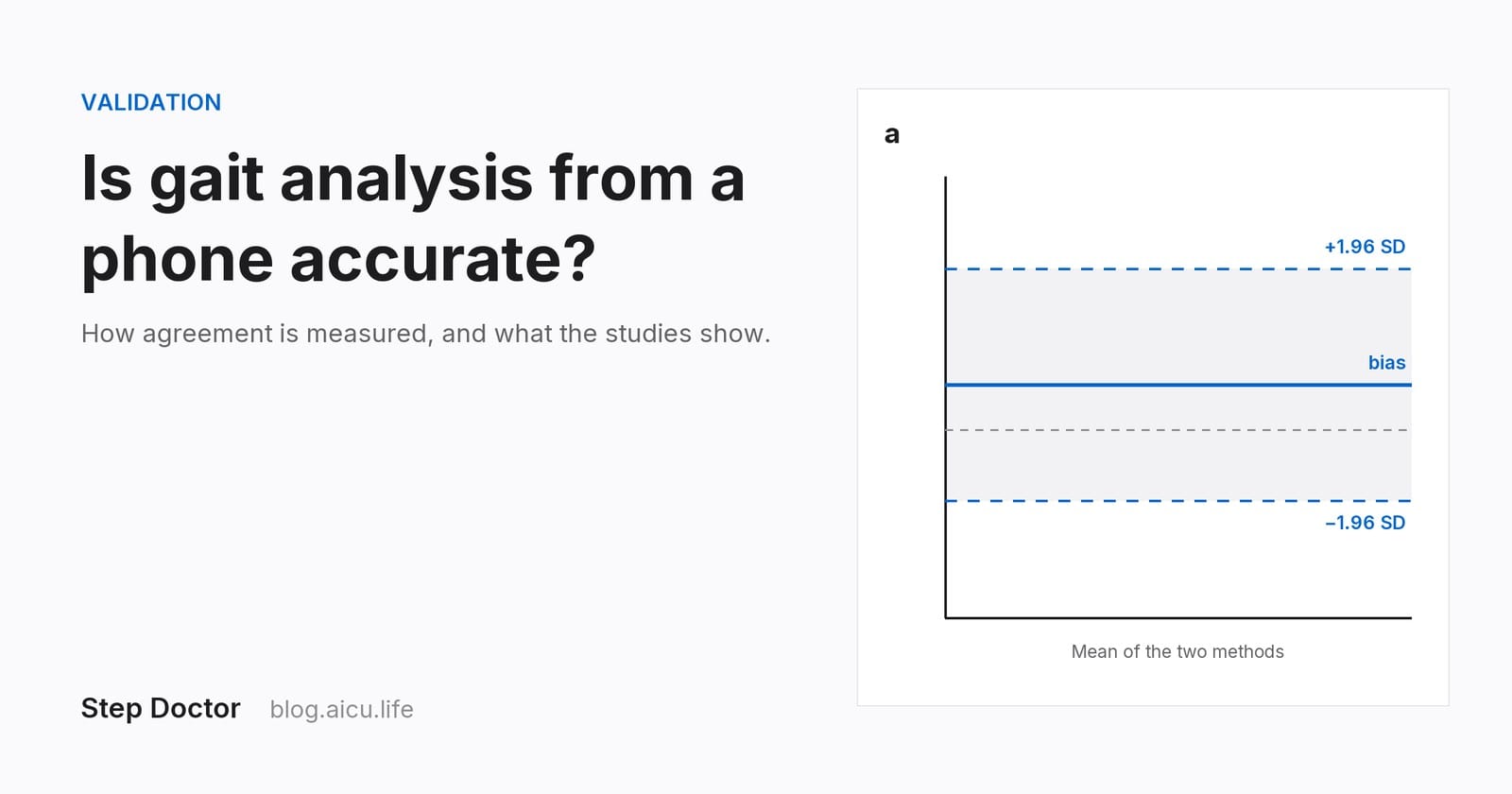
How far apart are the two measurements, in real units? That's agreement, shown with a Bland–Altman plot: the difference between the methods for each person, plotted against their average. The average difference is the bias (does the tool read high or low?), and the limits of agreement show how far apart the two will usually be. Bland and Altman wrote them as the bias ± 2 standard deviations, or more precisely ± 1.96 (Bland & Altman, 1986).
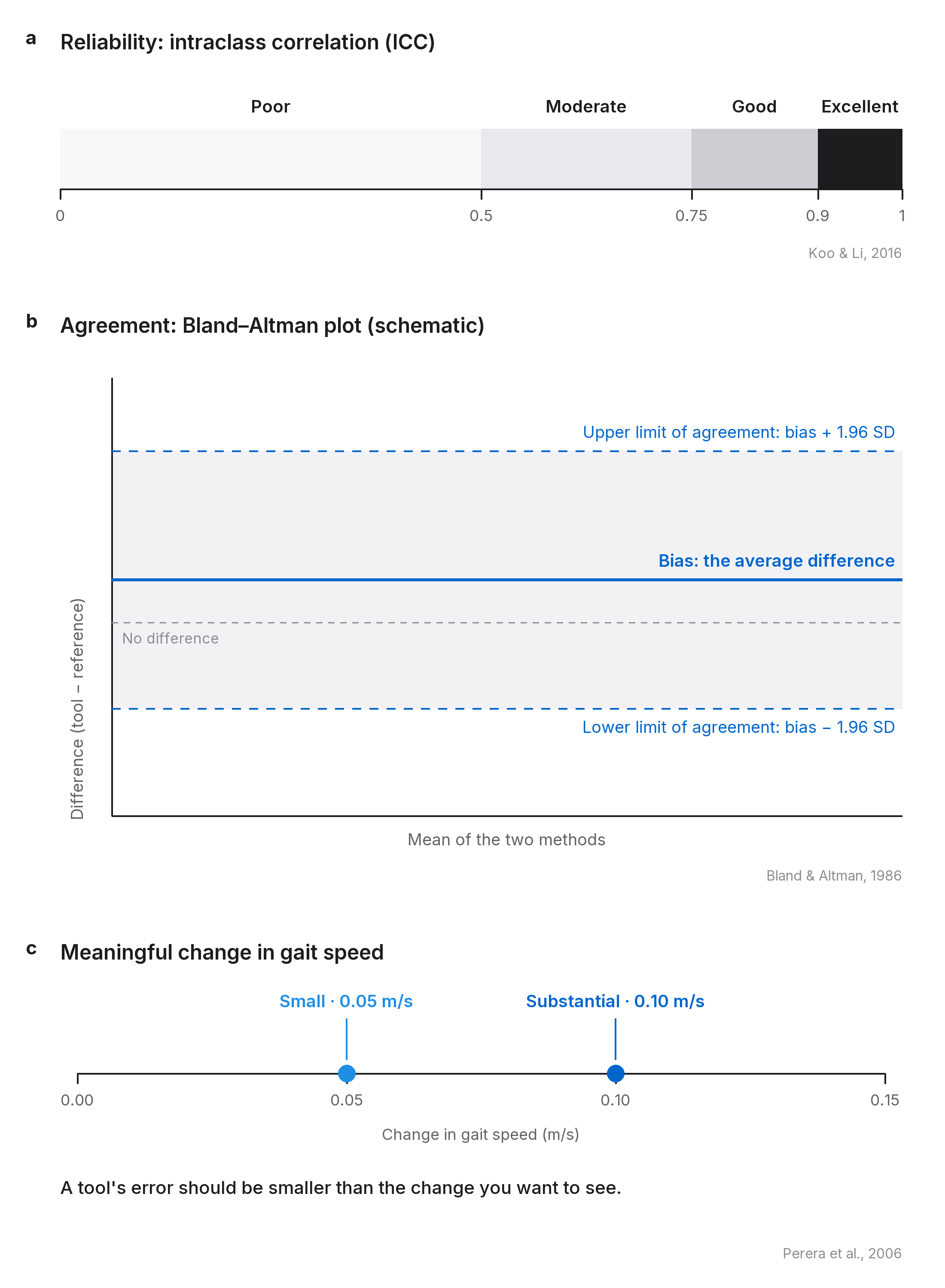
A high ICC alone can hide a tool that reads consistently 10% fast. Good studies report both.
How small is small enough?
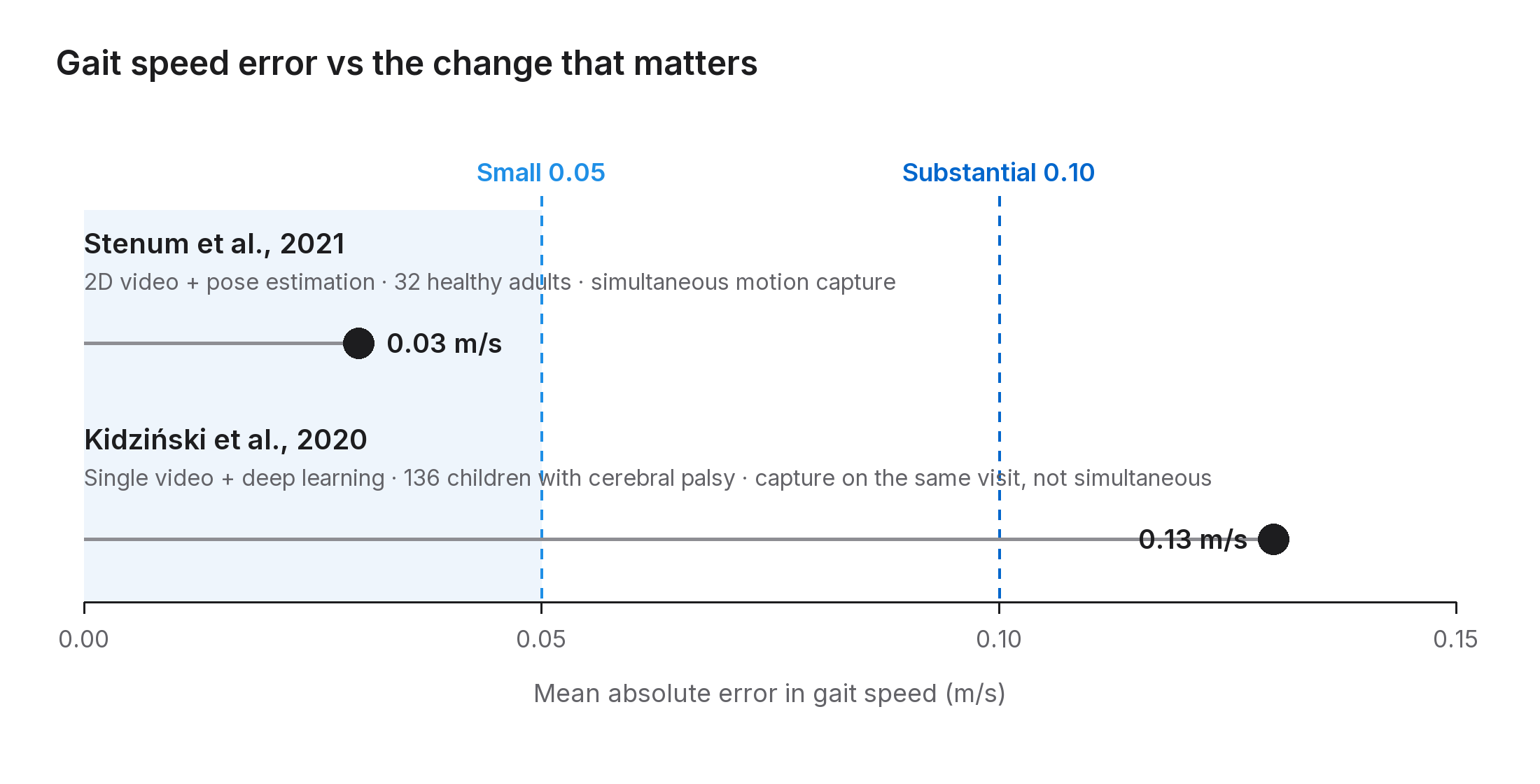
The error that matters depends on what you're trying to see. For gait speed in older adults, a change of about 0.05 m/s is small but meaningful and about 0.10 m/s is substantial (Perera et al., 2006). In adults with health conditions, most estimates of the minimal clinically important difference fall between 0.10 and 0.20 m/s (Bohannon & Glenney, 2014). A tool whose error is larger than the change you're watching for can't tell you whether someone improved.
What the studies of camera and phone tools found
| Study | Tool and people | Reference | Gait speed result |
|---|---|---|---|
| Stenum et al., 2021 | 2D video with pose estimation · 32 healthy adults | Motion capture, simultaneous | Mean absolute difference 0.03 m/s; step length 0.049 m per step; knee angle error 5.6° |
| Azhand et al., 2021 | One smartphone video (Lindera) · 44 older adults | GAITRite walkway | ICC 0.98; limits of agreement for speed and step length about −11% to +13%. Developer-authored |
| Kidziński et al., 2020 | Single video with deep learning · children with cerebral palsy | Motion capture, same visit but not simultaneous | Correlation r = 0.73; mean absolute error 0.13 m/s |
| Shahar & Agmon, 2021 | Phone in a pocket, motion sensors (OneStep) · 60 adults | Body-worn sensor system | ICC 0.935 (95% CI 0.896–0.962). Funded by the developer |
| Uhlrich et al., 2023 | Two or more phone videos (OpenCap) · 10 adults | Motion capture and force plates | Joint angle error 4.5° on average; speed not the focus. Authors co-founded the company behind it |
The pattern is encouraging: in controlled conditions, a camera can measure gait speed with errors close to or below the smallest meaningful change. It also shows why details matter. The largest error came from the study where the reference wasn't recorded at the same time and the walkers were children with cerebral palsy, a much harder test than healthy adults on a clear path.
Six questions to ask of any gait app's evidence
- What was the reference? A walkway or motion capture, recorded at the same time, is the strongest.
- Who walked? Results in healthy young adults may not hold for older adults, people with a walking aid or children.
- Is there a confidence interval? An ICC without one tells you less than it seems.
- Are the limits of agreement in real units? Then compare them with the change you care about.
- Who ran the study? Developer-funded work can be sound, but independent replication counts for more.
- Under what conditions? Lighting, camera placement, distance and clothing all affect video measurement.
Where Step Doctor stands
Step Doctor reconstructs the body in 3D from one phone video and grades every result against published norms. We compared its measurements with a pressure-sensor walkway in an internal study, with 93% clinical accuracy. We plan to publish its method and results, reported the way this article describes: agreement statistics with confidence intervals and limits of agreement for each measure, the people who took part and the conditions. Until then, treat our accuracy figure as a claim to be checked, not a settled fact. What we can show today is on the science page, with every reference value and its source on the reference values page.
Questions
Is gait analysis from a phone as accurate as a gait lab? For gait speed in controlled conditions, published camera methods have come close: one study found a mean difference of 0.03 m/s against motion capture. Accuracy varies with the tool, the people and the setting, so check each tool's own evidence.
What is a good ICC for a gait measure? Above 0.9 is usually read as excellent and 0.75–0.9 as good, ideally judged on the 95% confidence interval rather than the single value.
Can a phone measurement replace a clinical assessment? No. It supports screening and monitoring; results should inform, not replace, the judgement of a healthcare professional.
Related: how Step Doctor measures movement, gait analysis at home and the gait analysis apps compared.
Step Doctor supports screening and monitoring. It doesn't diagnose, and results should inform, not replace, the judgement of a healthcare professional.