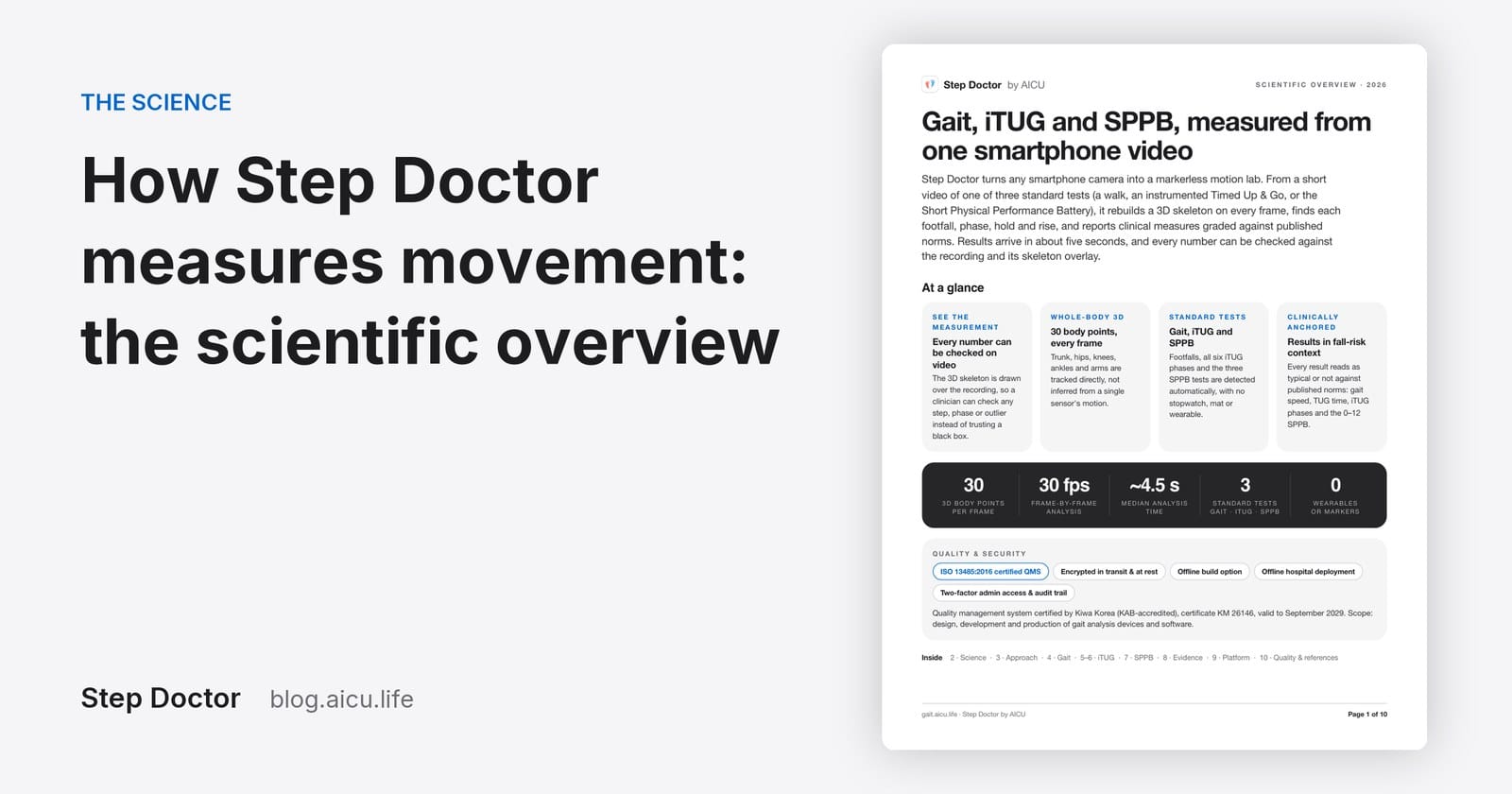
Can a phone camera measure how someone walks, stands up and keeps their balance well enough to be useful? We've written up how Step Doctor does it, what each result is judged against and what has and hasn't been validated yet, in a ten-page scientific overview. You can download the PDF (also in Korean). This post is the short version.
From phone video to measurement
A camera sees the whole body, so Step Doctor measures from where the joints actually are, not from where a single sensor in a pocket suggests they might be. Every test goes through the same five steps:
- Record. A short video with the phone's camera: a walk toward the phone, an instrumented Timed Up and Go (iTUG), or the three SPPB tests.
- Find the person. The person being tested is found and followed on every frame, even with other people in view.
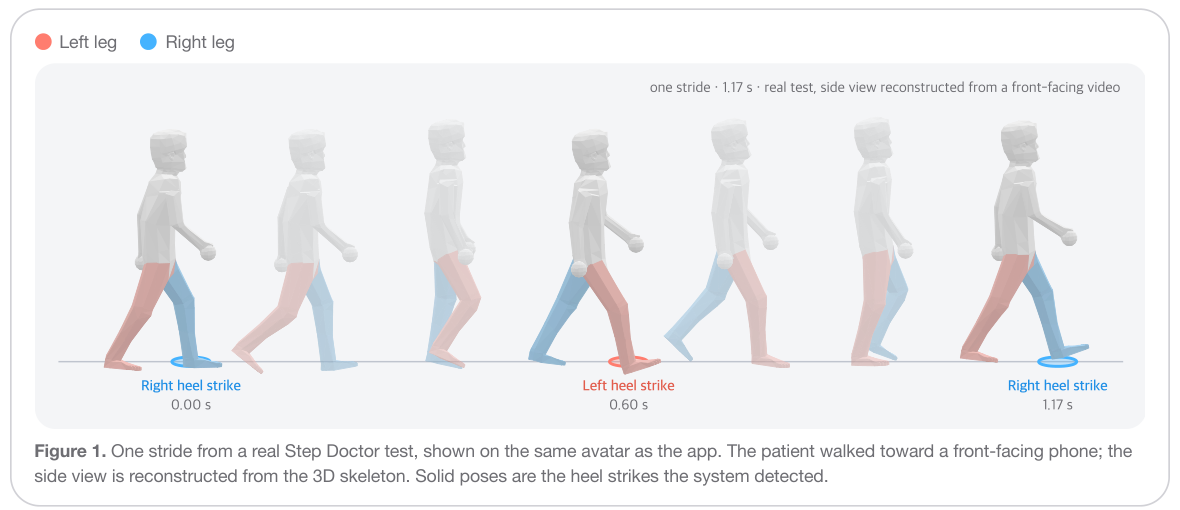
- Reconstruct in 3D. 30 body points per frame, in metric 3D: feet, knees, hips, trunk, arms and head.
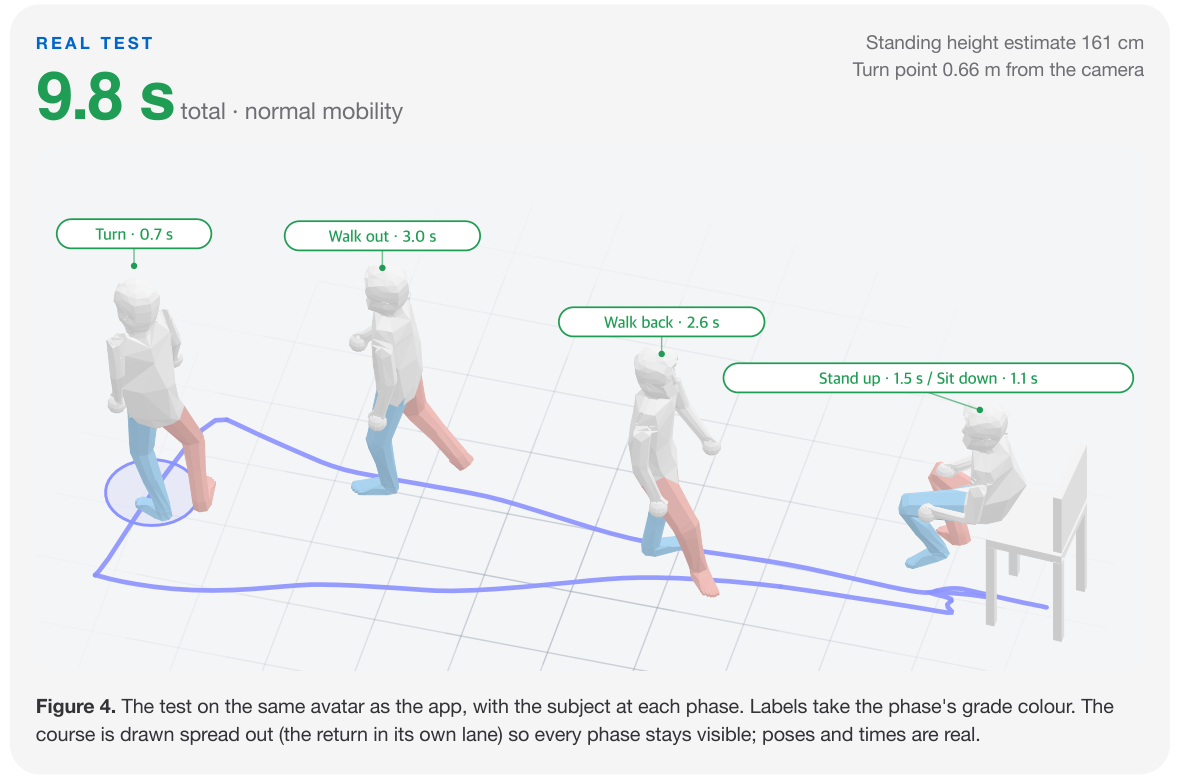
- Find the events. Heel strikes for gait; the six iTUG phases; for the SPPB, each balance hold, the timed walk and every chair rise.
- Report in context. Each measure is graded against published norms and shown with a 3D replay of the test.
A camera, compared with a phone in a pocket
Smartphone gait tools mostly use either the phone's motion sensor, carried on the body, or its camera. Both have strengths:
| Camera with 3D pose | Phone-in-pocket motion sensing | |
|---|---|---|
| What is measured | Joint positions directly in 3D | Movement of one point near the hip; gait events are inferred |
| Can you see what was measured? | Yes, in the 3D replay | No, the signal isn't human-readable |
| Whose phone? | Any phone; a clinician or family member can film | Usually the person's own, carried on the body |
| iTUG and SPPB | From posture: hip height, heading and distance show every phase, hold and rise | Inferred from changes in acceleration |
| All-day monitoring | Not the goal: standardized tests on demand | A strength of body-worn sensing |
Three standard tests
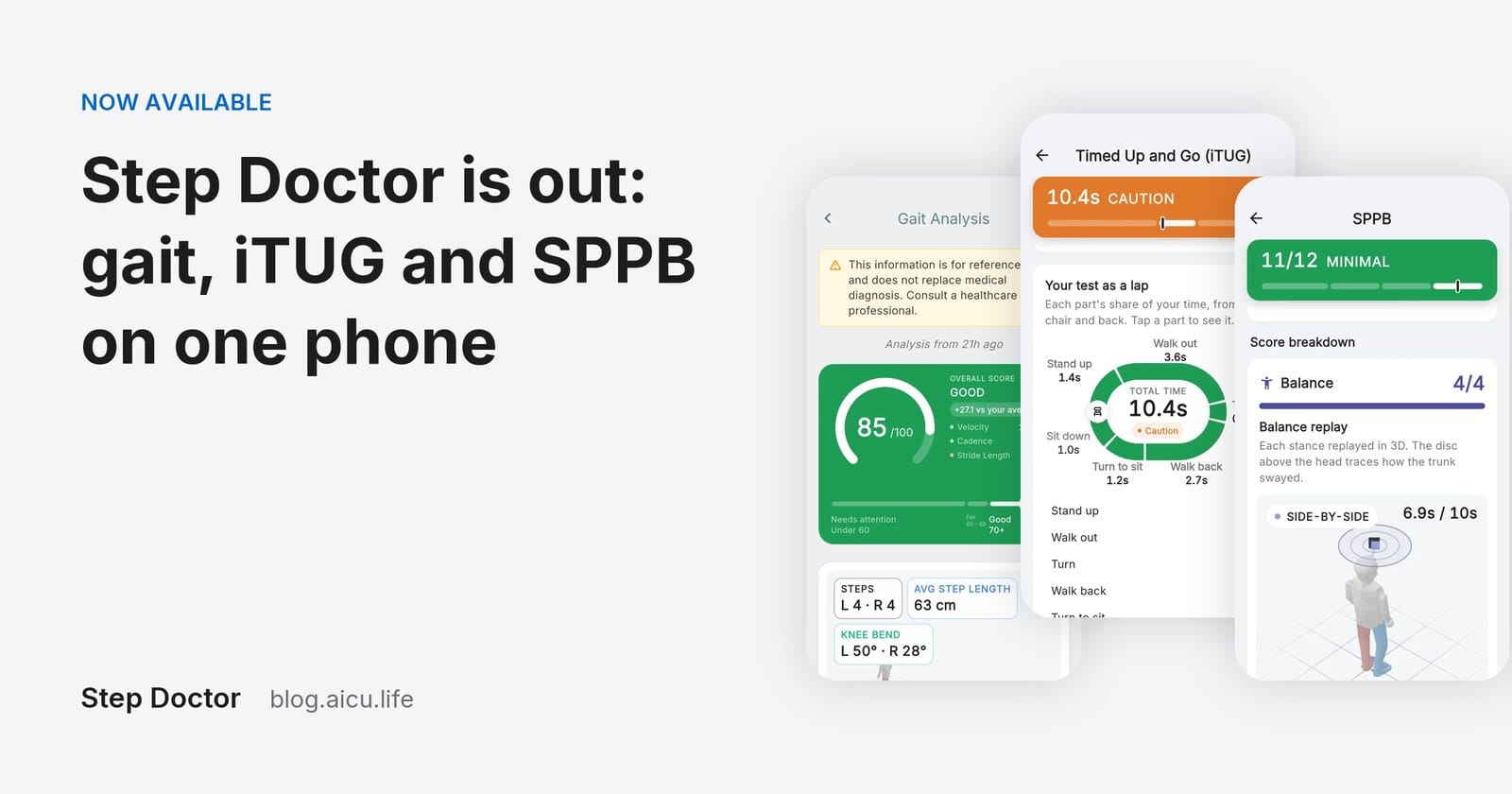
- Gait analysis: walking speed, cadence, step and stride length, step timing, stance and swing, left–right balance and consistency, summed up in a 0–100 gait score. Read the gait guide.
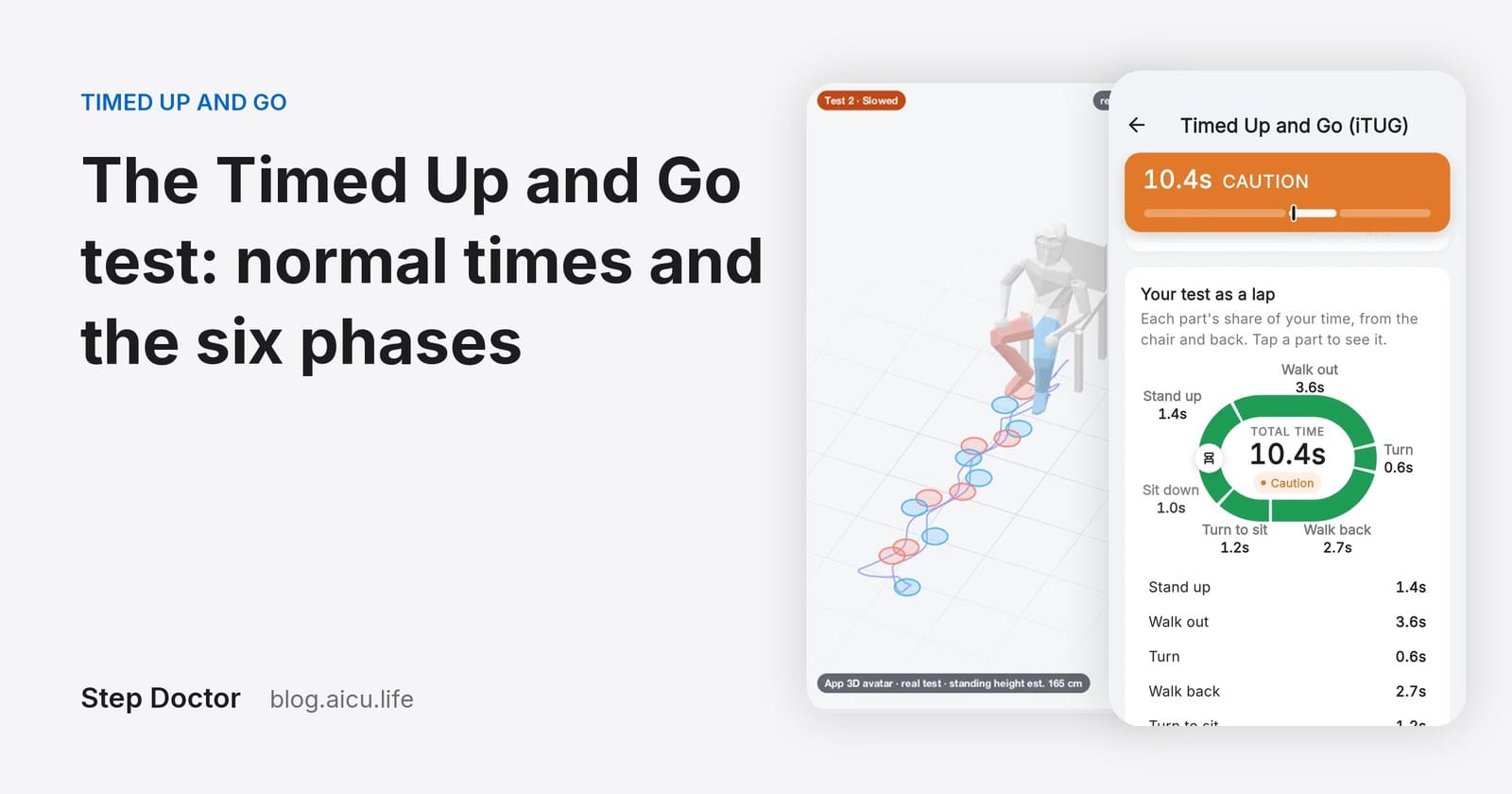
- Instrumented Timed Up and Go: the total time and six phases (stand up, walk out, turn, walk back, turn to sit, sit down), each graded against Mirelman et al. (2014). Read the TUG guide.
- SPPB: balance, a 4-metre walk and five chair stands, scored 0–12 with the standard NIA cut-offs. Read the SPPB guide.
Judged against published evidence
Gait speed, TUG time and the SPPB are among the most studied predictors of falls and decline in older adults, and Step Doctor reports each against the thresholds from that research: the Studenski gait speed thresholds, Bohannon's TUG norms, the Shumway-Cook 13.5-second cut-off (with Barry et al.'s caveat that it shouldn't be used alone), the NIA SPPB cut-points and Perera's meaningful-change values. Every value and its source is on the reference values page, and the science page has the full evidence table with DOI links.
In numbers
- 3 standard tests: gait, iTUG and SPPB
- 30 body points tracked in 3D on every frame
- 6 iTUG phases, each timed and graded
- ~4.5 s median analysis time after upload (496 analyses, October 2026)
What has been validated, and what hasn't yet
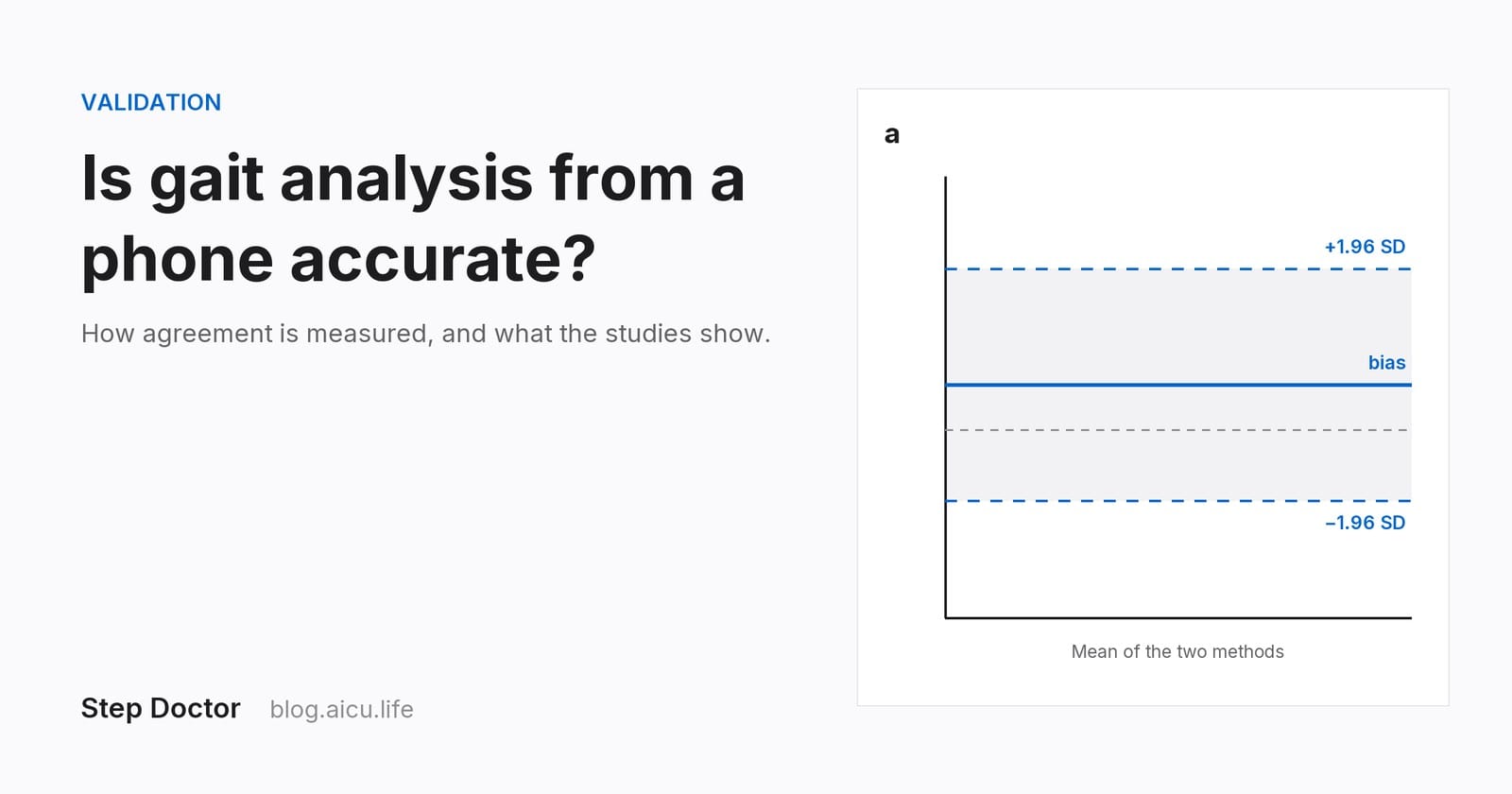
The thresholds come from peer-reviewed studies of the tests themselves. Step Doctor's own measurements were compared with a pressure-sensor gait mat in an internal study, with 93% clinical accuracy. That study is not yet peer-reviewed. We will publish its method and results, and we'd rather say so plainly than let the number stand on its own.
Step Doctor supports screening and monitoring. It doesn't diagnose, and results should inform, not replace, the judgement of a healthcare professional.
Quality and data protection
AICU's quality management system is certified to ISO 13485:2016 (certificate KM 26146, Kiwa Korea). Videos and results are encrypted in transit and at rest; videos are used only to produce your results and are deleted from our servers after about 72 hours. Results are never sold or used for advertising.
Download the scientific overview (PDF) · The science page · Step Doctor on the App Store and Google Play