Mobility and fall risk screening
Timed Up and Go test, timed by your phone
The Timed Up and Go (TUG) is one of the most widely used mobility tests: stand up from a chair, walk 3 metres, turn, walk back and sit down. Step Doctor runs it hands-free with voice cues, times it from the video and shows where the time goes.
- Time
- About 2 min
- You'll need
- A chair and about 5 m of floor




See it in action
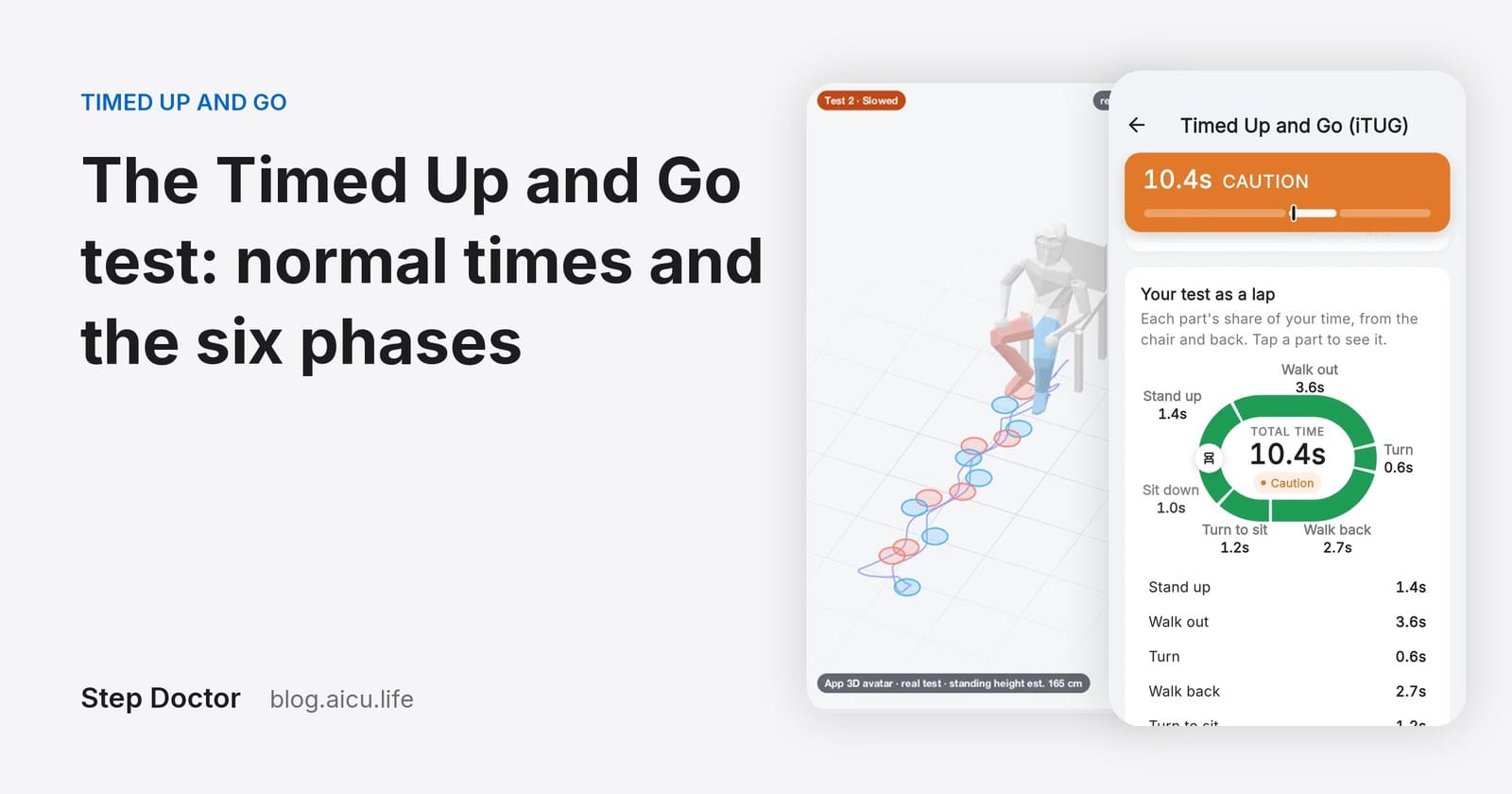
Two real iTUG tests in real time: a typical 9.8-second test with every phase typical, then a slowed 19.6-second test in the fall-risk band, each phase graded against Mirelman et al. (2014).
Real tests from Step Doctor, replayed on the app's 3D avatar (no faces are shown).
What it measures
Total time
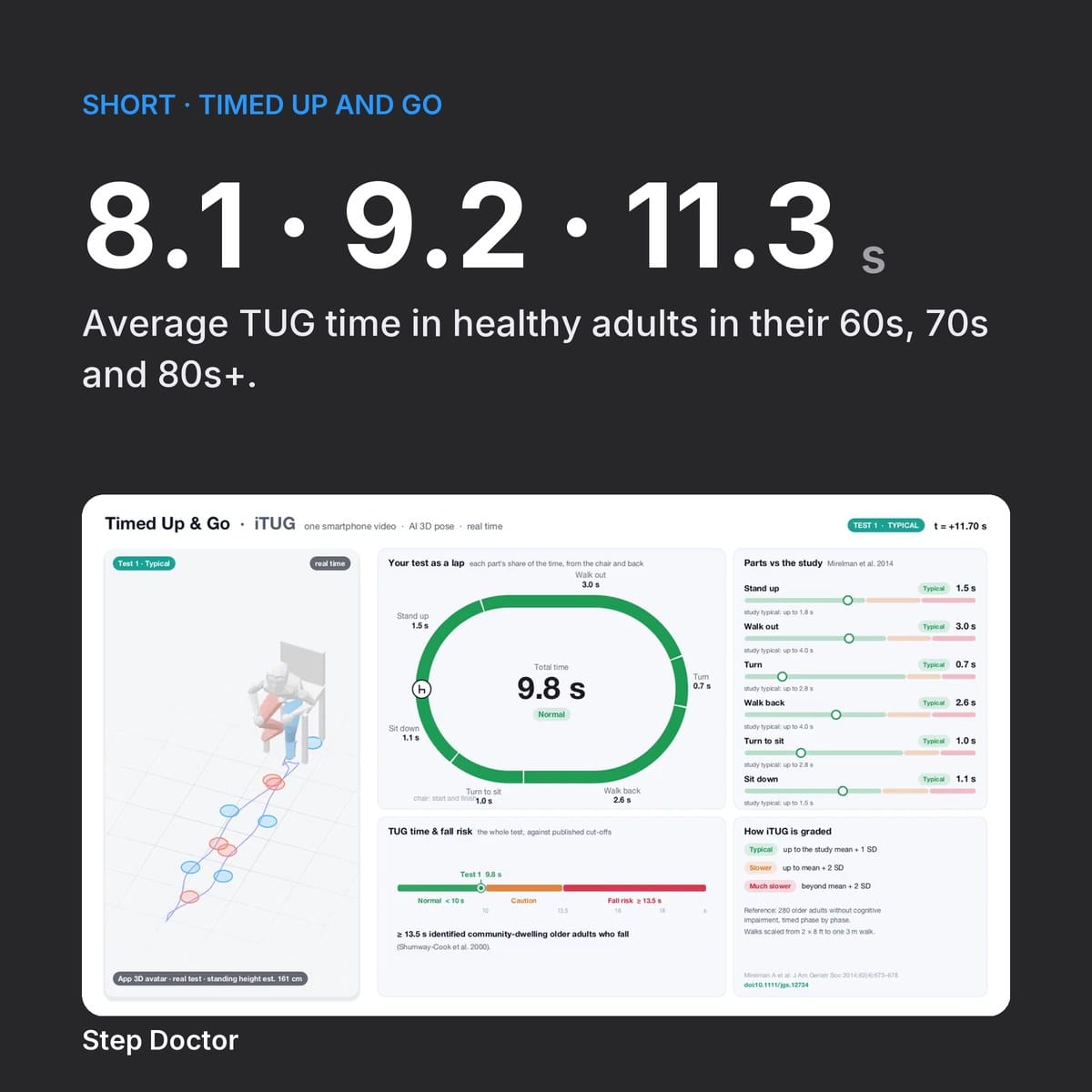
From the voice saying Go to sitting back down. Under 10 seconds is typical, 10 to 13.4 seconds calls for caution, and 13.5 seconds or more is a widely used fall-risk cut-off.
Six phases
Stand up, walk out, turn, walk back, turn to sit and sit down, each with its own time and its share of the test.
Phase grades
Each phase is compared with the instrumented TUG reference values of Mirelman et al. (2014) and graded typical, slower or much slower. The study timed both walks together, so the walk grades are approximate.
3D replay
The whole test replayed in 3D, with your path on the floor and a marker where each phase ended.
How to do it
Place the chair and the phone
Use a chair you can sit in normally and stand the phone facing it, about 5 metres away; you walk about 3 metres of that floor. Voice prompts help you find the right spot.
Sit and wait for Go
Once you're seated in place, the recording starts and a voice says Go. The clock starts on the Go.
Walk, turn at the cue, come back
Stand up, walk toward the phone and turn when you hear the turn cue. Walk back and sit down at your usual pace.
See the result
Your total time and its band, the six phase times with their grades, a 3D replay and a PDF report.
Normal values and cut-offs for gait speed, TUG, SPPB and sit-to-stand, with sources
How it's scored
The total time is banded at 10 and 13.5 seconds. For context, healthy older adults average 8.1 s at 60–69, 9.2 s at 70–79 and 11.3 s at 80–99 (Bohannon, 2006). 13.5 seconds or more was associated with falls in community-dwelling older adults (Shumway-Cook et al., 2000); pooled later studies found that a slow time makes falls more likely, but a faster time doesn't rule them out, so the TUG shouldn't be used alone. Each phase is graded against the study's no-impairment group: typical up to the mean plus one standard deviation, slower up to two, much slower beyond.
Under 10 s · 10–13.4 s · 13.5 s or more
Example: a real iTUG, 8.7 s. Graded phases: stand up, walk out, turn, walk back, turn to sit, sit down.
Step Doctor supports screening and monitoring. It doesn't diagnose, and results should inform, not replace, the judgement of a healthcare professional.
Who it's for
- Older adults and families who want to check mobility and fall risk at home.
- Physiotherapists, falls clinics and rehabilitation teams who want phase times without wearable sensors.
- Care homes that repeat the test to follow residents over time.
Questions
What is the iTUG?
The instrumented Timed Up and Go: the same test, with each phase measured separately instead of only the total time. Step Doctor measures the phases from video, so nothing has to be worn.
What does a slow TUG time mean?
A total of 13.5 seconds or more is a widely used cut-off for a higher risk of falls in community-dwelling older adults (Shumway-Cook et al., 2000). It's a screening signal, not a diagnosis: talk to a healthcare professional about your result.
Can I do the test on my own?
Yes. The voice guide tells you where to sit, when to start and when to turn. Having someone nearby for safety is always a good idea.
Why measure the phases, not just the total?
Two people with the same total can lose time in different places: one stands up slowly, another slows down in the turn. The phase times show which part of the movement to work on.
References
- Podsiadlo D, Richardson S. The timed "Up & Go": a test of basic functional mobility for frail elderly persons. J Am Geriatr Soc. 1991;39(2):142–148.
- Bohannon RW. Reference values for the Timed Up and Go test: a descriptive meta-analysis. J Geriatr Phys Ther. 2006;29(2):64–68.
- Shumway-Cook A, Brauer S, Woollacott M. Predicting the probability for falls in community-dwelling older adults using the Timed Up & Go Test. Phys Ther. 2000;80(9):896–903.
- Mirelman A, et al. Association between performance on Timed Up and Go subtasks and mild cognitive impairment: further insights into the links between cognitive and motor function. J Am Geriatr Soc. 2014;62(4):673–678.
Read more
The other tests in Step Doctor
Walking test
Gait analysis
Walk toward the camera for a few seconds. Step Doctor measures walking speed, cadence, stride length and left–right balance, and gives a 0–100 gait score.
Learn moreShort Physical Performance Battery
SPPB
Three balance stances, two 4 m walks and five chair stands, scored 0–12 on the standard SPPB scale with its limitation bands. Voice prompts guide every step, so you never touch the phone.
Learn moreGet Step Doctor
Free to download on iPhone and Android. Each test uses credits, and new accounts get welcome credits.