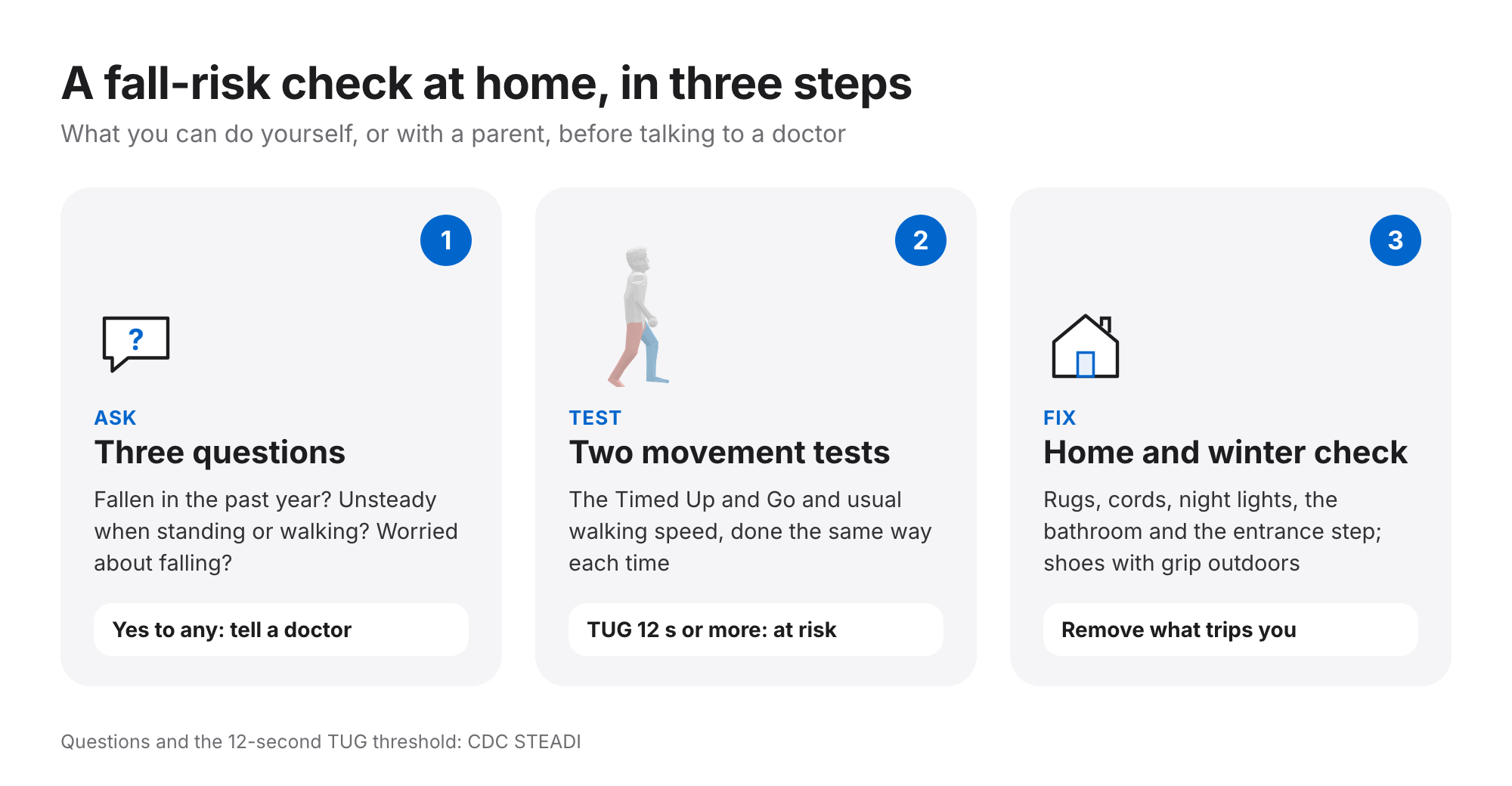
One in four people aged 65 and over falls each year (CDC STEADI), and many never mention it to a doctor. Winter makes it worse: ice outside, dark evenings and heavier shoes. The good news is that most of what a clinic checks first can be done at home in about fifteen minutes, by you or with a parent. This guide walks through it in three steps: ask, test, fix.
Step 1: ask three questions
The CDC's STEADI program, used by doctors across the US, starts every fall-risk check with three questions:
- Have you fallen in the past year?
- Do you feel unsteady when standing or walking?
- Do you worry about falling?
A "yes" to any of them counts as being at risk, and it's worth raising at the next appointment. If the answer to the first is yes, also note how many times and whether there was an injury: that's the first thing a doctor will ask.
For a fuller picture, STEADI's patient brochure has a 12-question checklist. Each "yes" scores 1 or 2 points, and 4 points or more means you may be at risk. It was developed by the Greater Los Angeles VA and validated as a self-assessment (Stay Independent brochure; Rubenstein et al., 2011).
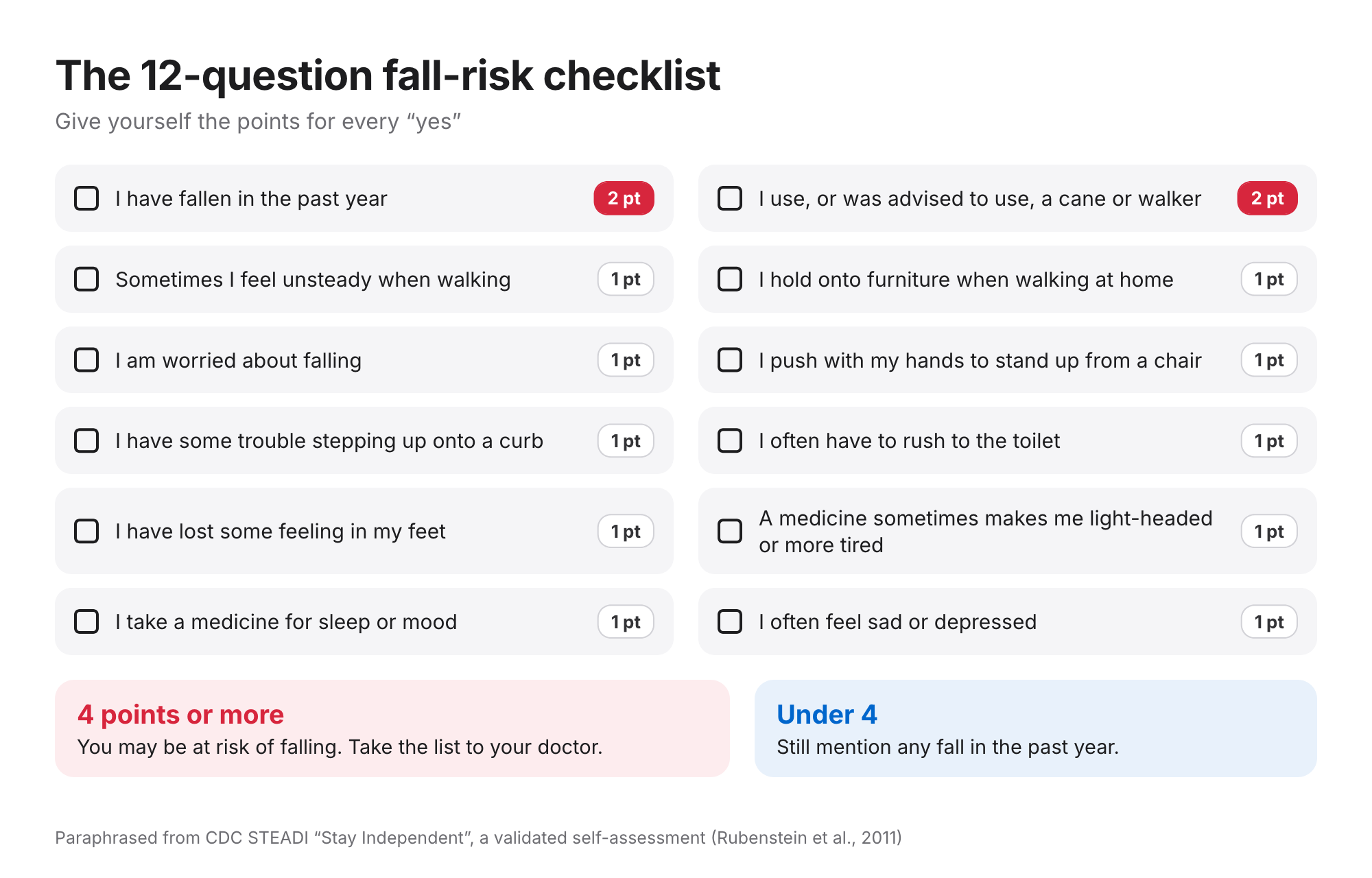
Several items have nothing to do with walking: rushing to the toilet at night, numb feet, sleeping pills, low mood. That's the point. Falls rarely have a single cause, and a few of these are easy to change, for example by asking a pharmacist to review medicines.
Step 2: two movement tests
Questions tell you about risk; movement tests show how someone actually moves. Two take about a minute each and need only a chair, a tape measure and a timer.
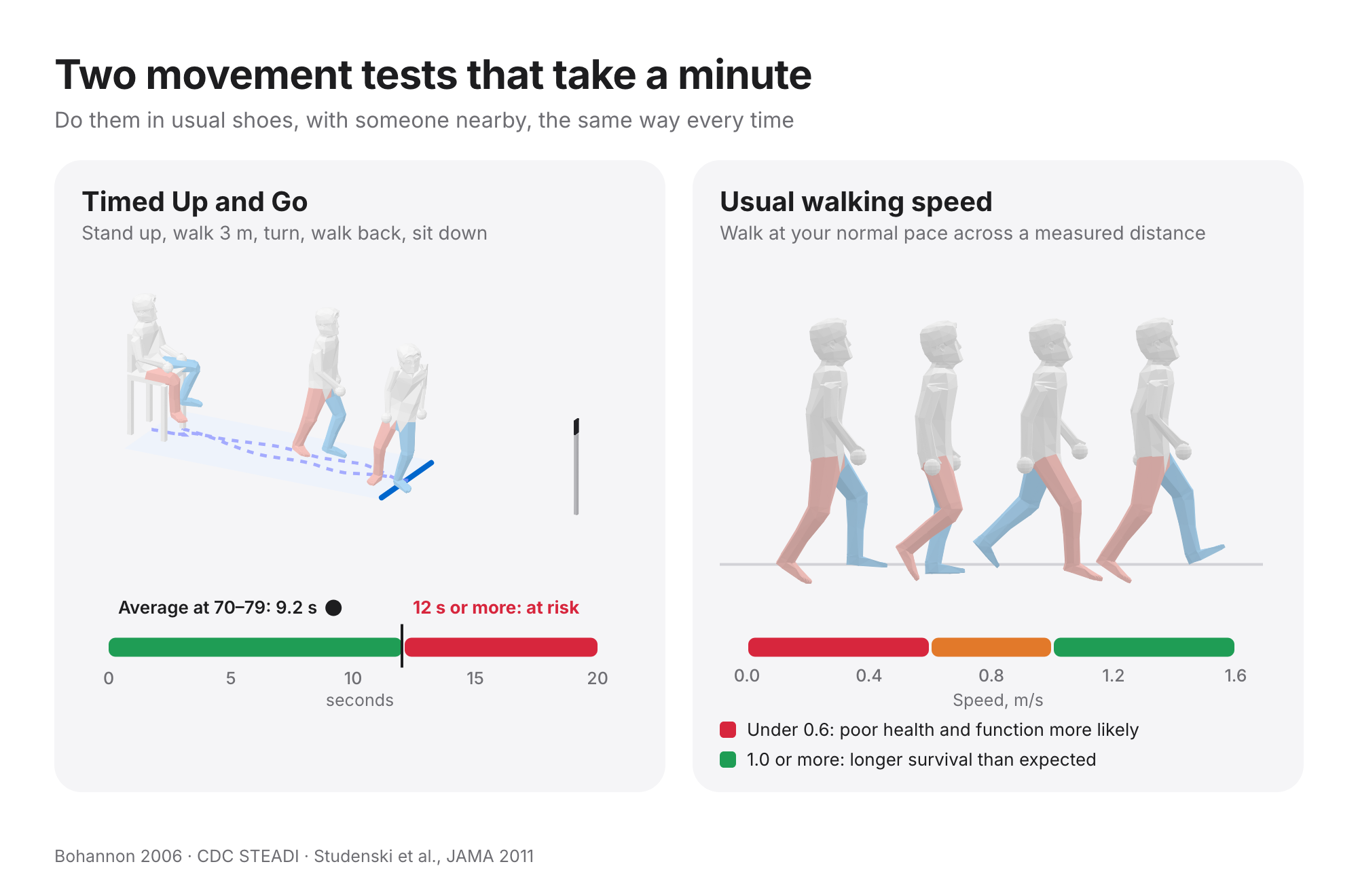
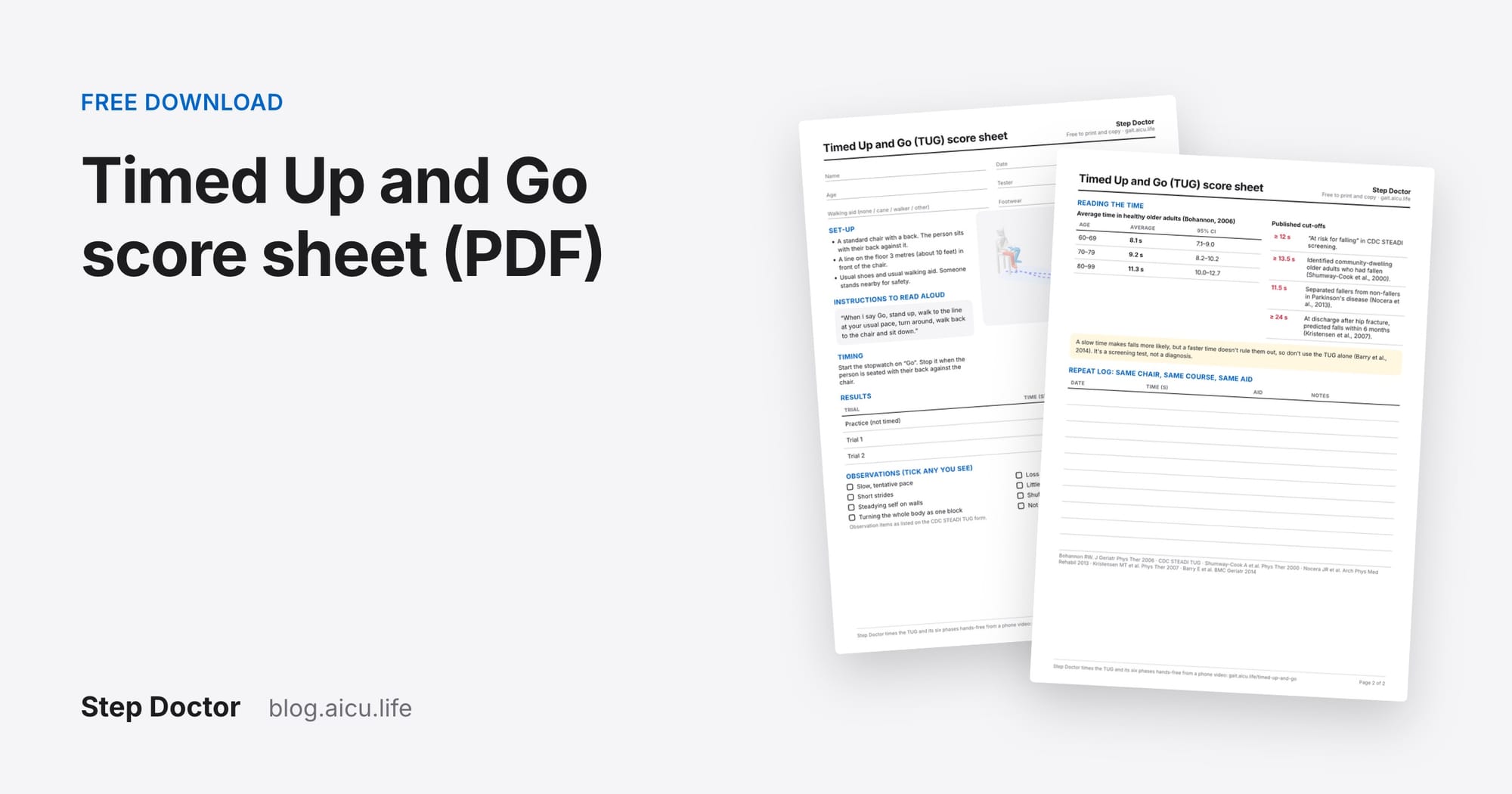
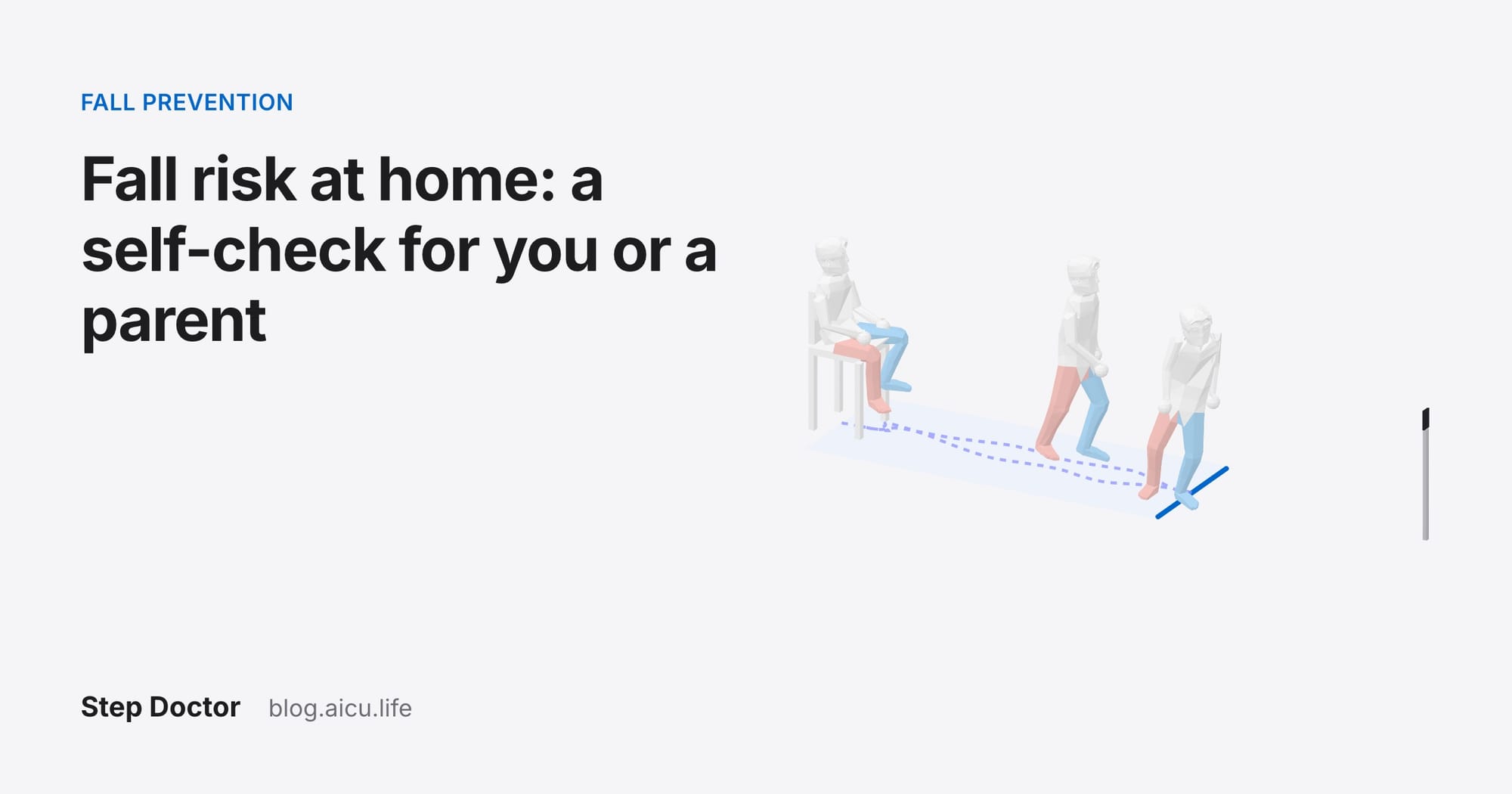
The Timed Up and Go (TUG). Sit in a chair with a back, stand up, walk 3 metres at a normal pace, turn, walk back and sit down. STEADI treats 12 seconds or more as being at risk. For comparison, healthy adults aged 70–79 average about 9.2 seconds (Bohannon, 2006). Our free TUG score sheet has the instructions to read aloud, and the cut-offs by condition cover Parkinson's, stroke and hip fracture.
Usual walking speed. Walk across a measured distance at your everyday pace and divide the distance by the time. In a pooled analysis of nearly 35,000 older adults, speeds under 0.6 m/s went with poorer health and function, and 1.0 m/s or more with longer survival than expected for age and sex (Studenski et al., 2011). See typical values by age.
A few rules make the numbers trustworthy:
- Someone stands nearby, especially if the person is unsteady. Stop if they feel dizzy or unwell.
- Usual shoes and usual walking aid, and the usual pace, not a race.
- The same setup every time: same chair, same course, similar time of day. That's what makes a change visible.
CDC's own assessment also includes a 30-second chair stand and a four-stage balance test; a physiotherapist can run those if the first checks raise concern.
Step 3: fix the home
Most of the fixes are cheap. Go room by room with the list below, ideally at night with the lights the person actually uses.
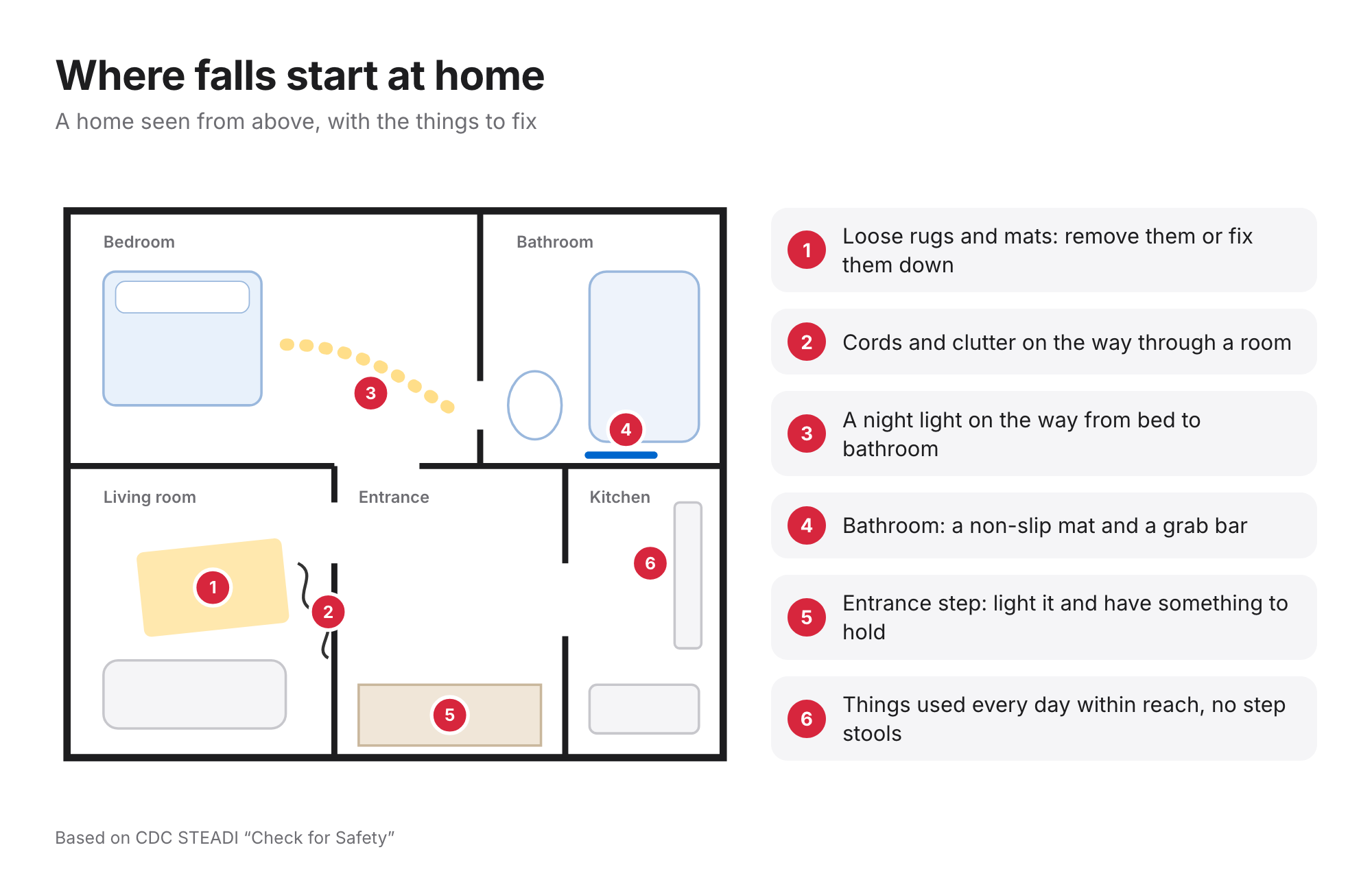
- Floors: loose rugs, mats with curled edges, cords and clutter on the way through a room.
- Night: a light from the bed to the bathroom, and a switch or lamp reachable from bed.
- Bathroom: a non-slip mat in the shower or bath and a grab bar where you step out.
- Entrance and stairs: a light at both ends and something to hold on to. In many apartments the entrance step is the one change in floor level, and it's easy to miss in the dark.
- Kitchen: everyday things on the lower shelves, so nobody needs a step stool.
The CDC's "Check for Safety" brochure, among the STEADI materials, has the full room-by-room checklist.
Winter: walking outside on ice
Ice turns a small stumble into a fall. A few habits help:
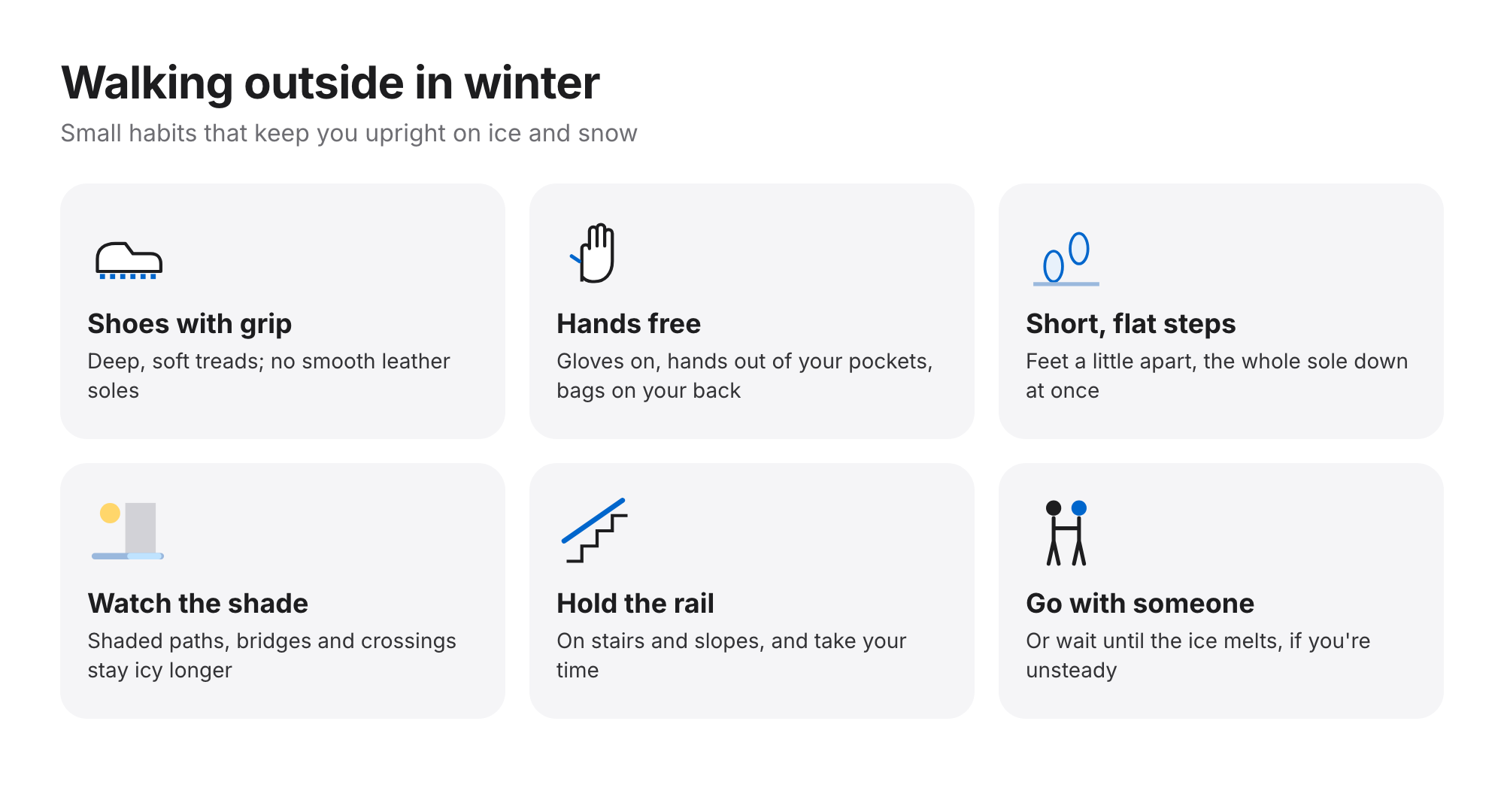
- Wear shoes with deep, soft treads; leave smooth leather soles for dry days.
- Keep your hands free and out of your pockets, so you can catch yourself. Carry bags on your back.
- Take short, flat steps with your feet slightly apart, putting the whole sole down at once.
- Expect ice where the sun doesn't reach: shaded paths, bridges, crossings and building entrances.
- Use handrails on stairs and slopes, and give yourself extra time.
- If you're unsteady, go out with someone, or wait until the paths have been cleared.
What to do with the results
Take the checklist score, the TUG time and the walking speed to a doctor or physiotherapist, especially if any of them is above its threshold or has changed since last time. In the STEADI approach, the next steps are a medicine review, a check of eyesight, feet and blood pressure on standing, and exercise that trains balance and strength, which reduced the rate of falls by about a quarter across trials in older people living at home (Sherrington et al., 2019).
A home check doesn't diagnose anything. Its value is that it's quick, it's repeatable, and it turns a vague worry into numbers you can bring to an appointment and compare next season.
Questions
How can I check my fall risk at home? Answer the three STEADI questions (a fall in the past year, feeling unsteady, worrying about falling), time a Timed Up and Go, measure your usual walking speed, and go through the home with a safety checklist.
What TUG time means a higher fall risk? The CDC's STEADI program treats 12 seconds or more as being at risk. Other cut-offs apply after stroke, hip fracture or in Parkinson's disease.
What score on the fall-risk checklist is a concern? On the 12-question Stay Independent checklist, 4 points or more means you may be at risk of falling. Under 4, a fall in the past year still counts.
How can older adults avoid falling on ice? Shoes with good tread, hands free, short flat steps, extra care in shaded spots and on crossings, handrails on stairs, and company or staying in when it's icy if you're unsteady.
Step Doctor times the Timed Up and Go and measures walking speed from a phone video, so the same test can be repeated at home and shared as a PDF report. Read more about the Timed Up and Go in Step Doctor, or get it on the App Store or Google Play.
Step Doctor supports screening and monitoring. It doesn't diagnose, and results should inform, not replace, the judgement of a healthcare professional.