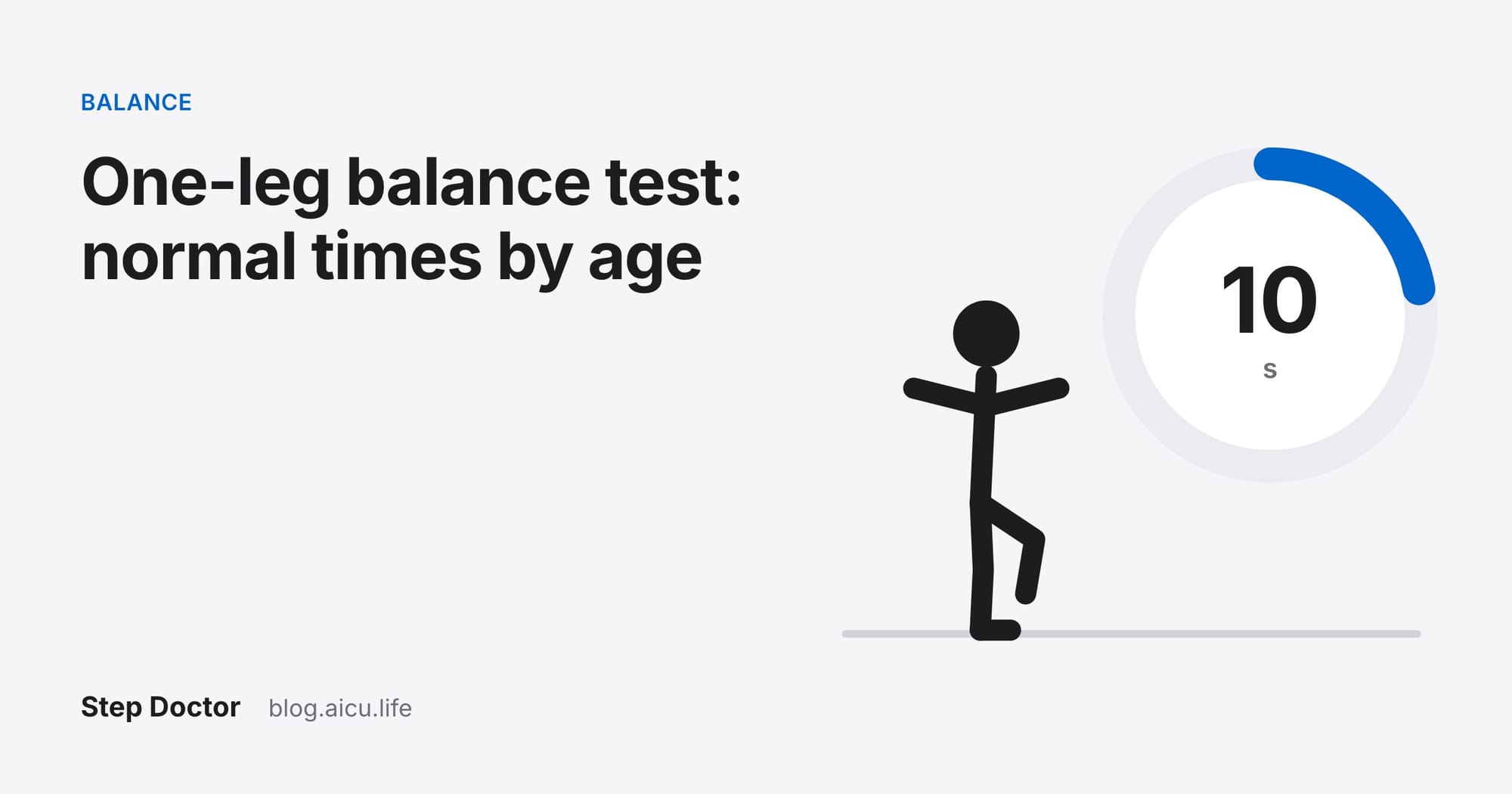
How long can you stand on one leg? It sounds like a party trick, but it's one of the simplest balance checks there is, and doctors and physiotherapists use it for a reason: the time drops steadily with age, and a very short time goes with a higher risk of falls. This guide gives the normal one-leg stance times by age, with eyes open and closed, explains the CDC's 4-stage balance test, shows how to do both safely at home, and covers what the results mean and what helps balance improve.
One-leg stance: normal times by age
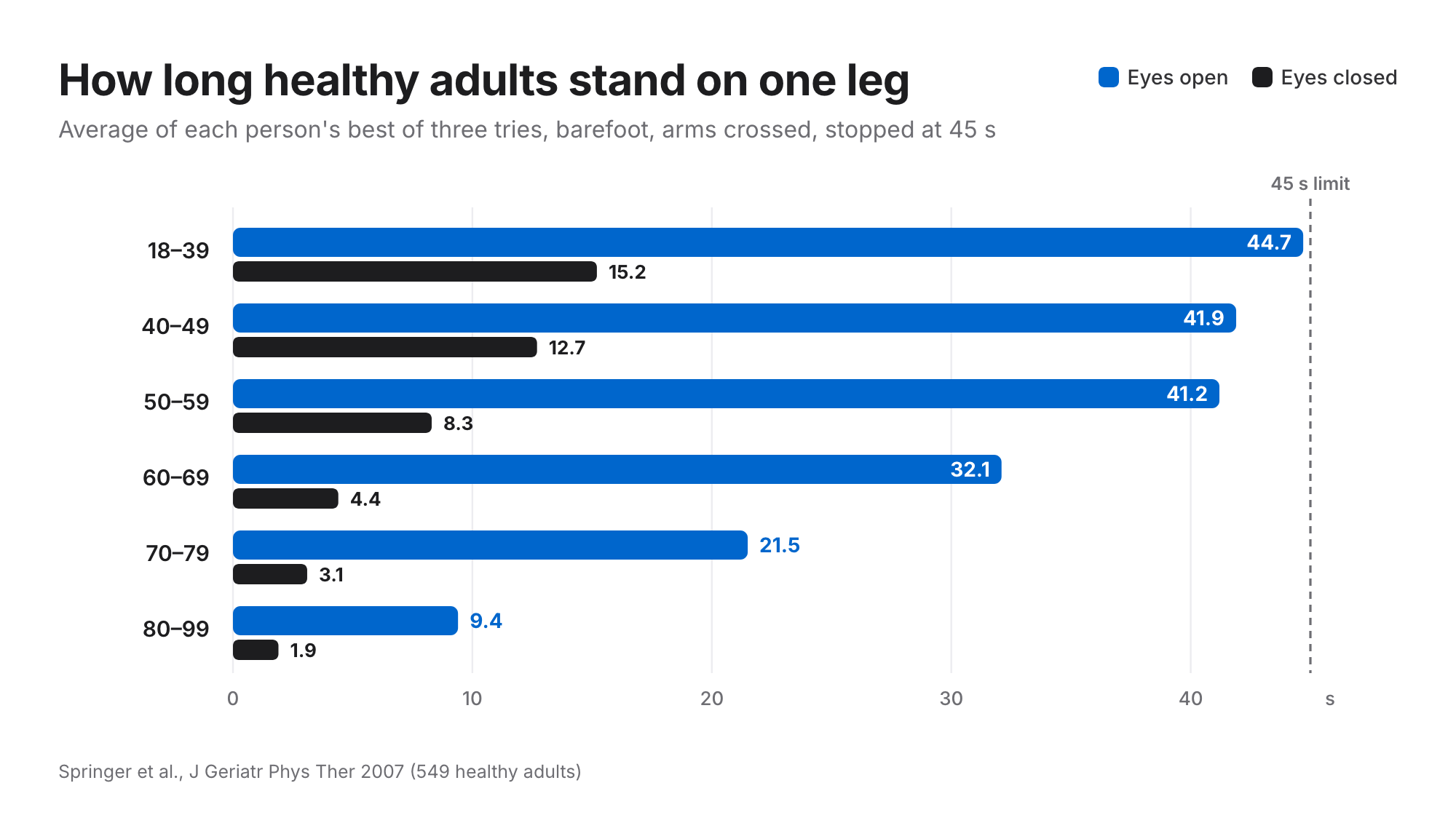
The most detailed reference values come from a study of 549 healthy adults aged 18 to 99 (Springer et al., 2007). Everyone stood barefoot on the leg of their choice, arms crossed over the chest, with the raised foot near but not touching the standing ankle. The clock stopped when they uncrossed their arms, touched the raised foot down or against the other leg, shifted the standing foot, opened their eyes in the eyes-closed trials, or reached 45 seconds. Each person had three tries in each condition. These are the group averages of the best of the three:
| Age | Eyes open (s) | Eyes closed (s) |
|---|---|---|
| 18–39 | 44.7 | 15.2 |
| 40–49 | 41.9 | 12.7 |
| 50–59 | 41.2 | 8.3 |
| 60–69 | 32.1 | 4.4 |
| 70–79 | 21.5 | 3.1 |
| 80–99 | 9.4 | 1.9 |
Two patterns stand out. With eyes open, most adults under 60 can stand close to the 45-second limit, and the drop is steepest after 60. With eyes closed, the times are much shorter at every age, because balance then relies on the inner ear and the sense of where your joints are, without help from vision. Men and women scored about the same, so the study gives one set of values for both.
The spread within each age group was wide, especially from 60 on. Use the averages as a rough guide: a time somewhat below the average for your age isn't a problem on its own, but a time far below it, or one that drops from one season to the next, is worth a closer look.
The 4-stage balance test (CDC STEADI)
For older adults, the CDC's STEADI fall-prevention program uses a stepped version that starts easy and gets harder. There are four positions, each held for 10 seconds, with eyes open and without a cane or walker (CDC, The 4-Stage Balance Test):
- Feet side by side.
- Semi-tandem: the instep of one foot touching the big toe of the other.
- Tandem: one foot directly in front of the other, heel touching toe.
- One foot.
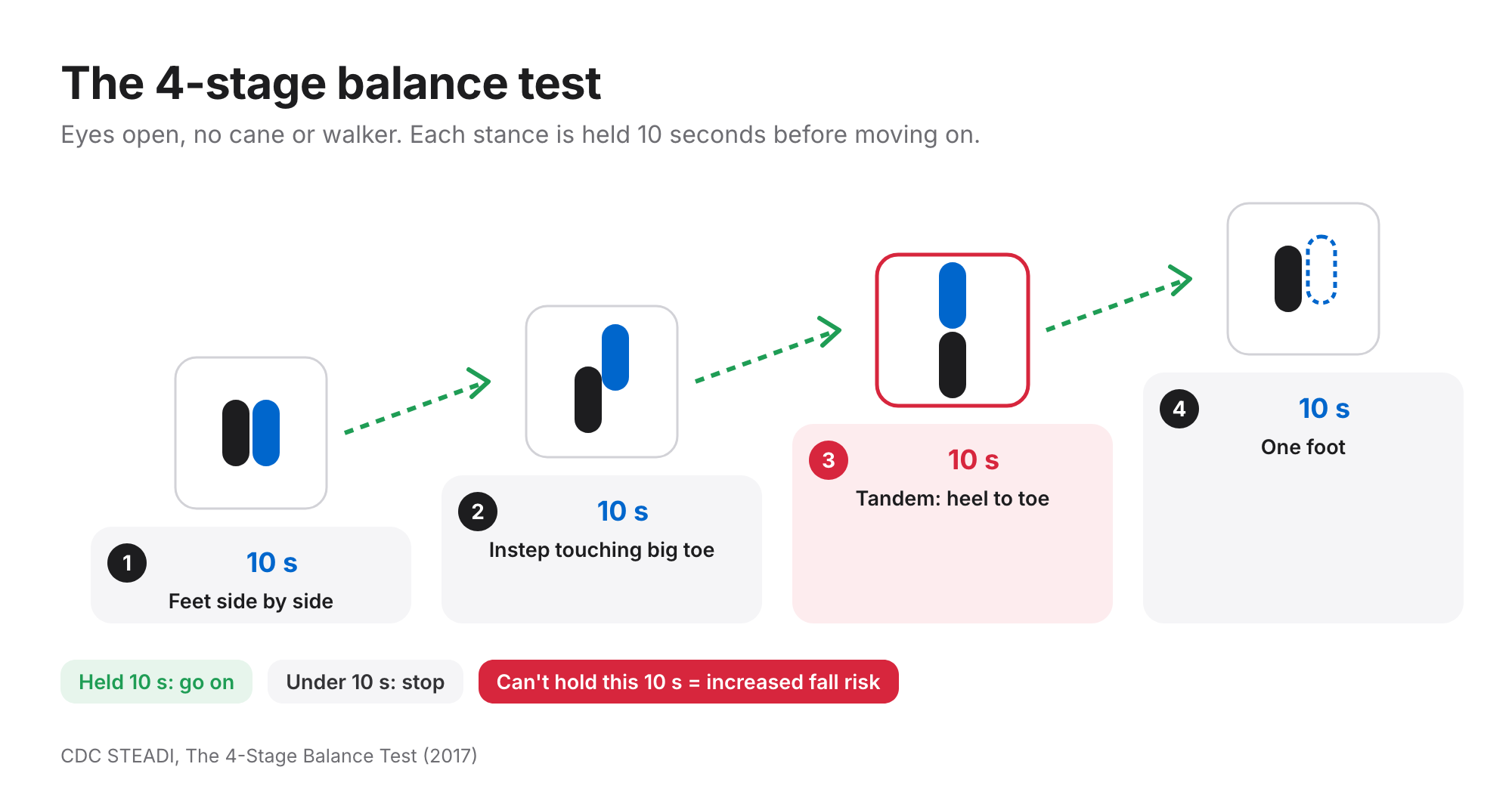
If a position is held for 10 seconds without moving the feet or needing support, go on to the next one. If not, stop there. The person may hold their arms out or move their body to keep their balance, but not move their feet. The key line in the STEADI form: an older adult who can't hold the tandem stand for at least 10 seconds is at increased risk of falling, and the CDC suggests referral to physical therapy for gait and balance exercise or to an evidence-based program such as Tai Chi.
The first three positions are also the balance part of the SPPB, a well-known physical performance battery, where they're scored in points instead.
How to do it safely at home
Balance tests are meant to find the point where balance gives out, so set things up so that point is harmless:
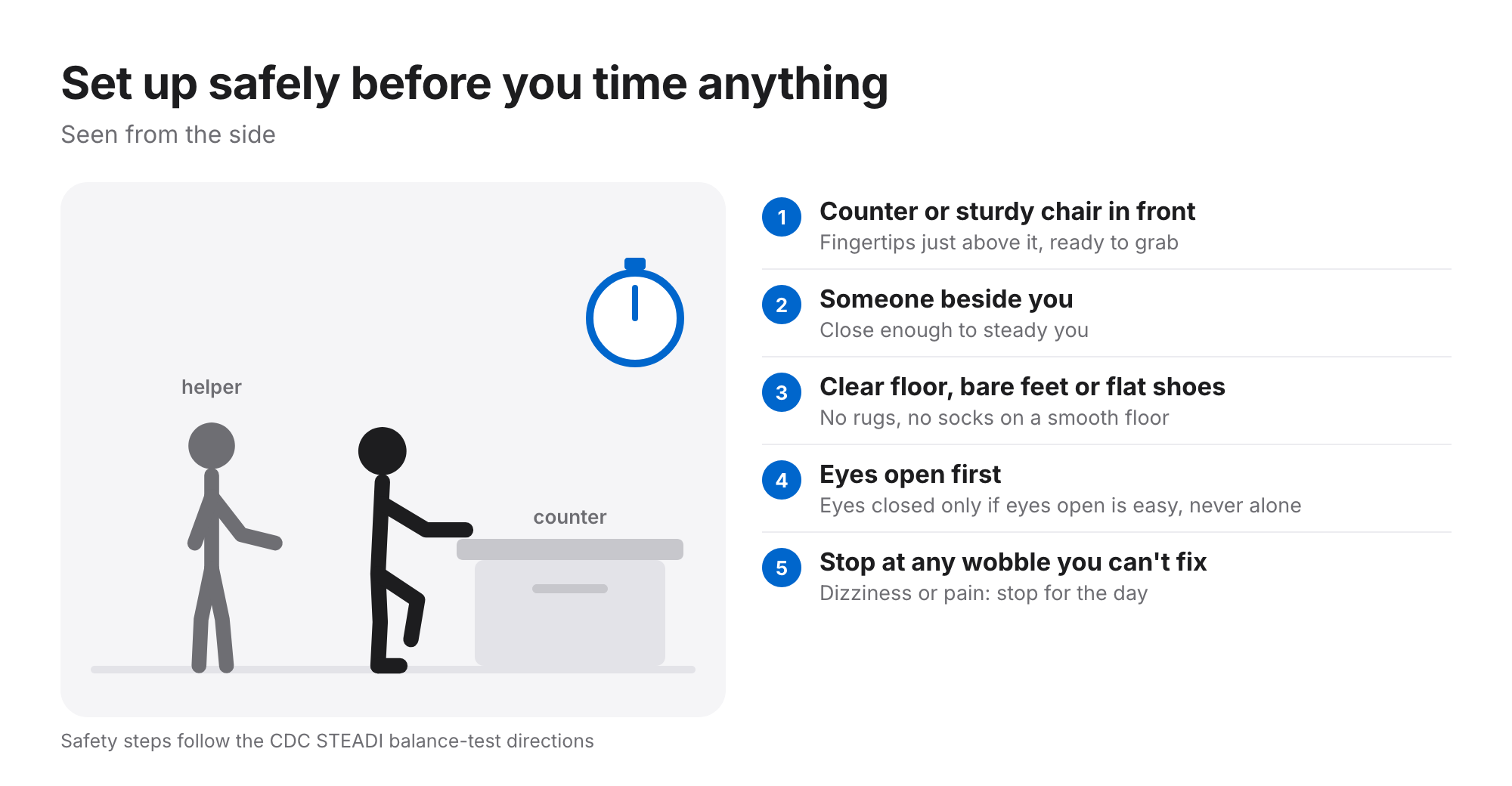
- Stand in front of a kitchen counter or the back of a sturdy chair, with your fingertips just above it, ready to grab. A chair should be pushed against a wall so it can't slide.
- Have someone stand beside you, close enough to steady you. In the STEADI test the tester holds the person's arm until they're steady in each position, then lets go and starts the timer.
- Clear the floor of rugs and clutter. Go barefoot or wear flat shoes; avoid socks on a smooth floor.
- Do eyes open first. Try eyes closed only if eyes open is easy, and never on your own.
- Stop at any wobble you can't correct, and stop for the day if you feel dizzy, unwell or in pain.
If you've fallen recently, feel unsteady standing up or have had a recent operation, ask a doctor or physiotherapist to run the test instead.
Timing the one-leg stance. Pick a spot on the wall at eye level. Cross your arms if you want to compare with the table above, or keep your hands over the counter if you need them there (that's safer, but your times won't match the table exactly). Lift one foot so it rests near your standing ankle without touching it. Start the timer when the foot leaves the floor and stop it when the foot touches down, the standing foot shifts, you grab for support, or you reach 45 seconds. Take the best of three tries, and note which leg you stood on so you can repeat it the same way next time.
What the results can mean
Several studies link short balance times with later problems. Each comes from one study population, and none of them is a diagnosis:
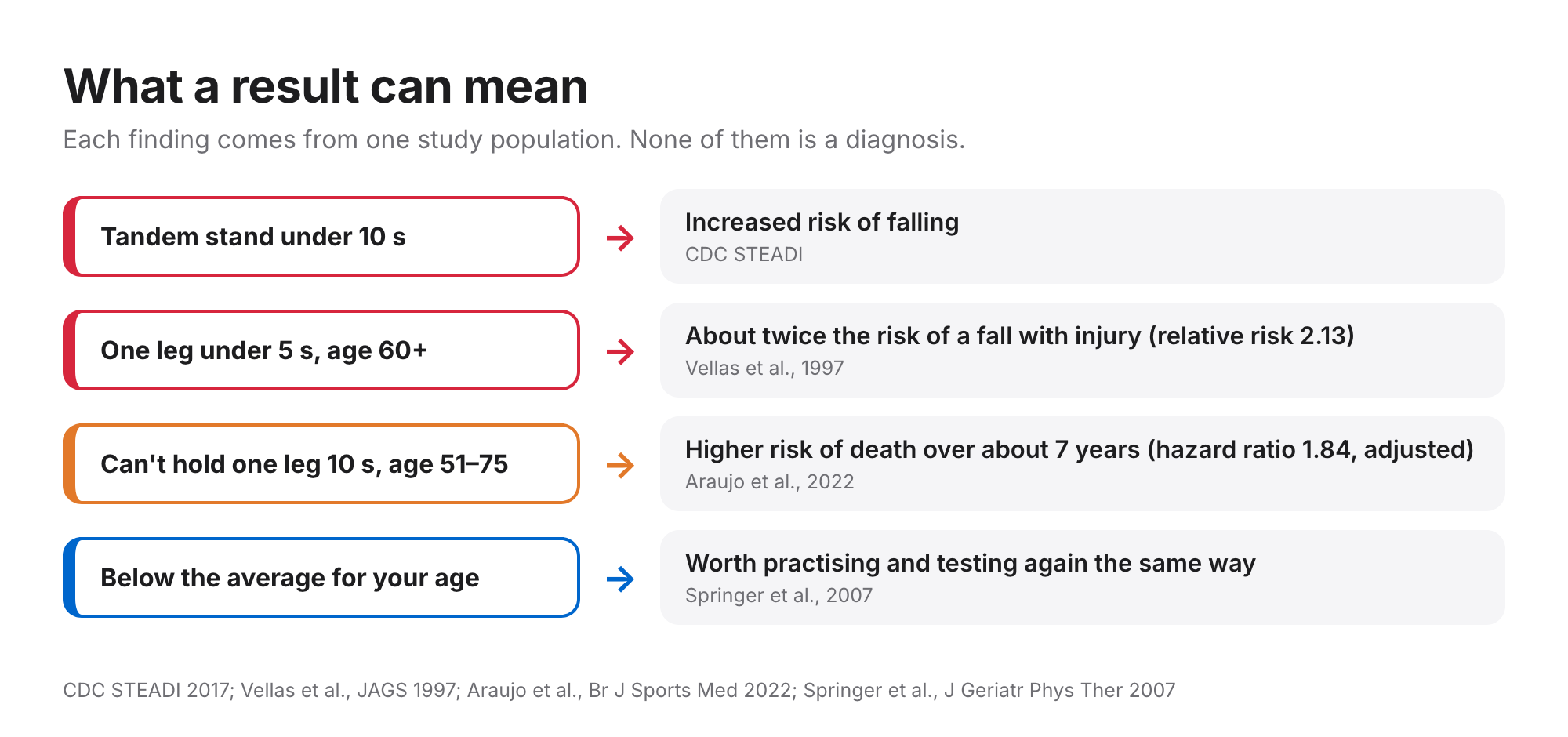
- Tandem stand under 10 seconds: increased risk of falling (CDC STEADI).
- Can't stand on one leg for 5 seconds: in 316 healthy adults over 60 followed for three years, this was the strongest single predictor of a fall with injury, with about twice the risk (relative risk 2.13). It didn't predict falls in general, and the authors stress that no single test is enough on its own (Vellas et al., 1997).
- Can't hold one leg for 10 seconds, age 51–75: in 1,702 people, the one in five who couldn't had a higher risk of death over a median of seven years (17.5% vs 4.6% died), and after adjusting for age, sex, body mass index and illnesses the hazard ratio was 1.84 (Araujo et al., 2022). That's an association: the test is a sign of overall fitness, not a cause.
Balance is one part of fall risk. Our fall-risk self-check adds the three STEADI questions, the Timed Up and Go and a home safety check, and the TUG normal times by age show how a walking test fits in. Usual walking speed is another quick marker; see average walking speed by age and the reference values for all of these tests.
Can balance improve?
Yes. A Cochrane review of 108 trials in older people living at home found that exercise programmes reduced the rate of falls by 23%. Programmes built mainly on balance and functional exercises reduced it by 24%, and Tai Chi may reduce it by 19% (Sherrington et al., 2019). Functional exercises are everyday movements done as training, such as standing up from a chair, stepping and reaching.
Simple ways to practise, always with something to hold on to:
- Stand on one leg at the kitchen counter while the kettle boils, holding on lightly, then with fingertips only.
- Walk heel to toe along the counter, one hand sliding along it.
- Stand up from a chair and sit down slowly a few times, without using your arms if you can.
- Join a Tai Chi or strength-and-balance class, or ask a physiotherapist for a programme.
The trials that worked used regular practice over months, so a little every day matters more than a hard session now and then. Repeat the test the same way every few weeks to see the change.
Questions
How long should I be able to stand on one leg? In healthy adults with eyes open, the average best of three tries was about 45 seconds under 40, about 41 seconds in the 40s and 50s, 32 seconds in the 60s, 22 seconds in the 70s and 9 seconds from 80 (Springer et al., 2007). With eyes closed it was 15 seconds under 40 and about 2 to 4 seconds after 60.
What is the 4-stage balance test? A CDC STEADI test with four positions held 10 seconds each: feet side by side, semi-tandem, tandem (heel to toe) and one foot. Not being able to hold the tandem stand for 10 seconds means an increased risk of falling.
Is not being able to stand on one leg for 10 seconds a concern? In adults aged 51 to 75 it was linked to a higher risk of death over about seven years, after adjusting for other factors (Araujo et al., 2022). It's a reason to talk to a doctor and train balance, not a diagnosis.
Is it safe to test balance at home? Yes, if you stand in front of a counter or sturdy chair, have someone beside you, clear the floor and start with eyes open. If you've fallen recently or feel unsteady, ask a physiotherapist to test you.
How can I improve my balance? Regular balance and functional exercise, such as one-leg stands at the counter, heel-to-toe walking and chair stands, or Tai Chi. In trials, balance-focused programmes reduced the rate of falls by about a quarter (Sherrington et al., 2019).
Step Doctor times the Timed Up and Go and measures walking speed from a phone video, so the same tests can be repeated at home and shared as a PDF report. Read more about the Timed Up and Go in Step Doctor, or get it on the App Store or Google Play.
Step Doctor supports screening and monitoring. It doesn't diagnose, and results should inform, not replace, the judgement of a healthcare professional.