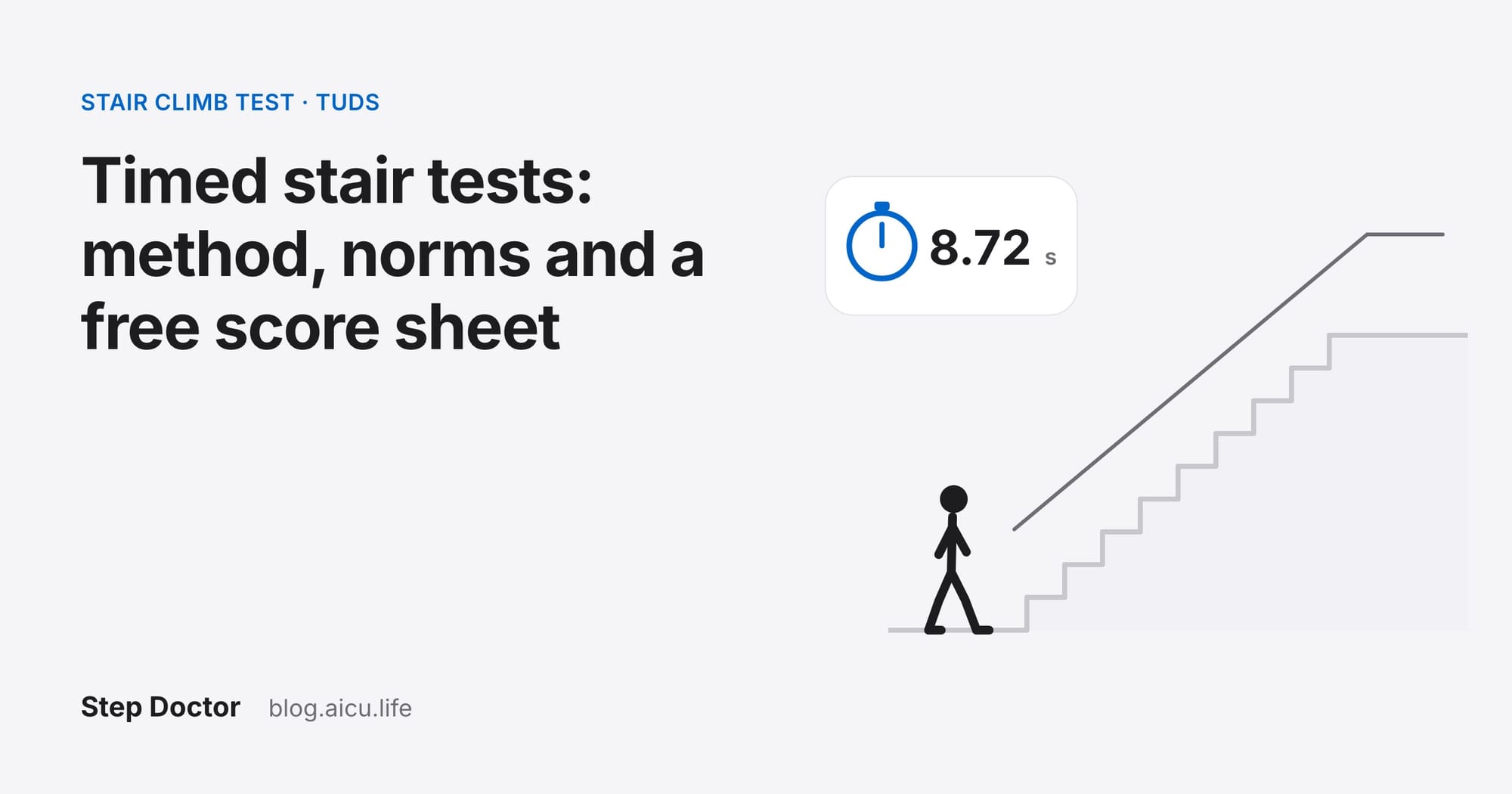
A timed stair test measures how long it takes to go up a flight of stairs, turn and come back down, as quickly as is safe. It goes by two names. The Timed Up and Down Stairs (TUDS) test was introduced for children (Zaino et al., 2004), and the Stair Climb Test is the version the Osteoarthritis Research Society International (OARSI) describes for adults with hip or knee osteoarthritis (Dobson et al., 2013). Both need only a flight of stairs and a stopwatch. This guide gives the standard method, the published reference values, how much change is real, why two results are only comparable on the same stairs, and a free score sheet to print.
TUDS and the Stair Climb Test: two names, one task
| Timed Up and Down Stairs (TUDS) | Stair Climb Test (SCT) | |
|---|---|---|
| Introduced in | 47 children aged 8–14, with and without cerebral palsy (Zaino et al., 2004) | OARSI's recommended tests for people over 40 with hip or knee osteoarthritis (Dobson et al., 2013) |
| Stairs | A 14-step flight in the original study; 10 steps of 16 cm in the largest set of child norms (del Corral et al., 2021) | 9 steps of 20 cm with a handrail where possible; steps of 16–20 cm are suitable |
| Instruction | Up as quickly but safely as possible, turn on the top step, all the way down | Up as fast but as safe as you can, turn, back down |
| Result | Total time in seconds, from "go" until both feet are back on the bottom landing. Shorter is better. |
In the original study the TUDS was highly reliable (intraclass correlation 0.94 or more between and within raters and on retest) and correlated with the Timed Up and Go (r = 0.78) (Zaino et al., 2004). OARSI puts a stair test in its minimal core set for hip and knee osteoarthritis but, because studies use different stairs, doesn't name a single version; its manual says how to run one consistently (Dobson et al., 2013).
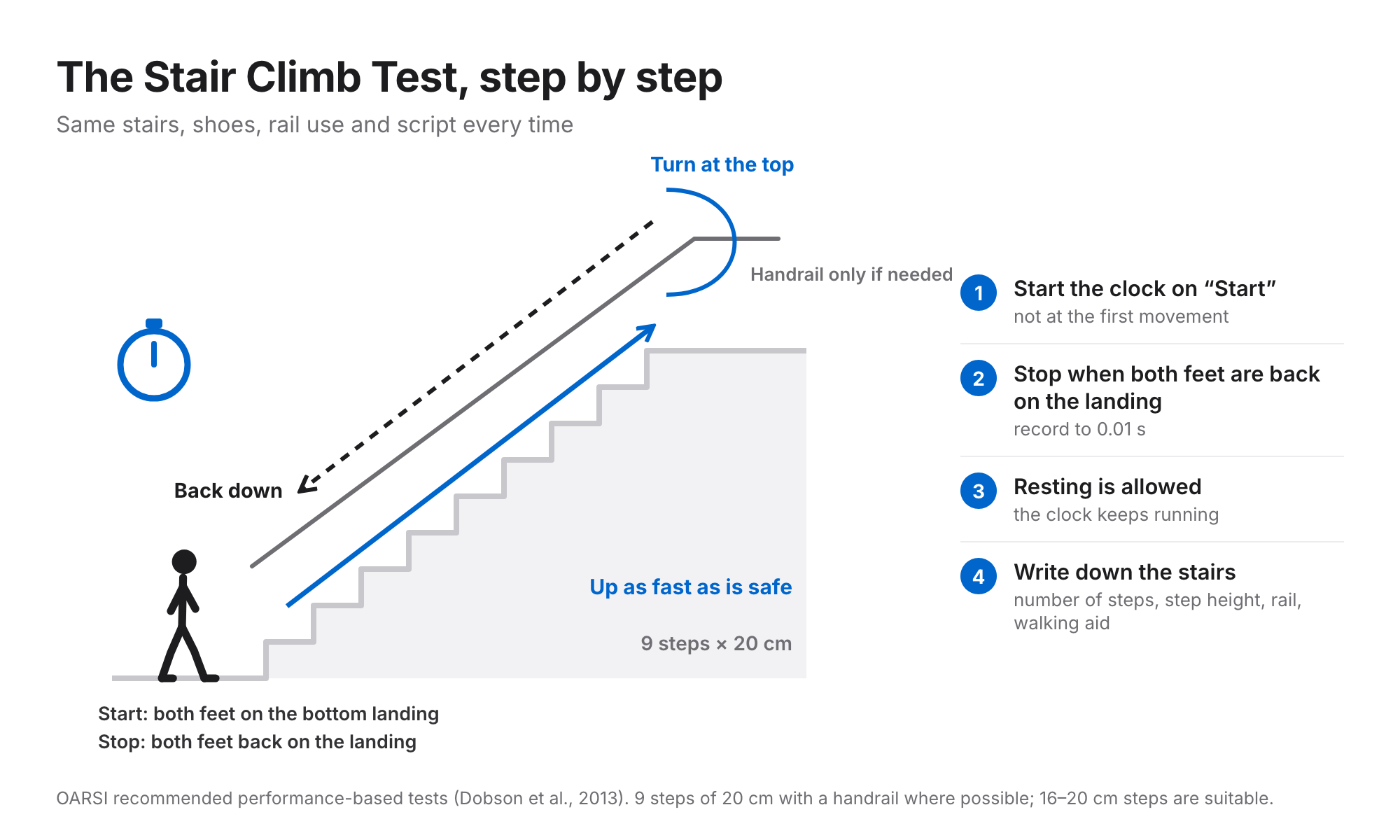
How to do the Stair Climb Test
The OARSI manual describes the test like this:
- Stairs: where possible, a flight of 9 steps 20 cm high with a handrail. Use the same stairs every time you retest, with good light and no traffic.
- Shoes: comfortable walking shoes. The person uses the walking aid they normally use, and the rail only if needed; both are recorded.
- Practice: one practice trial with the tester guarding, to check it's safe. If safety is a concern, guard from behind and below on the way up and from ahead or the side on the way down.
- Start: both feet on the bottom landing. Read the instructions: "For this test, do the best you can by going as fast as you can but don't push yourself to a point of overexertion or beyond what you think is safe for you. Start with both feet on the bottom landing. On start, go to the top of the stairs as fast but as safe as you can, turn around and return back down and stop with both feet back on the ground landing. Use the rail only if needed. Get ready and START."
- Timing: start the clock on the signal and stop it when both feet are back on the ground. Record to the nearest hundredth of a second. The person may stop and rest, but the clock keeps running.
- Record: the number of steps, the step height, rail use (up, down or both, and which side) and any walking aid.
The TUDS used for children is the same task with small differences: the child starts 30 cm from the bottom step, turns on the top step, mustn't run, jump or skip steps, and the better of two trials counts (del Corral et al., 2021).
Reference values for adults
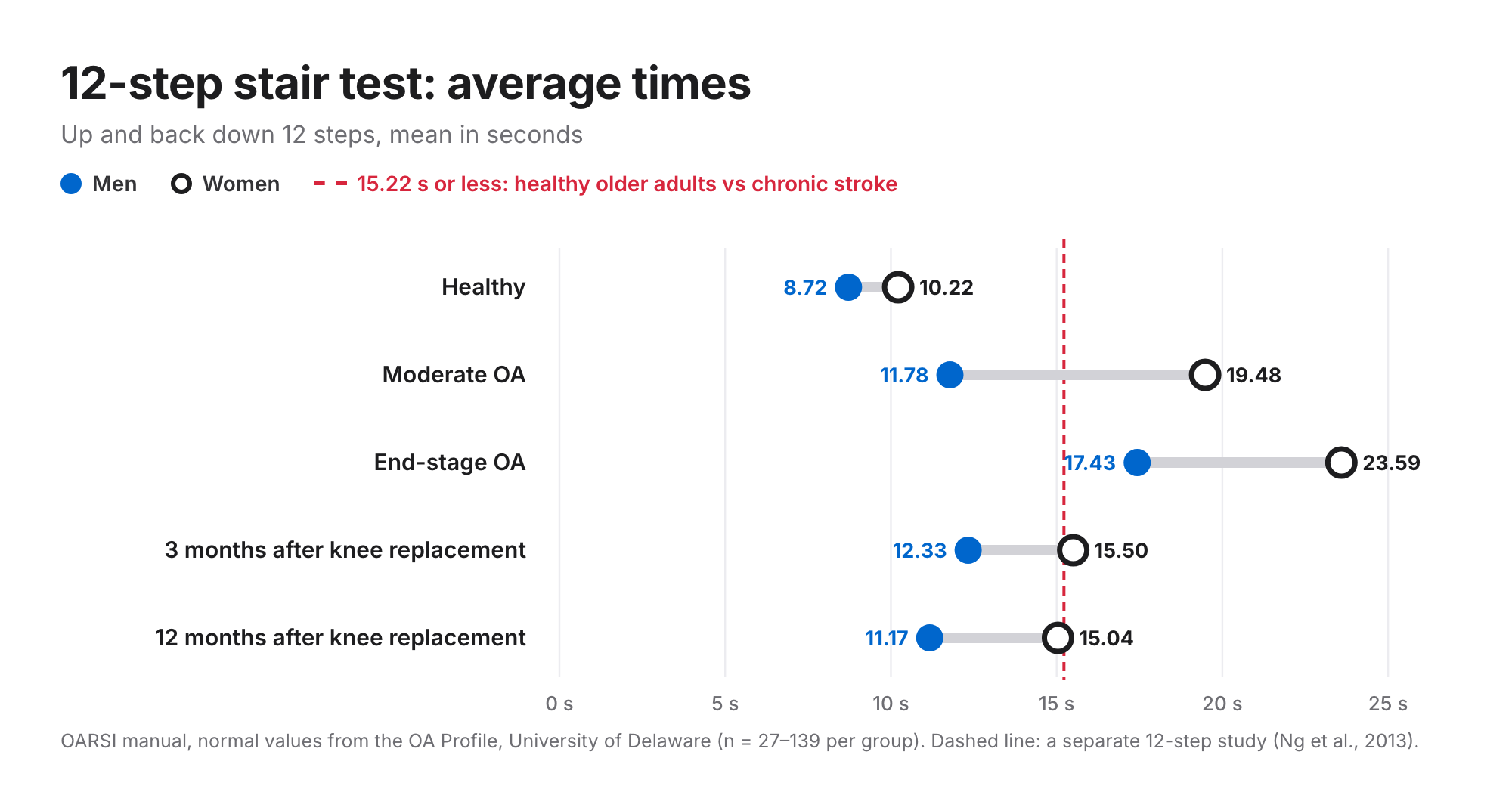
12-step stair test. The OARSI manual lists normal values only for a 12-step test, from the University of Delaware's osteoarthritis data (Dobson et al., 2013, Appendix 2):
| Group | Men, mean (SD) | Women, mean (SD) |
|---|---|---|
| Healthy | 8.72 s (2.58), n = 27 | 10.22 s (2.61), n = 38 |
| Moderate osteoarthritis | 11.78 s (4.70) | 19.48 s (9.30) |
| End-stage osteoarthritis | 17.43 s (8.35) | 23.59 s (9.81) |
| 3 months after knee replacement | 12.33 s (4.87) | 15.50 s (4.85) |
| 12 months after knee replacement | 11.17 s (3.85) | 15.04 s (6.17) |
The manual doesn't give the ages of the healthy group, so treat these as a rough guide rather than age norms.
Stroke. In a separate study of a 12-step ascend and descend test, a time of 15.22 seconds or less separated healthy older adults from people with chronic stroke (Ng et al., 2013).
Three steps in adults over 70. In 513 community-dwelling adults aged 70 and over (mean age 80.8), going up 3 steps took 2.78 s on average (SD 1.49) and coming down 2.83 s (SD 1.61). Each extra second went with a 12% (up) and 15% (down) higher risk of functional decline during follow-up (mean 1.8 years), after adjusting for walking speed and other factors (Oh-Park et al., 2011).
TUDS norms for children
In 258 healthy children in Madrid on 10 steps of 16 cm, average times were (del Corral et al., 2021):
| Age | Boys, mean (SD) | Girls, mean (SD) |
|---|---|---|
| 6–8 years | 6.27 s (0.65) | 6.68 s (0.77) |
| 9–11 years | 5.22 s (0.61) | 5.66 s (0.68) |
| 12–14 years | 4.82 s (0.60) | 5.31 s (0.62) |
The same paper gives reference equations from age, height and weight. Children in the original 14-step study were slower (8.8 s at 8–10 and 7.3 s at 13–14, as reported by del Corral et al.), which shows how much the flight changes the time.
How much change is real
- 9-step test, end-stage hip or knee osteoarthritis awaiting joint replacement: the smallest change beyond measurement error (MDC90) was 5.5 seconds (Kennedy et al., 2005).
- 11-step test after knee replacement: MDC90 2.6 seconds (Almeida et al., 2010).
- 3 steps, adults over 70: about 0.5 seconds slower was proposed as a meaningful decline and about 0.2 seconds faster as a meaningful improvement (Oh-Park et al., 2012).
A change smaller than these can be day-to-day variation. Retest on the same stairs, with the same instructions, shoes and rail use.
Why results only compare on the same stairs
A review of 88 studies found that timed stair tests used very different methods: ascent only, descent only or both, different numbers and heights of steps, and different instructions. Times rose with age and with many medical conditions, but there wasn't enough data for general normative values. The authors recommended timing ascent and descent together and asking people to go as quickly and safely as possible (Nightingale et al., 2014). In practice:
- Compare a result with a reference only if the number and height of steps match.
- Write the stairs down on the score sheet, so the next tester can use the same ones.
- Your own earlier results on the same stairs are often the most useful comparison.
Free stair test score sheet (PDF)

Download the stair test score sheet (PDF, A4). One page with the stairs and conditions, the OARSI instructions to read aloud, timing rules, five dated trials and the reference values above. Print and copy it as often as you like.
A stair test sits well next to other short tests: the Timed Up and Go, the five times sit-to-stand and a gait speed test. For falls at home, see the fall-risk self-check.
Questions
What is the Timed Up and Down Stairs (TUDS) test? A timed test of going up a flight of stairs, turning and coming back down as quickly as is safe. It was introduced in children with and without cerebral palsy and showed excellent reliability (Zaino et al., 2004).
How many steps are used in the Stair Climb Test? OARSI recommends 9 steps of 20 cm with a handrail where possible, and says steps of 16–20 cm are suitable. Other studies used 3, 4, 10, 11, 12 or 14 steps, so always record the number and height of the steps.
What is a normal stair climb test time? On a 12-step test, healthy men averaged 8.72 seconds and healthy women 10.22 seconds (OARSI manual). On 3 steps, adults over 70 took about 2.8 seconds up and 2.8 seconds down (Oh-Park et al., 2011). Compare only with a test on the same number and height of steps.
Can I use the handrail during the stair test? Yes, if needed. OARSI allows the handrail and the usual walking aid, and asks you to record which you used so the next test is done the same way.
How much does a stair test time have to change to be real? It depends on the test and the people: 5.5 seconds on a 9-step test in end-stage hip or knee osteoarthritis, 2.6 seconds on an 11-step test after knee replacement, and about 0.5 seconds slower on 3 steps in adults over 70.
Step Doctor doesn't time stairs. It times the Timed Up and Go and its phases and measures walking speed from a phone video with voice cues, and keeps each result in a PDF report, so you can follow mobility alongside a stair test. Read more about the Timed Up and Go in Step Doctor, or get it on the App Store or Google Play.
Using this with patients? Request early clinic access.
Step Doctor measures and records movement tests. It doesn't diagnose, and results should inform, not replace, the judgement of a healthcare professional.