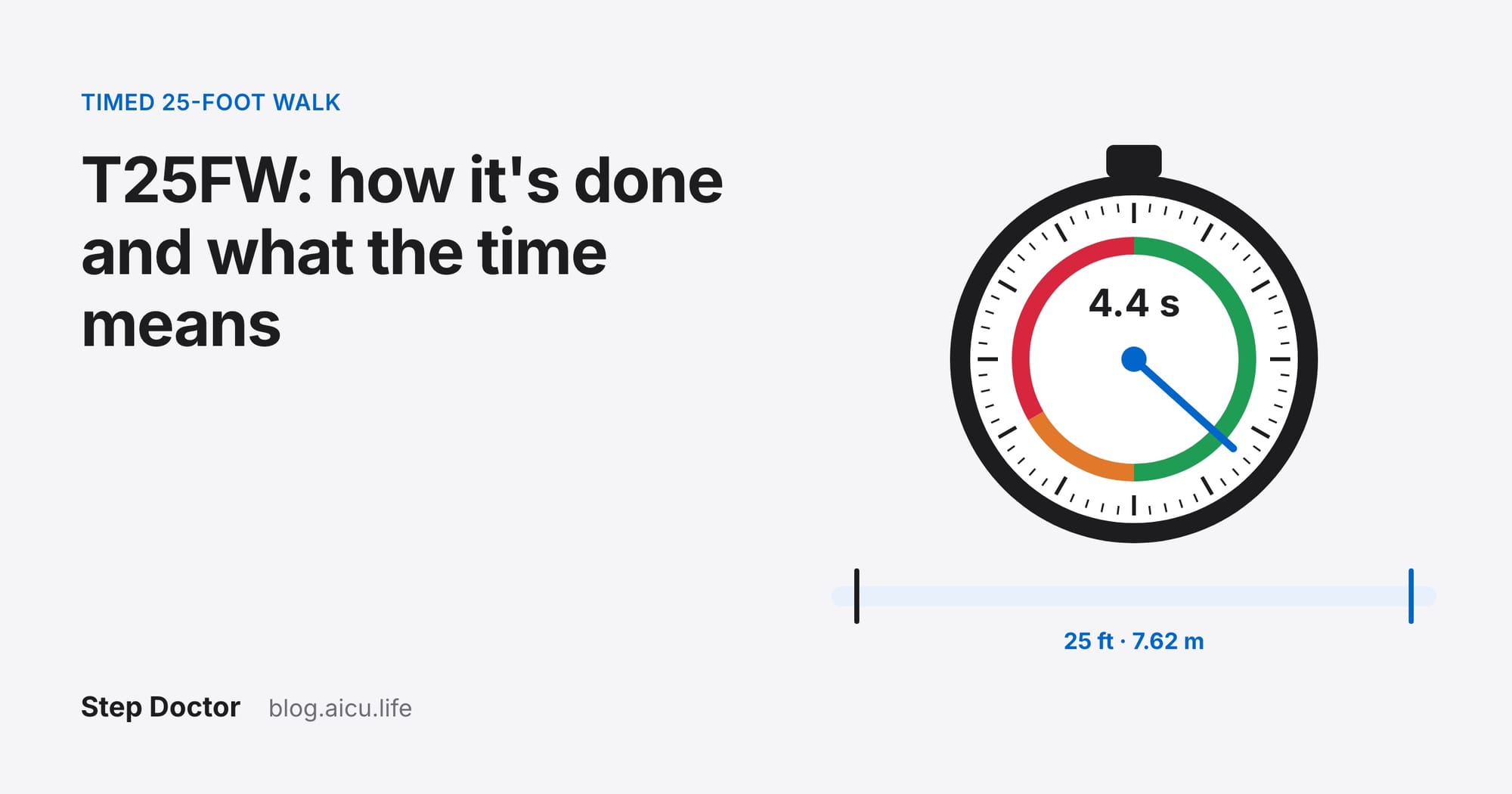
The Timed 25-Foot Walk (T25FW) asks one thing: how many seconds it takes to walk 25 feet (7.62 m) as quickly as you safely can. It is the first part of the Multiple Sclerosis Functional Composite (Fischer et al., 1999) and one of the most widely used walking measures in multiple sclerosis (MS) research. This guide covers the standard procedure, what healthy people score, the 6- and 8-second benchmarks, how much change matters, and why a T25FW time can't be swapped for a 10-metre walk result.
How to do the T25FW
The procedure as summarised by the MS Outcome Assessments Consortium (Motl et al., 2017):
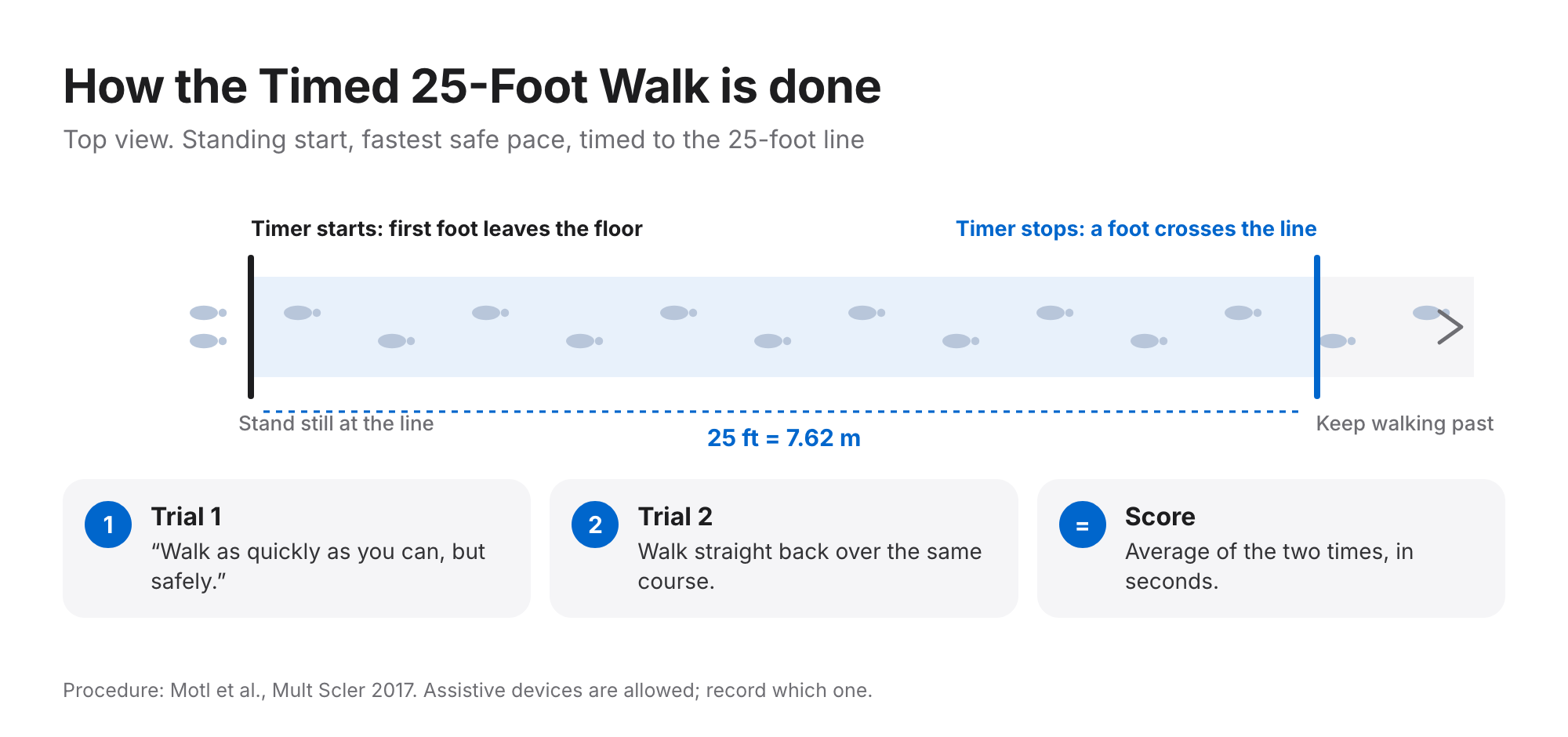
- A straight, clearly marked 25-foot (7.62 m) course with no turns, and room to keep walking past the end line.
- The person starts standing still at the start line. The instruction is to walk as quickly as possible, but safely.
- Start timing when the first foot leaves the floor and stop when a foot crosses the 25-foot line. The person walks through the line before slowing down.
- Do it twice (the second trial walks back over the same course) and average the two times. The score is in seconds; speed is 7.62 m divided by the time.
- Canes, walkers and orthoses are allowed. Record which one was used, and use the same one next time.
Some trial protocols start the clock at the instruction to begin instead of the first step (example protocol, NCT03799718). Either works if you use the same rule every time and write it down.
What is a normal T25FW time?
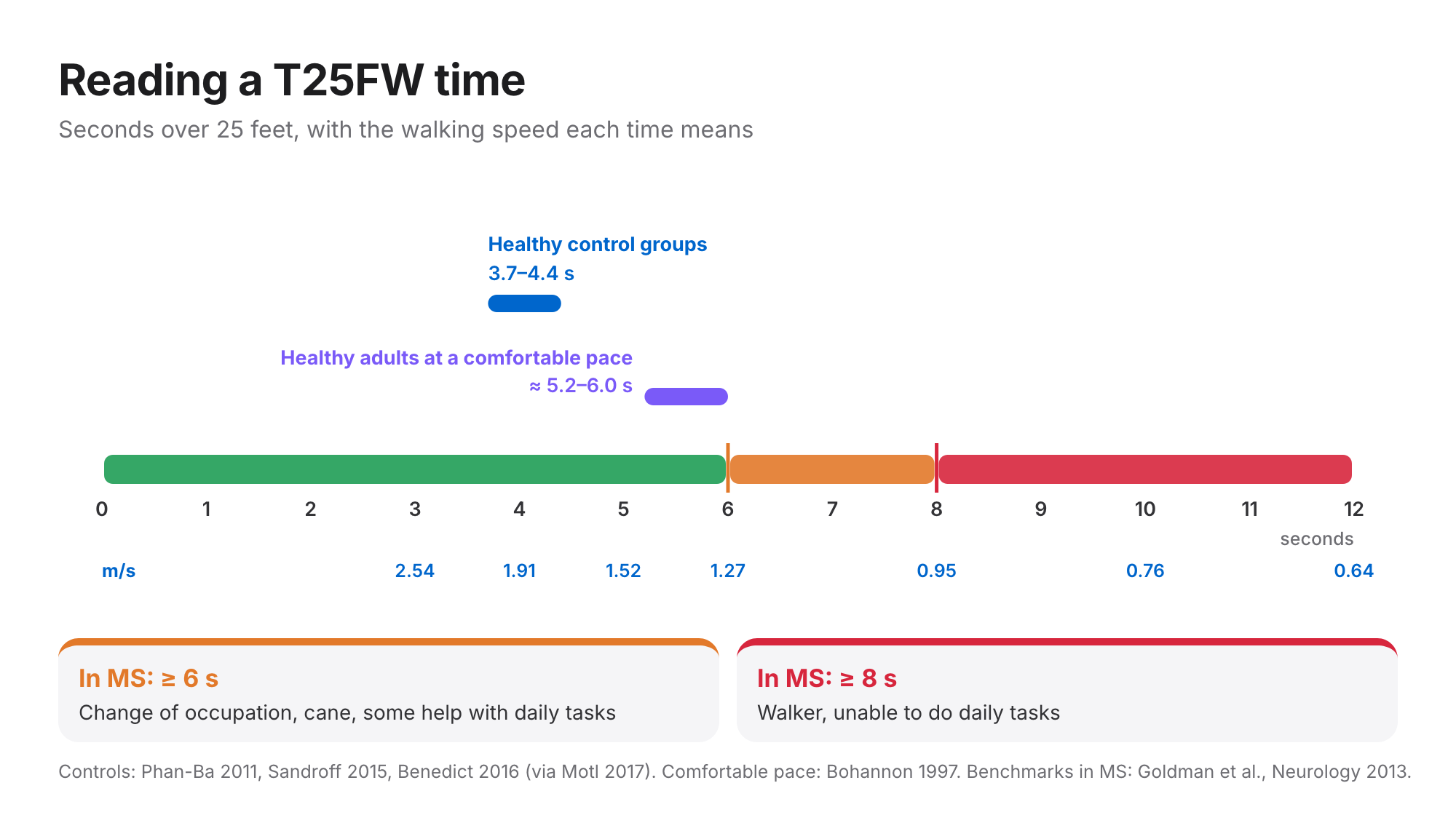
There is no official normative table, but healthy control groups in MS studies give a clear picture. They took about 3.7 seconds in two studies (104 and 31 controls) and 4.4 seconds in a third (109 controls), as reviewed by Motl et al. (2017). In the same studies, people with MS took 4.4 to 9.2 seconds, depending mostly on how much disability the group had.
A meta-analysis of the published studies found that people with MS took 2.4 seconds longer than healthy controls on average, and that people with moderate or severe disability took 5.4 seconds longer than those with mild disability (Sikes et al., 2020).
The healthy-adult reference values fit. Over the same 7.62 m, 230 healthy adults aged 20–79 reached average maximum speeds of 1.75 to 2.53 m/s (Bohannon, 1997), which is about 3.0 to 4.4 seconds. At their comfortable pace they walked 1.27 to 1.46 m/s, or about 5.2 to 6.0 seconds. That is the most practical point in this guide: a healthy person who strolls the course can land near 6 seconds, so the "fastest safe" instruction has to be given the same way every time.
The 6- and 8-second benchmarks
In people with MS, two times stand out (Goldman et al., 2013):
| T25FW | Speed | What it went with in people with MS |
|---|---|---|
| Under 6 s | over 1.27 m/s | The reference group |
| 6 to 7.99 s | 0.95–1.27 m/s | A change of occupation because of MS, occupational disability, walking with a cane, needing "some help" with everyday tasks such as shopping or cooking |
| 8 s or more | under 0.95 m/s | Disability income and public health insurance, walking with a walker, being unable to do those everyday tasks |
The benchmarks come from 159 people with MS and were then checked prospectively in 95 more: the three groups differed on 12 of 13 measures of walking, cognition and self-reported function. The authors call them proposed benchmarks and ask for larger, longitudinal studies. They were derived in MS, so treat them as MS reference points, not general cut-offs for older adults. For older adults, speed thresholds such as 0.8 and 1.0 m/s are more common; see average walking speed by age.
How much change is meaningful?
A 20% change is the accepted threshold for a real change on the T25FW (Motl et al., 2017):
- It goes beyond test noise. In two drug trials with 533 people with MS, the T25FW speed of the same person varied by 7.2–8.7% within a visit and by 14.4–16.3% between visits (Hobart et al., 2013).
- People notice it. In the same trials, speed gains above 20%, and possibly 15%, went with meaningful improvement in self-reported walking ability.
- It matters when things get worse, too. In 527 patients followed for at least a year, those whose time worsened by more than 20% also reported more disability in daily life, mostly in leg function and fatigue (Kragt et al., 2006).
In practice: a person who walked 6.0 seconds needs to reach about 7.2 seconds before you call it a worsening, and 5.0 seconds before you call it an improvement (speed up by 20%). Anything smaller can be day-to-day variation.
T25FW vs the 10-metre walk test
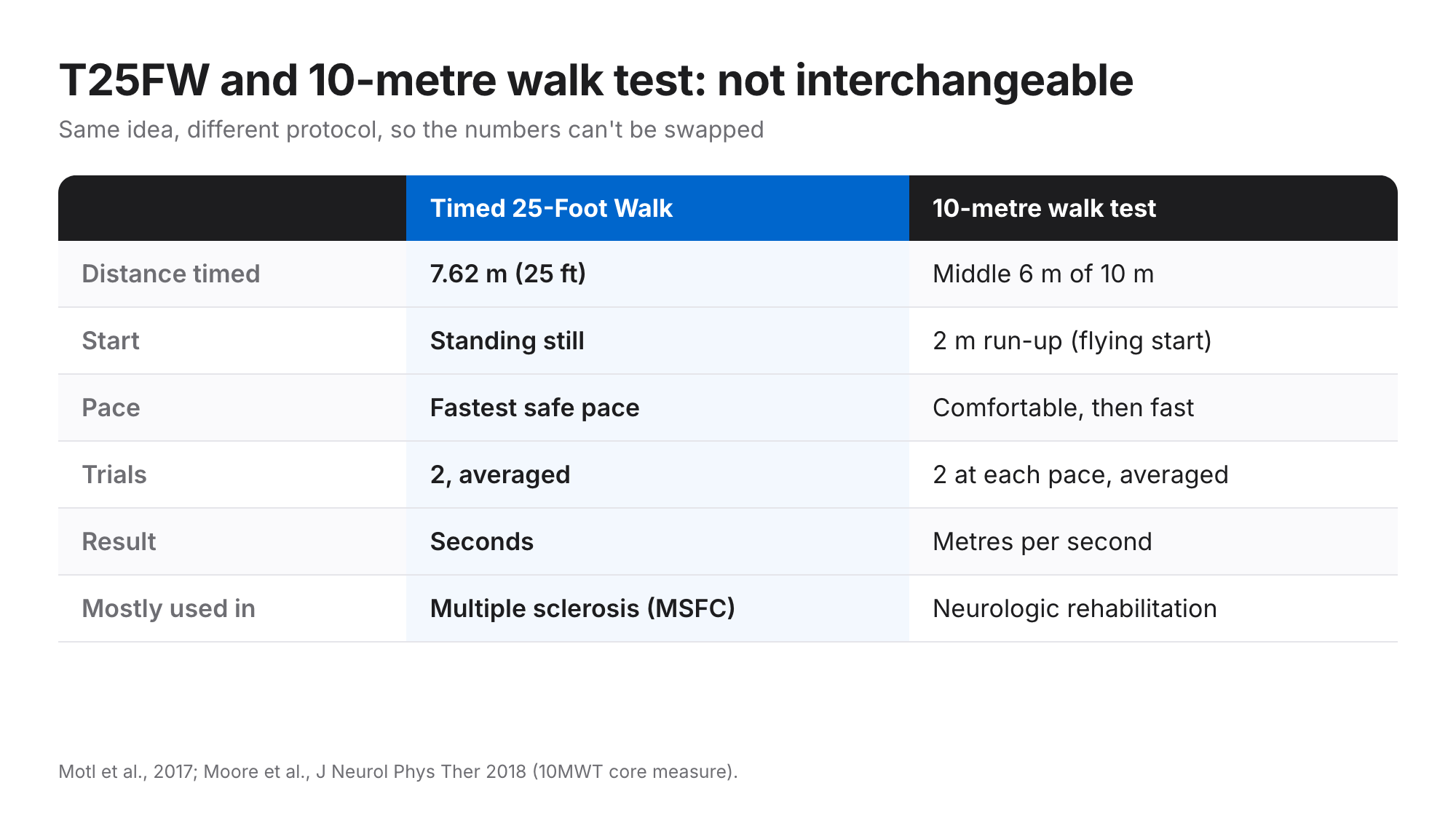
Both time a short walk, but the protocols differ in the ways that change the number most. The T25FW starts from standing and asks for the fastest safe pace; the 10-metre walk test times only the middle 6 m after a 2 m run-up and is usually done at a comfortable and then a fast pace (Moore et al., 2018). A standing start includes the acceleration, so it reads slower: in one study, people with MS walked faster on average over 100 metres than over 25 feet, which led the authors to conclude that the T25FW may underestimate their maximum walking speed (Phan-Ba et al., 2011).
So convert with care. A T25FW of 6 seconds is 1.27 m/s, but that is a fast-pace, standing-start speed, and it can't be compared with a comfortable-pace 10MWT result or with usual-pace thresholds. Keep each person on one test.
What the T25FW doesn't tell you
- Only speed. It says nothing about how the person walks: step length, symmetry or balance.
- Short distance. It misses fatigue that shows up over longer walks. In a study of MS relapses, a 2-minute walk picked up change better than the T25FW (summarised by Motl et al., 2017).
- A floor effect. People who can't walk 25 feet, even with help, can't be scored.
- Strong reliability. Test-retest agreement is excellent (ICC 0.94–0.99 across studies), which is why a 20% change can be read with confidence.
How to document it
Record the two times and their average, the assistive device, the instruction used and anything unusual (a stumble, a rest). A sample line:
T25FW: 6.42 s and 6.18 s, mean 6.30 s (1.21 m/s). Single-point cane, right hand. Standard instruction, standing start. Previous 5.20 s on 3 Mar: +21%, a clinically meaningful worsening (≥ 20%).
Questions
What is the Timed 25-Foot Walk? A test that times how long it takes to walk 25 feet (7.62 m) as quickly as possible but safely, from a standing start. Two trials are averaged. It is part of the Multiple Sclerosis Functional Composite.
What is a normal T25FW score? Healthy control groups averaged about 3.7 to 4.4 seconds. In people with MS, 6 seconds or more and 8 seconds or more mark meaningful levels of walking disability (Goldman et al., 2013).
What is a clinically significant change in the T25FW? A change of 20% or more. Smaller changes can be day-to-day variation (Hobart et al., 2013; Kragt et al., 2006).
What is the difference between the T25FW and the 10-metre walk test? The T25FW times 7.62 m from a standing start at the fastest safe pace and reports seconds. The 10MWT times the middle 6 m of a 10 m path after a run-up, at comfortable and fast pace, and reports m/s. Their results aren't interchangeable.
Can you use a walker or cane for the T25FW? Yes. Assistive devices are allowed; record which one so the next test uses the same.
How do you convert a T25FW time to walking speed? Divide 7.62 m by the time in seconds. 6 seconds is 1.27 m/s and 8 seconds is 0.95 m/s.
Step Doctor measures walking speed, step length and cadence from a phone video and keeps each walk in a PDF report, so the same walk can be repeated and compared over time. It measures a usual-pace walk, not the T25FW itself. Read more about gait analysis in Step Doctor, or get it on the App Store or Google Play.
Using this with patients? Request early clinic access.
Step Doctor measures and records movement tests. It doesn't diagnose, and results should inform, not replace, the judgement of a healthcare professional.