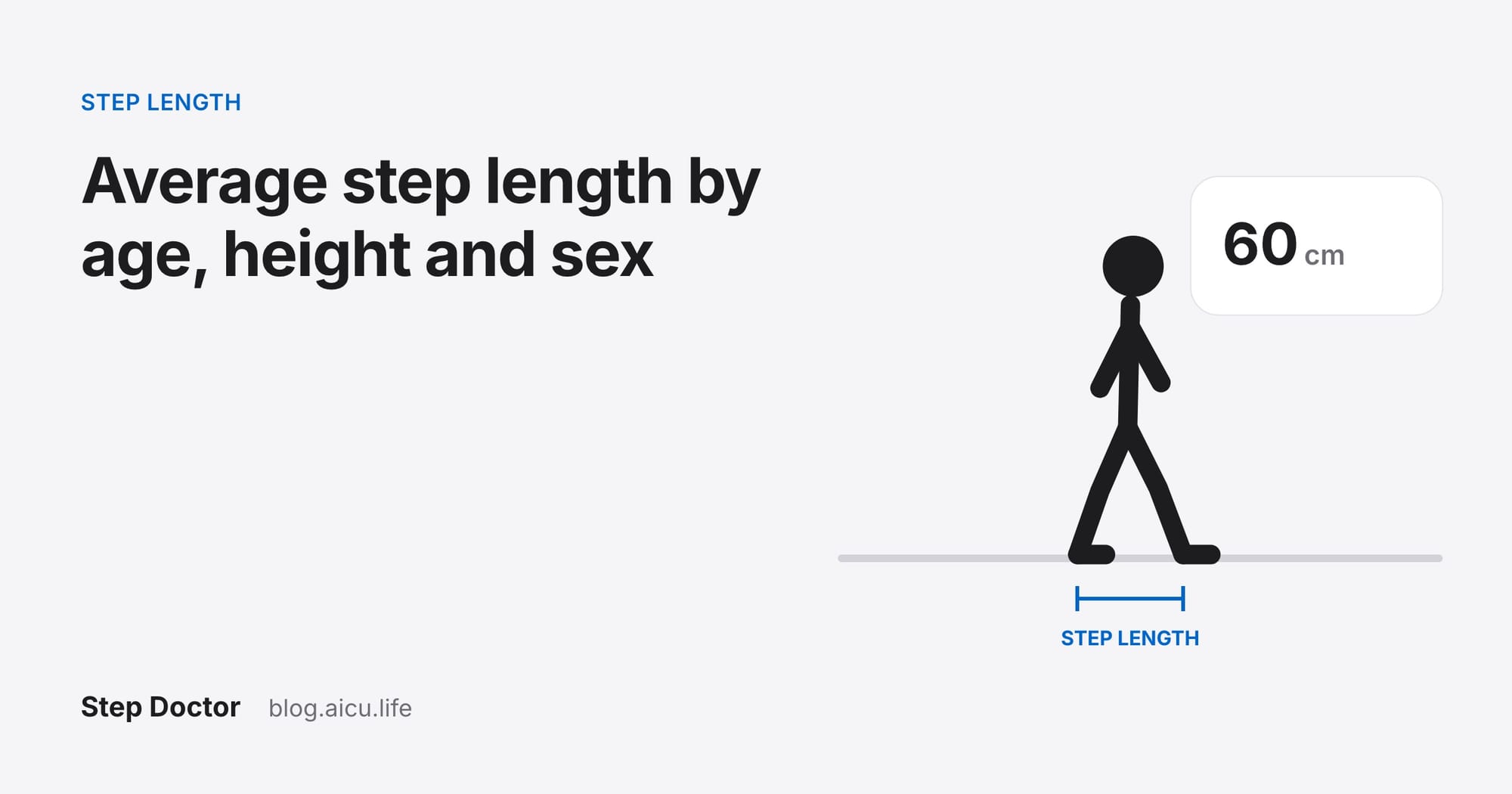
Step length is the distance from the heel of one foot to the heel of the other as you walk. In healthy adults aged 21 to 70 walking at their usual pace, average steps were about 60–63 cm (24–25 in) for men and 55–60 cm (22–23.5 in) for women, measured barefoot on an instrumented walkway (Lau et al., 2020). After 70, steps get shorter: to about 45–48 cm on average after 80. Taller people take longer steps, so this guide gives the averages by age and sex, a range by height and age, and a 2-minute way to measure your own.
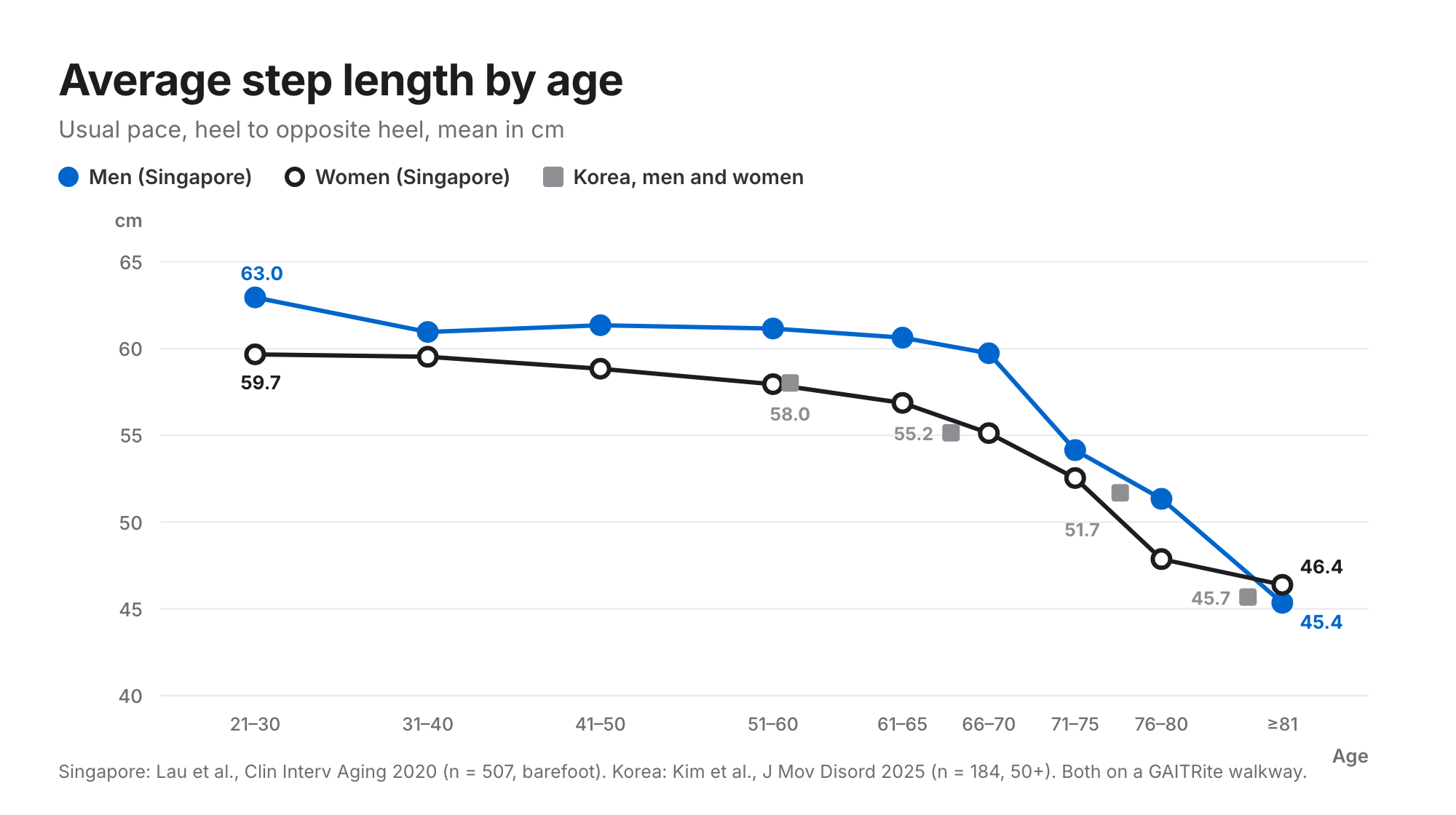
Average step length by age and sex
The Yishun Study measured 507 community-dwelling adults aged 21–90 in Singapore, walking barefoot at a habitual pace on a GAITRite walkway, three trials each (Lau et al., 2020). Mean step length:
| Age | Men | Women |
|---|---|---|
| 21–30 | 63.0 cm (24.8 in) | 59.7 cm (23.5 in) |
| 31–40 | 61.0 cm (24.0 in) | 59.5 cm (23.4 in) |
| 41–50 | 61.4 cm (24.2 in) | 58.8 cm (23.2 in) |
| 51–60 | 61.2 cm (24.1 in) | 58.0 cm (22.8 in) |
| 61–65 | 60.6 cm (23.9 in) | 56.9 cm (22.4 in) |
| 66–70 | 59.7 cm (23.5 in) | 55.1 cm (21.7 in) |
| 71–75 | 54.2 cm (21.3 in) | 52.5 cm (20.7 in) |
| 76–80 | 51.3 cm (20.2 in) | 47.9 cm (18.9 in) |
| 81 and over | 45.4 cm (17.9 in) | 46.4 cm (18.3 in) |
Men's steps were longer, but men were also taller (166.8 cm vs 155.3 cm on average). Divided by height, women's steps were slightly longer than men's (Lau et al., 2020).
Older adults: two more data sets
United States, 70 and over. In 294 adults without conditions affecting gait, from the Mayo Clinic Study of Aging, walking at their normal pace on a GAITRite walkway (Hollman et al., 2011):
| Age | Men | Women |
|---|---|---|
| 70–74 | 69 cm | 61 cm |
| 75–79 | 68 cm | 59 cm |
| 80–84 | 65 cm | 55 cm |
| 85 and over | 59 cm | 54 cm |
Korea, 50 and over. In 184 healthy Korean adults (90 men, 94 women), average steps were 58.0 cm in their 50s, 55.2 cm in their 60s, 51.7 cm in their 70s and 45.7 cm in their 80s, for men and women together (Kim et al., 2025). The authors note that their speeds and step lengths were lower than in Western studies and suggest shorter average height and leg length as one reason.
So the same age can mean quite different numbers from one population to another. Compare yourself with a group like you, and above all with your own earlier results.
Step length by height
Step length grows with height (Kim et al., 2025). In the Yishun data, barefoot steps were 0.36–0.38 of height on average up to age 70, falling to 0.28–0.31 after 80 (Lau et al., 2020). For someone 170 cm tall, 0.37 × 170 gives about 63 cm.
Many online step calculators multiply height by about 0.41. That gives longer steps than were measured in these walkway studies, and the gap grows with age, so a measured step length is more reliable than a formula.
The Korean study also gives a typical range that accounts for both age and height: the 10th and 90th percentiles of step length (valid for ages 53–90 and heights 137–182 cm; Kim et al., 2025). Worked out for a few heights:
| Height | Age 60 | Age 70 | Age 80 |
|---|---|---|---|
| 150 cm | 48–60 cm | 42–58 cm | 36–56 cm |
| 160 cm | 50–64 cm | 44–62 cm | 38–60 cm |
| 170 cm | 52–69 cm | 46–66 cm | 40–64 cm |
A step below the lower number is shorter than 9 in 10 healthy people of that age and height in the study. It's a reason to look more closely, not a diagnosis.
Step length or stride length?
A stride is two steps: from one heel strike to the next heel strike of the same foot. In the Korean data, average stride length was 116.7 cm in the 50s and 91.9 cm in the 80s, about twice the step length (Kim et al., 2025). Apps and step counters don't always use the words the same way, so check which one a number means before comparing. Our gait parameters guide explains the other measures.
How to measure your own step length
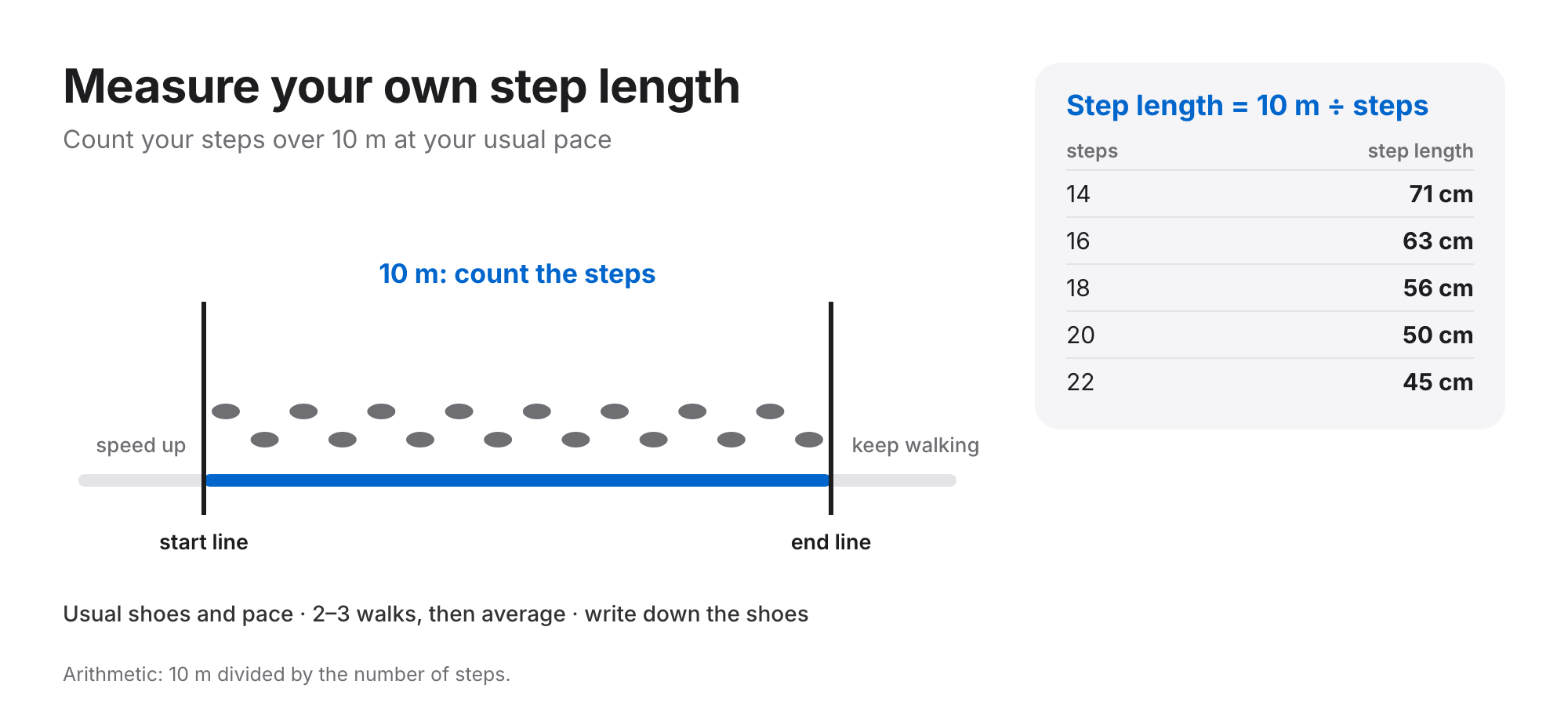
- Mark a straight 10 m stretch, with a couple of extra metres before and after so you're at full pace when you cross the start line and still walking when you cross the end.
- Walk it at your usual pace, in the shoes you normally wear, and count your steps between the two lines.
- Divide: step length = 10 m ÷ number of steps. 16 steps is 62.5 cm; 20 steps is 50 cm.
- Do it two or three times and take the average. Write down the shoes: in the Korean study, walking in shoes gave longer steps than walking barefoot (Kim et al., 2025), and most of the averages above were measured barefoot.
If you time the same walk, you also get your speed (10 m ÷ seconds) and cadence (steps ÷ seconds × 60). The three are linked: speed = step length × cadence ÷ 60.
Why step length matters
As people age, walking slows mainly because steps get shorter. In the Yishun men, cadence stayed at 109–114 steps per minute in every age group, while step length fell from 63 cm in the twenties to 45 cm after 80 (Lau et al., 2020). In the Korean study, step length fell with age, and so did speed (Kim et al., 2025). That makes step length a useful number to watch next to walking speed and cadence: it shows where a change in speed comes from.
Questions
What is the average step length for an adult? About 60–63 cm (24–25 in) for men and 55–60 cm (22–23.5 in) for women aged 21–70, walking barefoot at their usual pace (Lau et al., 2020). Taller people take longer steps.
What is a normal step length for a 70-year-old? In US adults aged 70–74, averages were 69 cm for men and 61 cm for women (Hollman et al., 2011). In Singapore, ages 71–75 averaged 54 cm (men) and 53 cm (women), and in Korea people in their 70s averaged 52 cm (Lau et al., 2020; Kim et al., 2025).
How do I calculate step length from height? In walkway studies, barefoot steps were about 0.37 of height up to age 70 (Lau et al., 2020), less after that. Counting your steps over a measured 10 m is more reliable than any formula.
What is the difference between step length and stride length? A step runs from one heel to the other heel; a stride is two steps, from one heel strike to the next strike of the same foot. Stride length is about twice the step length.
Why do older people take shorter steps? In the studies above, step length fell with age, mostly after 70, while cadence changed little, so shorter steps account for most of the slower walking speed in older age.
Step Doctor measures step length, walking speed and cadence from a phone video and keeps each walk in a PDF report so you can see the trend. Read more about gait analysis in Step Doctor, or get it on the App Store or Google Play.
Step Doctor supports screening and monitoring. It doesn't diagnose, and results should inform, not replace, the judgement of a healthcare professional.