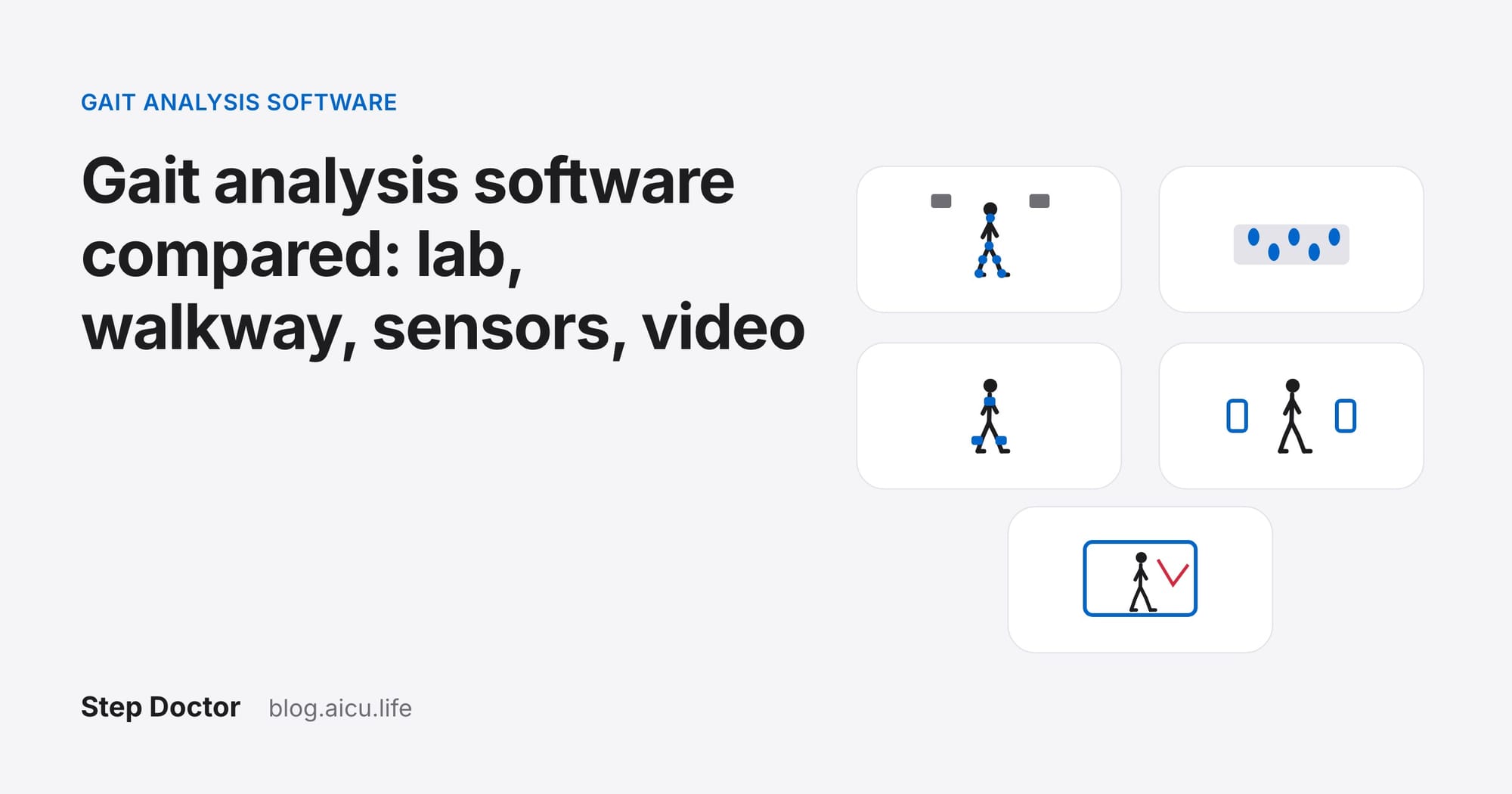
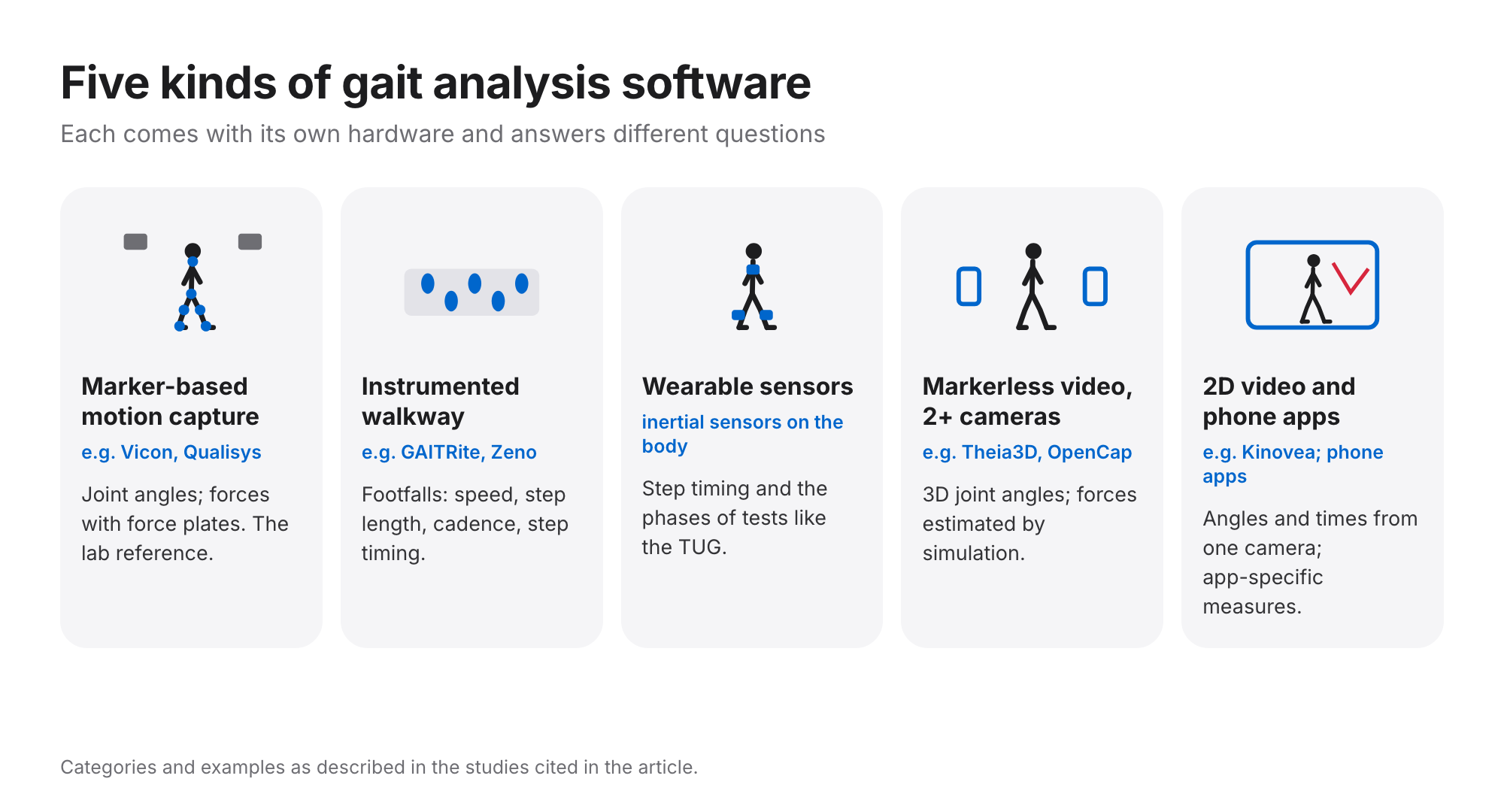
"Gait analysis software" covers very different systems. Each comes with its own hardware: reflective markers and infrared cameras, a sensor-filled walkway, sensors worn on the body, several synchronised video cameras, or a single camera or phone. What you can measure (step timing and length, joint angles, or the forces at the joints), where you can measure it and what it costs all follow from that choice. This guide compares the five kinds, what the published studies show about each, the free options, and how to choose for a clinic, a lab or repeated testing outside one.
1. Marker-based motion capture: the lab reference
Reflective markers are placed on the skin over landmarks and tracked by several infrared cameras; software such as Vicon's or Qualisys' reconstructs the skeleton in 3D. With force plates in the floor, a lab can also compute the forces and moments at the joints. It's the reference that other systems are validated against, as in the studies below, but it is time-intensive and needs highly trained operators (Kanko et al., 2021).
Best for: research, surgical planning and complex cases where joint angles and forces in 3D are needed.
2. Instrumented walkways
A portable mat with pressure sensors records each footfall as the person walks over it; GAITRite and Zeno are common examples. The software computes speed, step and stride length, cadence and the timing of each step, but not joint angles.
- In 25 healthy adults, GAITRite agreed very closely with a validated stride analyser for gait speed, stride length and cadence (intraclass correlation 0.99), less well for single support (0.69–0.91) and weakly for double support (Bilney et al., 2003).
- Against marker-based capture (Vicon) in 10 adults aged 54–83 after knee replacement, averaged speed, cadence, step length and step time agreed with intraclass correlations of 0.92–0.99, and individual steps were within 1.5 cm and 0.02 s on 80–94% of occasions (Webster et al., 2005).
Best for: clinics that want reliable spatiotemporal measures in a corridor.
3. Wearable inertial sensors
Small sensors with accelerometers and gyroscopes are strapped to the feet, legs, trunk or arms. Software detects steps and turns and can split a test into its parts. In an instrumented Timed Up and Go (iTUG), sensors separated sit-to-stand, walking, the 180° turn and turn-to-sit. In early Parkinson's disease the stopwatch time didn't differ from controls, but the sensors found slower cadence (111.1 vs 120.4 steps/min), less arm swing and longer turns (2.18 vs 1.79 s) (Salarian et al., 2010).
Best for: the phases of clinical tests, turning, and walking outside a lab.
4. Markerless video with two or more cameras
Deep-learning pose estimation finds body landmarks in synchronised videos and a biomechanical model turns them into 3D motion, with no markers on the body.
- Theia3D (commercial). With eight video cameras on 30 healthy adults on a treadmill, joint centres were within 2.5 cm of marker-based capture (3.6 cm at the hip) and segment angles within 5.5°, except rotations about a segment's long axis (Kanko et al., 2021). Spatiotemporal measures agreed well with marker-based capture and a gait mat, except stance time, double support and stride width (Kanko et al., 2021). Both studies included authors from the company that makes it.
- OpenCap (open source, free for academic research). It uses two or more smartphones and processes the videos in the cloud. Compared with lab motion capture and force plates, it estimated joint angles with a mean absolute error of 4.5° and ground reaction forces with 6.2% of body weight; in a 100-person field study a clinician measured movement dynamics 25 times faster than a lab, at under 1% of the cost (Uhlrich et al., 2023).
Validation in one group doesn't carry over to every group. In children with cerebral palsy wearing ankle-foot orthoses, Theia3D reported more ankle movement than the braces allow (Horn et al., 2026). The authors advise validating in each population before clinical use.
Best for: 3D kinematics without markers; with OpenCap, research on a budget.
5. 2D video analysis and single-phone apps
Kinovea is free and open-source video software for measuring angles, distances and times on a video, by hand or with semi-automatic tracking. On a test object filmed from 5 m, its measurements were valid and reliable at camera angles from 90° to 45°, best at 90° (Puig-Diví et al., 2019). It measures in 2D, so the camera has to be square to the movement.
Phone apps use one camera or the phone's own sensors and report measures such as walking speed, step length and cadence automatically. They differ in what they measure and in the evidence behind them; see gait analysis apps compared and how accurate phone gait analysis is.
Best for: teaching, sport and quick angle checks (Kinovea); repeated tests at home or in the community (apps).
Side by side
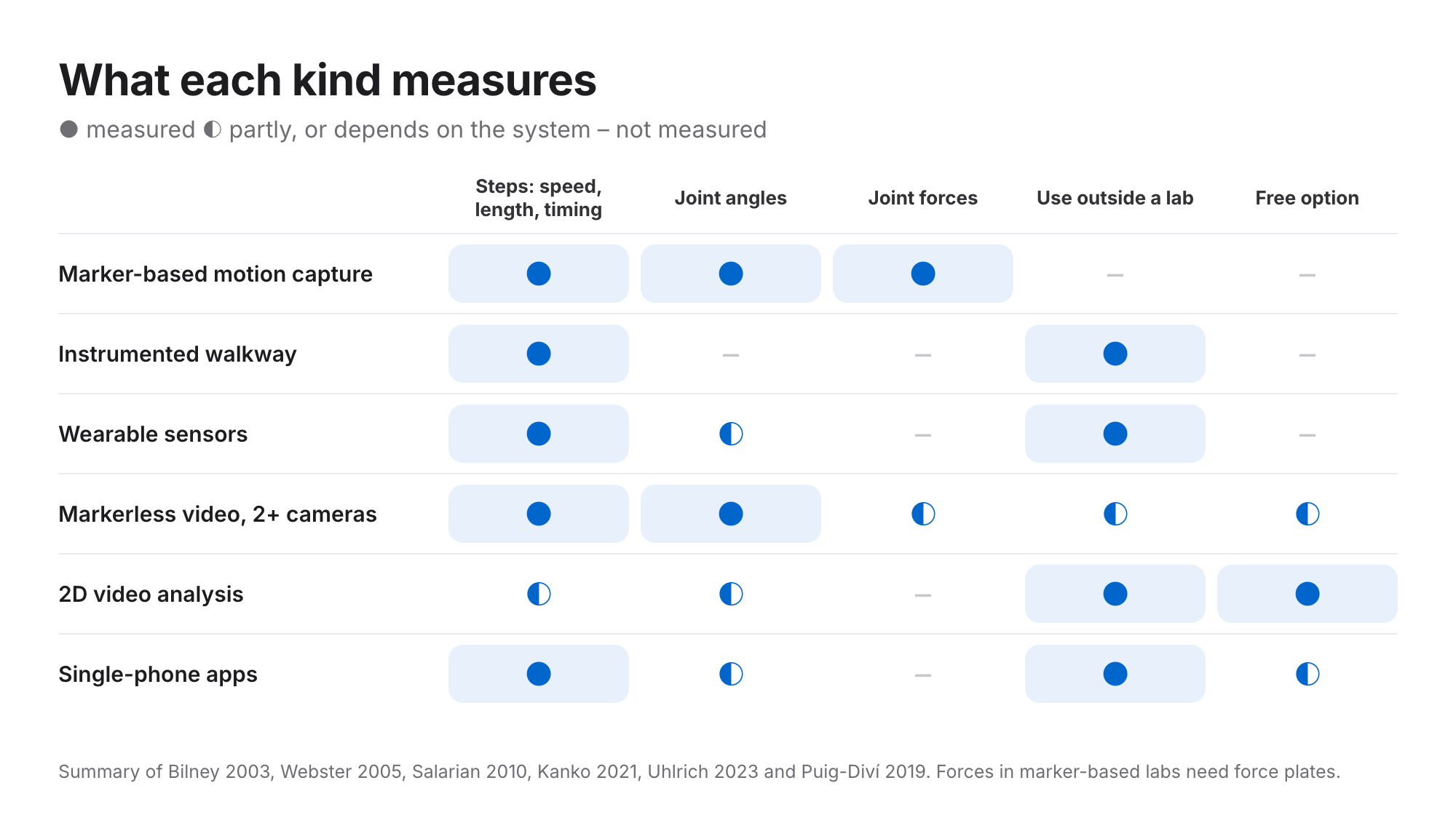
| Kind | Measures | Setup | Free option |
|---|---|---|---|
| Marker-based motion capture | 3D joint angles; forces with force plates | Lab, markers, trained operator | No |
| Instrumented walkway | Footfalls: speed, step length, cadence, timing | Portable mat in a corridor | No |
| Wearable sensors | Step timing, test phases, turns | Sensors strapped to the body | No |
| Markerless video, 2+ cameras | 3D joint angles; estimated forces | Synchronised cameras or phones | OpenCap, for academic research |
| 2D video analysis | Angles, distances, times, measured by hand | One camera square to the movement | Kinovea |
| Single-phone apps | Depends on the app | One phone | Some, or free to download |
Is there free gait analysis software?
Yes, two well-documented options: Kinovea, free and open source for 2D video measurement, and OpenCap, free for the academic research community, for 3D motion and estimated forces from two or more smartphones. Kinovea needs you to mark points and read off angles yourself; OpenCap needs at least two phones recording at once. For a single walking test without extra equipment, a phone app is simpler.
How to choose
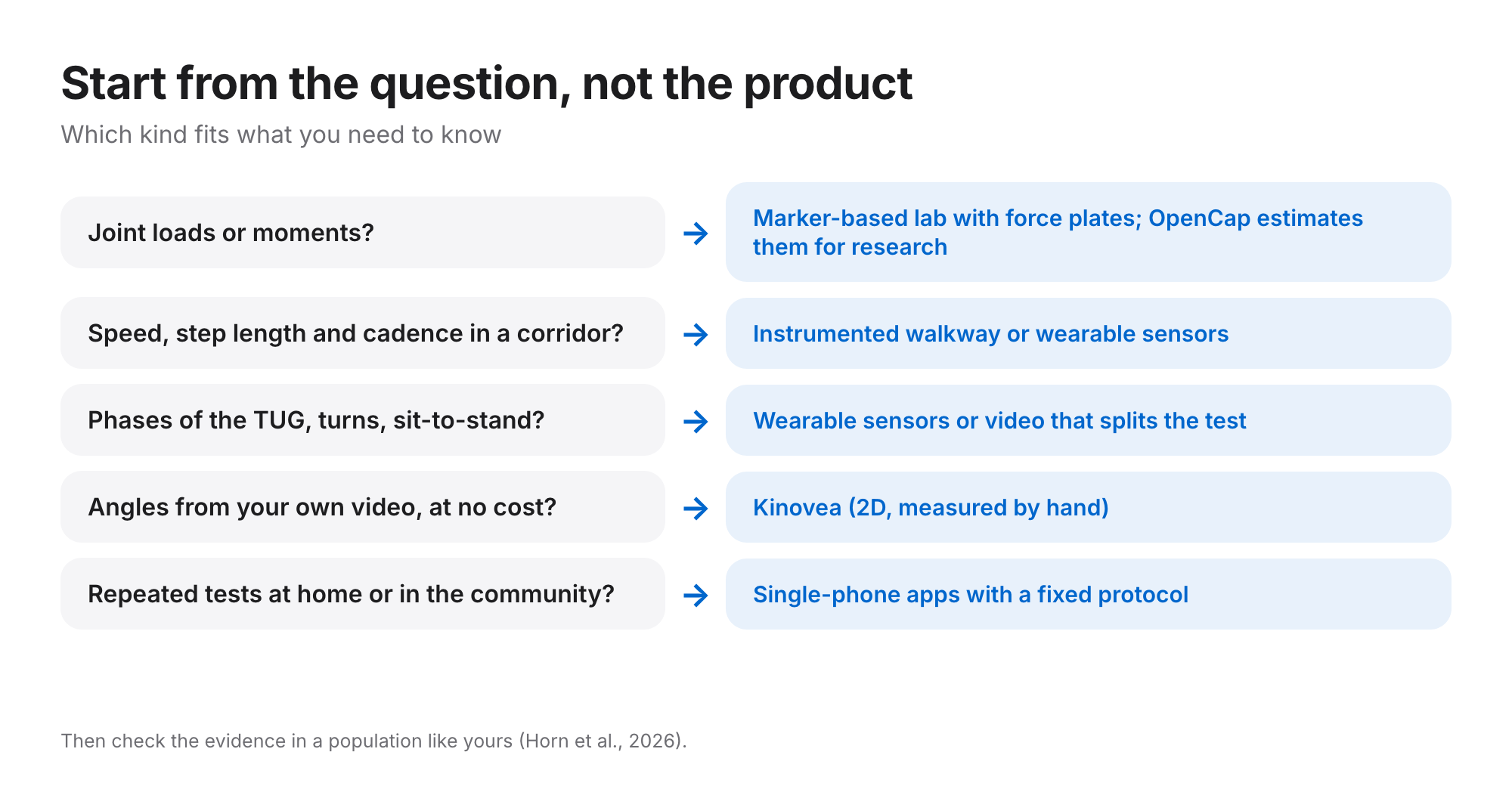
- Start from the question. Joint loads need force plates or a validated estimate; walking speed, step length and cadence don't.
- Think about where you test. A lab, a clinic corridor, a patient's home or a community centre each suit different kinds.
- Check the evidence in your population. Accuracy in healthy young adults on a treadmill doesn't guarantee the same in older adults, children or people with braces.
- Plan for repeat tests. Change is easier to see when every test uses the same setup and protocol; see the normal values of gait parameters for what to track.
Questions
What is the best gait analysis software? It depends on what you need. Marker-based motion capture remains the lab reference for 3D joint angles and, with force plates, joint forces. Instrumented walkways are reliable for speed, step length and cadence. Wearable sensors split tests like the TUG into phases. Markerless video and phone apps make testing outside a lab easier.
Is there free gait analysis software? Kinovea is free and open source for measuring angles, distances and times on a video. OpenCap is free for academic research and estimates 3D motion and forces from two or more smartphone videos.
What software do gait labs use? Gait labs typically use marker-based optical motion capture systems, such as those from Vicon or Qualisys, with force plates. Many also use an instrumented walkway such as GAITRite for spatiotemporal measures.
Can markerless video replace marker-based gait analysis? For many measures it comes close: in healthy adults, joint centres were within about 2.5 cm of marker-based capture (Theia3D), and joint angles were within a mean of 4.5° (OpenCap). Agreement is weaker for some measures and some populations, so check validation for your use.
Step Doctor measures walking speed, cadence, step length and left-right balance from one phone video, with a 3D replay and a PDF report, so the same walk can be repeated over time without a lab. Read more about gait analysis in Step Doctor, or get it on the App Store or Google Play.
Using this with patients? Request early clinic access.
Step Doctor supports screening and monitoring. It doesn't diagnose, and results should inform, not replace, the judgement of a healthcare professional.