Normal walking speed for adults is about 1.2–1.4 metres per second (Fritz & Lusardi, 2009). A meta-analysis of 35 studies and 14,015 healthy adults walking outdoors put the average usual pace at 1.31 m/s, which is 4.7 km/h, 2.9 mph, or about 12 minutes 43 seconds per kilometre (Murtagh et al., 2021). Below are the speeds for a slow, usual and brisk pace in m/s, km/h and mph, a converter with minutes per km and per mile, and what counts as slow.
Walking speed in m/s by pace
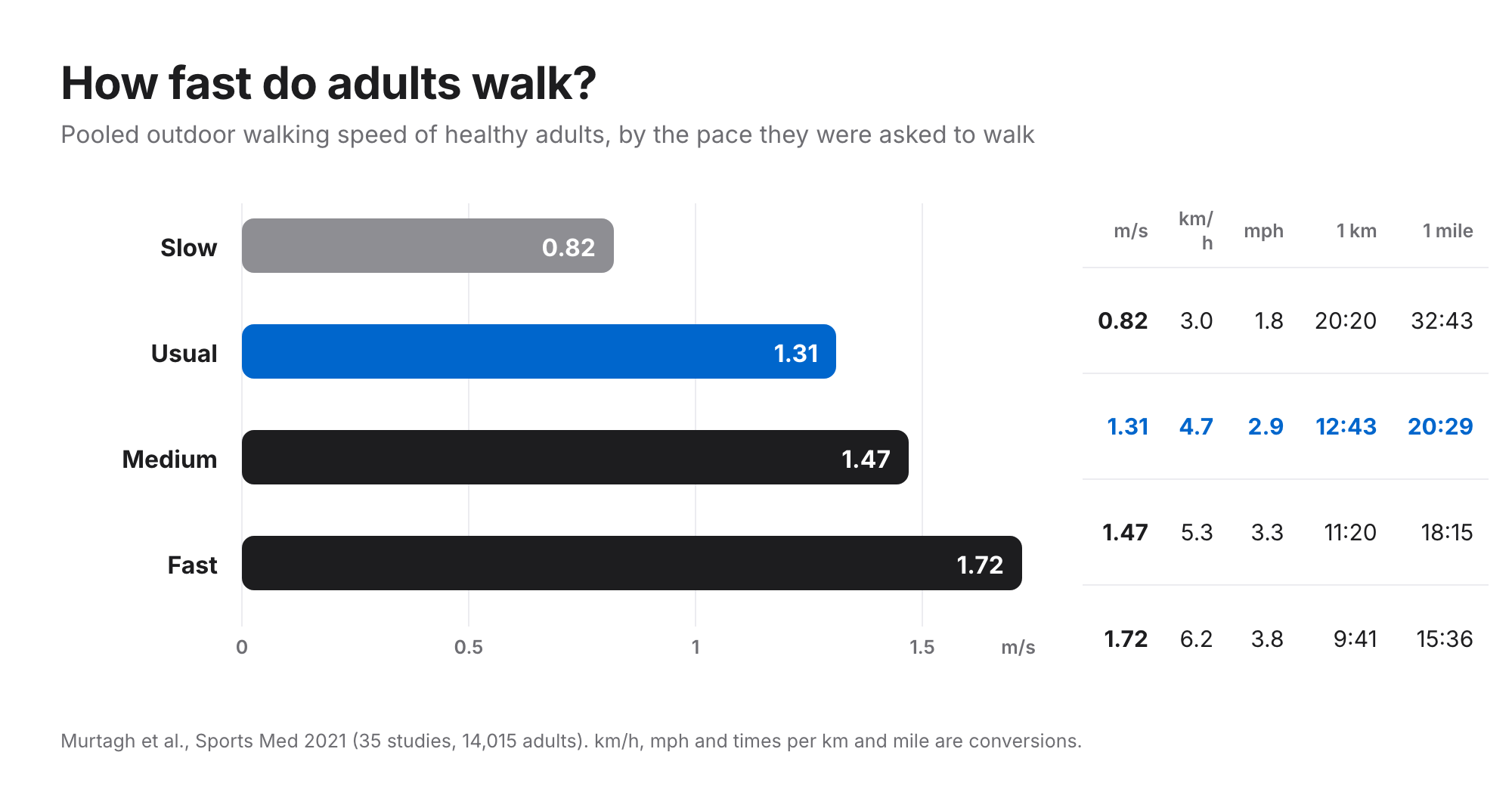
Murtagh and colleagues pooled studies that asked healthy adults to walk outdoors at a given pace (Murtagh et al., 2021). Mean speeds with their 95% confidence intervals:
| Pace | m/s | km/h | mph | 1 km | 1 mile |
|---|---|---|---|---|---|
| Slow | 0.82 (0.77–0.86) | 3.0 | 1.8 | 20:20 | 32:43 |
| Usual | 1.31 (1.27–1.35) | 4.7 | 2.9 | 12:43 | 20:29 |
| Medium | 1.47 (1.44–1.49) | 5.3 | 3.3 | 11:20 | 18:15 |
| Fast | 1.72 (1.64–1.81) | 6.2 | 3.8 | 9:41 | 15:36 |
Each study described its own paces, so "medium" and "fast" are the words participants were given, not fixed definitions. Cadence averaged 117 steps per minute at a usual pace and 127 at a fast pace. Times per km and per mile are conversions of the mean speeds.
Is a normal walking pace moderate exercise?
On average, yes. Oxygen use at a usual pace was 11.97 mL/kg/min (Murtagh et al., 2021). At 3.5 mL/kg/min per MET, that's about 3.4 METs, inside the 3 to under 6 METs that the WHO counts as moderate intensity (WHO guidelines, 2020). That's an average across studies: for a fit person a usual pace may be lighter, and for an unfit person harder. Our cadence guide covers steps per minute.
Walking speed converter: m/s, km/h, mph, minutes per km and mile
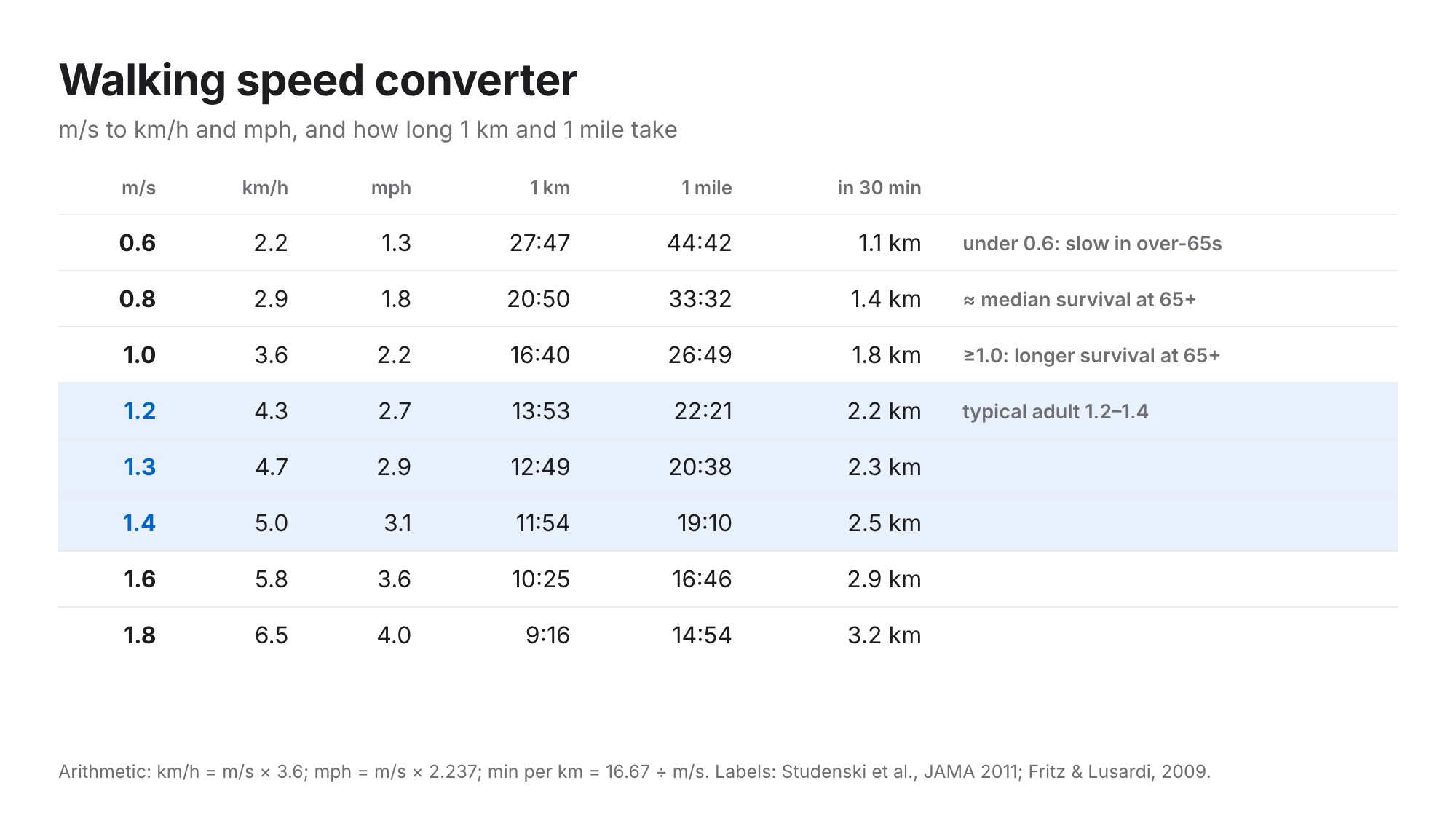
The formulas behind the table:
- km/h = m/s × 3.6 (1.3 m/s = 4.7 km/h)
- mph = m/s × 2.237 (1.3 m/s = 2.9 mph)
- minutes per km = 16.67 ÷ m/s (1.3 m/s = 12.8 min, or 12:49)
- minutes per mile = 26.82 ÷ m/s (1.3 m/s = 20.6 min, or 20:38)
- m/s from a timed walk = metres ÷ seconds (10 m in 8 s = 1.25 m/s)
What walking speed is slow?
In adults aged 65 and over, a pooled analysis of 34,485 people found (Studenski et al., 2011):
- Under 0.6 m/s (2.2 km/h): poor health and function are more likely.
- About 0.8 m/s (2.9 km/h): life expectancy close to the median for age and sex.
- 1.0 m/s or more (3.6 km/h): survival consistently longer than expected.
Sarcopenia guidelines use 0.8 m/s or less (Cruz-Jentoft et al., 2019) or under 1.0 m/s over 6 m (Chen et al., 2020) as a sign of low physical performance. Averages also fall with age, from about 1.3–1.4 m/s before 60 to under 1.0 m/s after 80 (Bohannon & Williams Andrews, 2011); the full table by age and sex is in our average walking speed by age guide.
A change of about 0.05 m/s is small but meaningful in older adults, and about 0.1 m/s is substantial (Perera et al., 2006).
Measuring your own speed in m/s
Mark two lines 4, 6 or 10 m apart with a couple of metres of run-up before and room after, walk at your usual pace, time from the first line to the second, and divide metres by seconds. Our 4 m vs 10 m walk test guide explains which distance to use. Note that a clinic walk indoors is usually a short, timed stretch, while the outdoor speeds above come from longer walks, so compare like with like.
Questions
What is a normal walking speed in meters per second? About 1.2–1.4 m/s for adults (Fritz & Lusardi, 2009). A meta-analysis of 14,015 adults walking outdoors found an average usual pace of 1.31 m/s (Murtagh et al., 2021).
What is the average walking speed in km/h? About 4.7 km/h at a usual pace (1.31 m/s), 5.3 km/h at a medium pace and 6.2 km/h at a fast pace (Murtagh et al., 2021).
How fast does the average person walk a mile? At the average usual pace of 1.31 m/s, a mile takes about 20.5 minutes and a kilometre about 12.7 minutes. A fast pace (1.72 m/s) brings a mile down to about 15.6 minutes.
How do I convert walking speed from m/s to km/h or mph? Multiply m/s by 3.6 for km/h or by 2.237 for mph. For minutes per km, divide 16.67 by the speed in m/s.
What walking speed is too slow? In adults over 65, under 0.6 m/s makes poor health more likely, and 1.0 m/s or more goes with longer than expected survival (Studenski et al., 2011).
Step Doctor measures walking speed in m/s, along with step length and cadence, from a short phone video, and keeps each walk in a PDF report so you can see the trend. Read more about gait analysis in Step Doctor, or get it on the App Store or Google Play.
Step Doctor supports screening and monitoring. It doesn't diagnose, and results should inform, not replace, the judgement of a healthcare professional.