Sarcopenia is the loss of muscle strength and mass that comes with age, and it's one of the main reasons older adults slow down, fall and lose independence. It's also easy to miss: weight can stay the same while muscle is replaced by fat. The Asian Working Group for Sarcopenia (AWGS), whose 2019 criteria are used in Korea, Japan and across Asia, designed its first steps so they can be done outside a hospital. This guide covers the four you can try at home and what each result means.
How sarcopenia is found
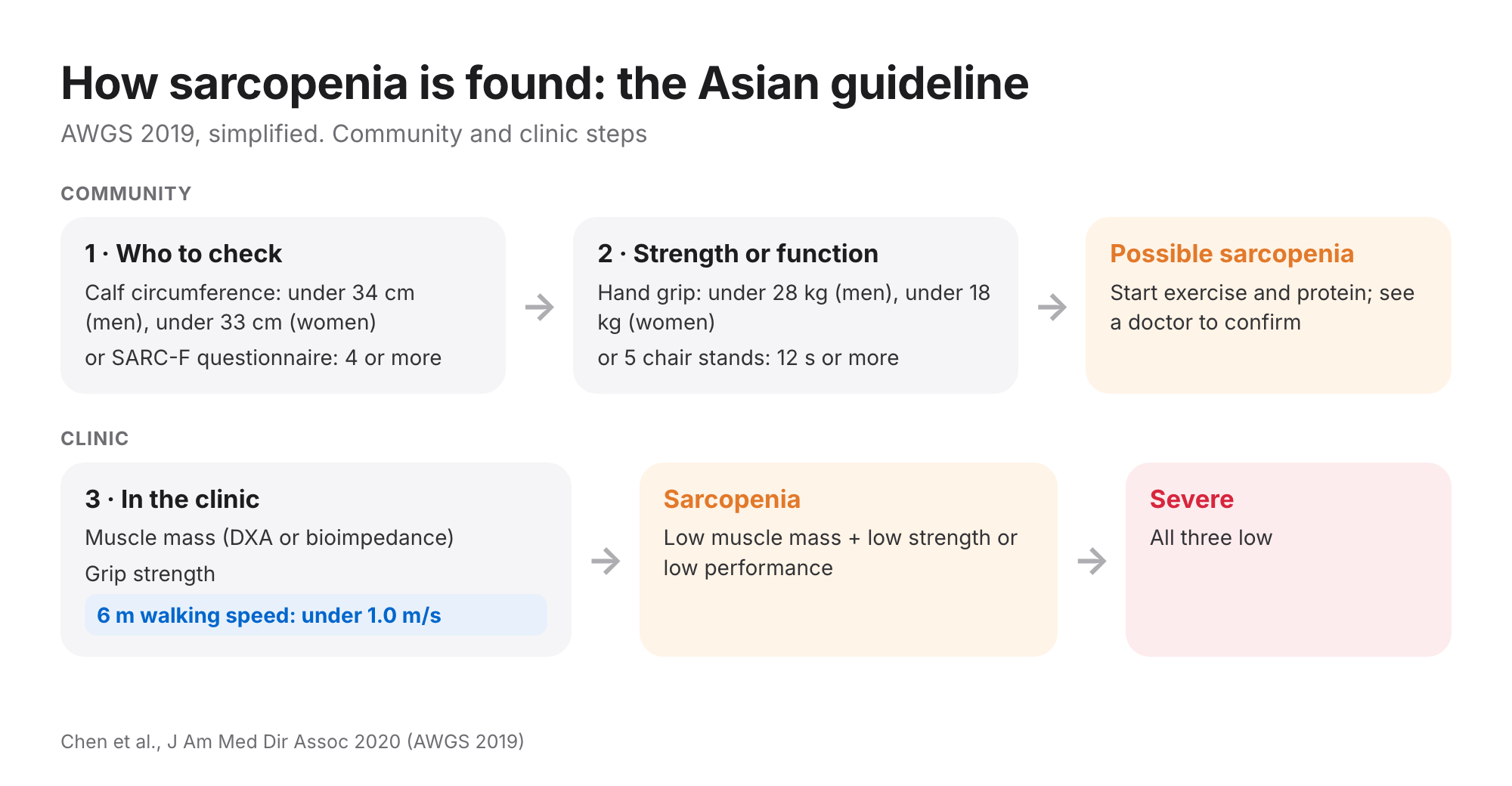
AWGS 2019 works in stages (Chen et al., 2020):
- Who to check: a small calf circumference or a SARC-F score of 4 or more.
- Strength or function: weak hand grip or slow chair stands. Either one, after step 1, is possible sarcopenia, which the guideline says is enough to start exercise and nutrition advice in the community.
- In the clinic: muscle mass is measured (DXA or bioimpedance), with grip strength and a 6-metre walking speed. Low muscle mass plus low strength or low performance is sarcopenia; all three low is severe sarcopenia.
Steps 1 and 2 need no equipment beyond a tape measure, a chair and a timer, which is why they're a good place to start.
1. The finger-ring test (30 seconds)
Calf circumference tracks whole-body muscle mass. The quickest way to check it without a tape measure is the finger-ring test from Japan ("yubi-wakka"). Sit down, make a ring with both thumbs and index fingers, and close it around the thickest part of your calf.
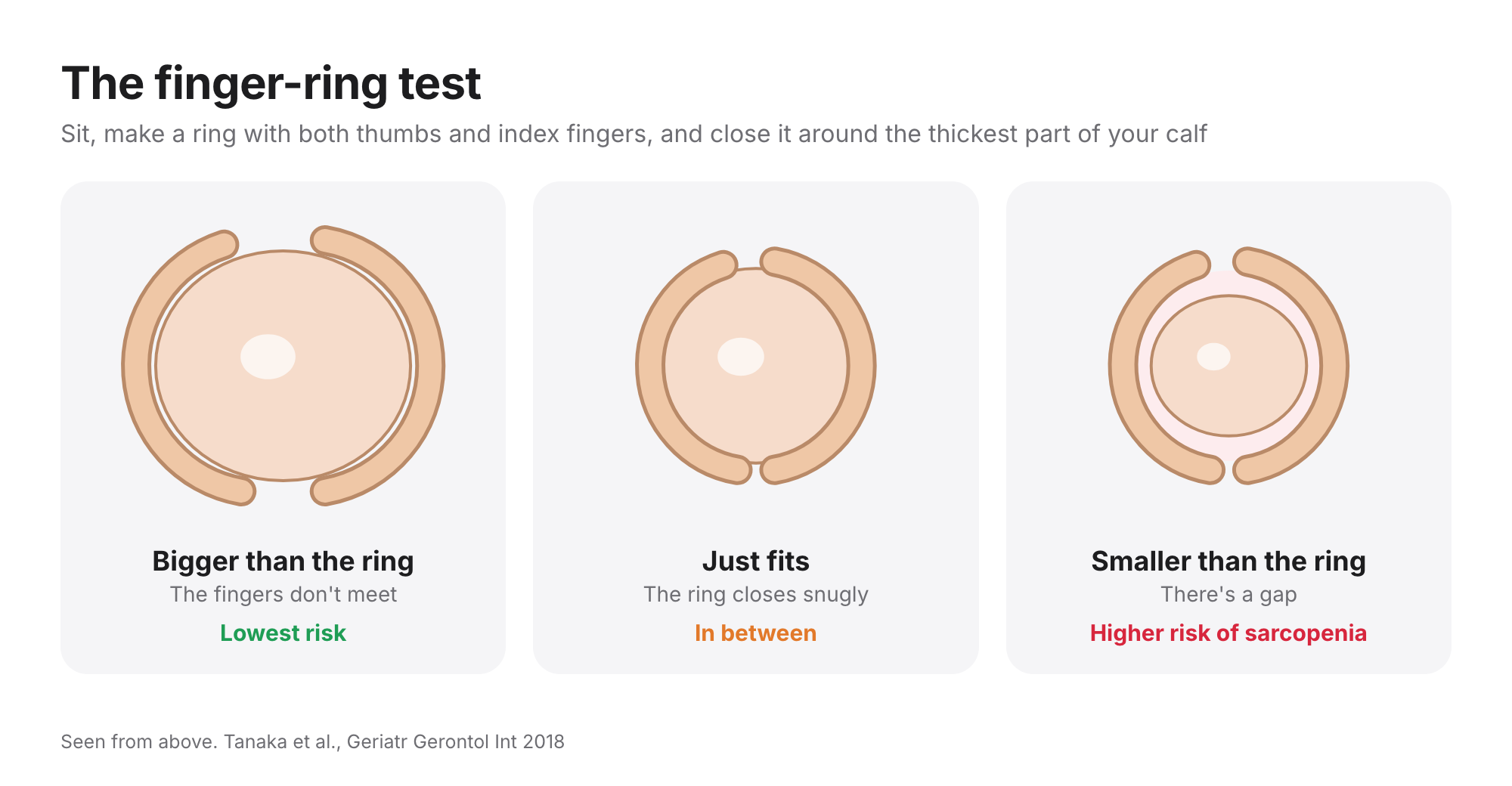
If your calf is bigger than the ring, risk is lowest. If the ring fits snugly, it's in between. If there's a gap, the risk of sarcopenia is higher: in the original study, people whose calves were smaller than the ring were more likely to have sarcopenia and to become disabled over the following years (Tanaka et al., 2018).
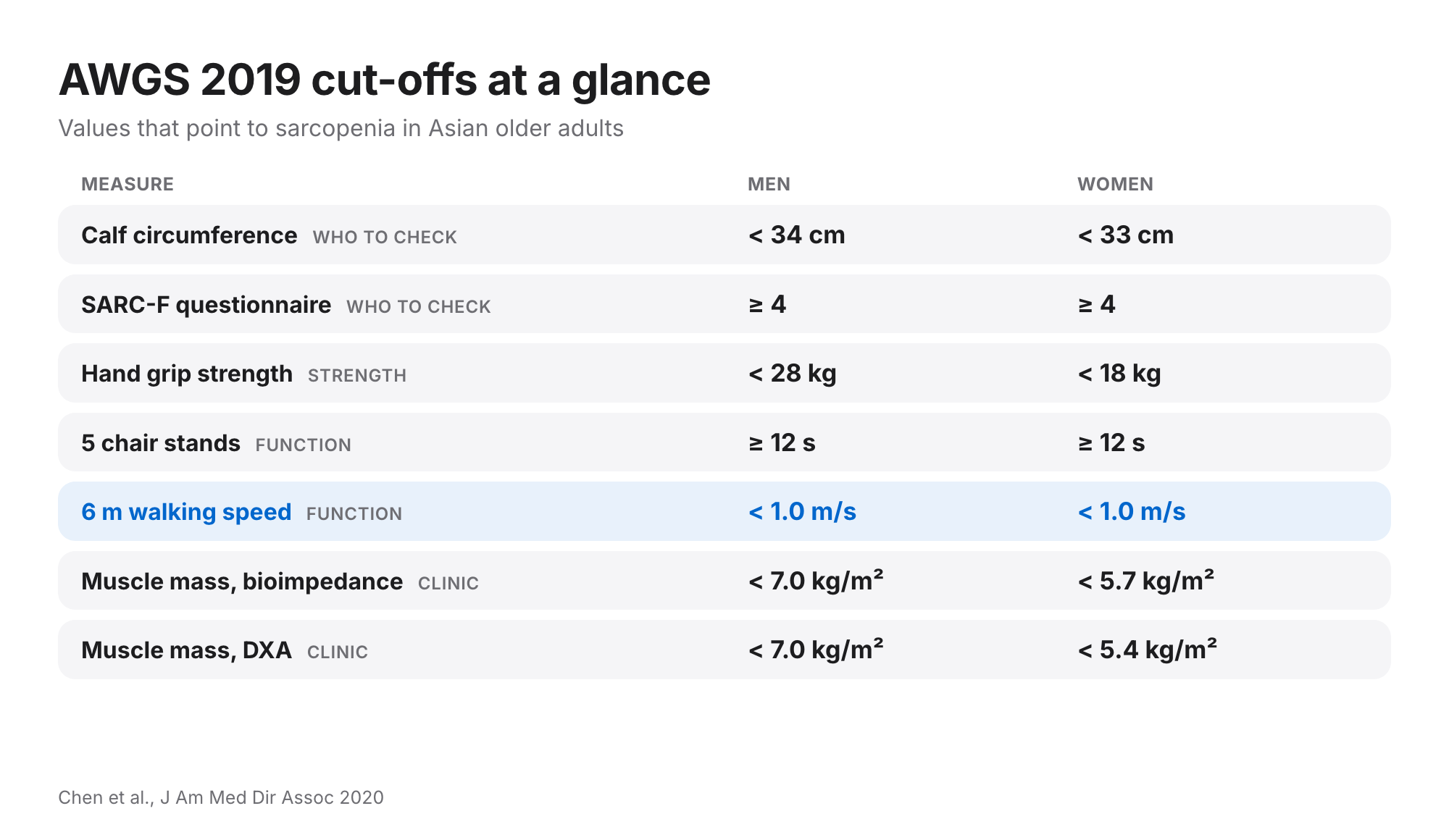
With a tape measure, AWGS uses under 34 cm for men and under 33 cm for women, measured at the widest part of the calf.
2. SARC-F (two minutes)
SARC-F is five questions about everyday tasks. Each scores 0, 1 or 2, for a total out of 10 (Malmstrom & Morley, 2013).
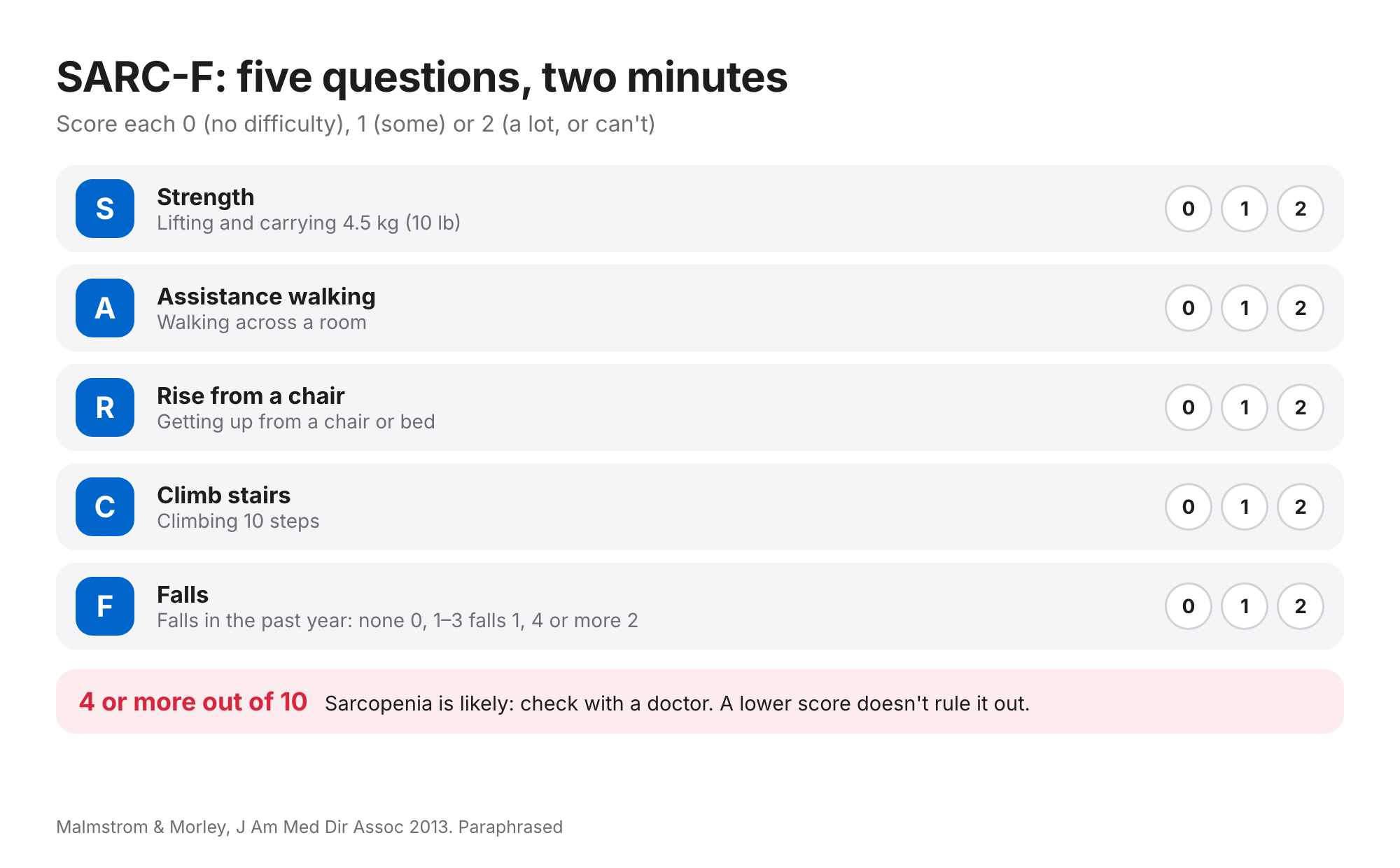
A score of 4 or more makes sarcopenia likely and is worth taking to a doctor. A lower score isn't a clean bill of health: SARC-F is good at confirming risk but misses many people who do have sarcopenia, which is why AWGS pairs it with calf size.
3. Grip and chair stands
AWGS uses hand grip under 28 kg for men or under 18 kg for women. Grip needs a dynamometer, which many health centres and some pharmacies have. Without one, the chair-stand test is the home alternative: fold your arms and stand up fully from a chair and sit down five times, as fast as you safely can. Taking 12 seconds or more points to possible sarcopenia. Have someone nearby, and use a chair that won't slide.
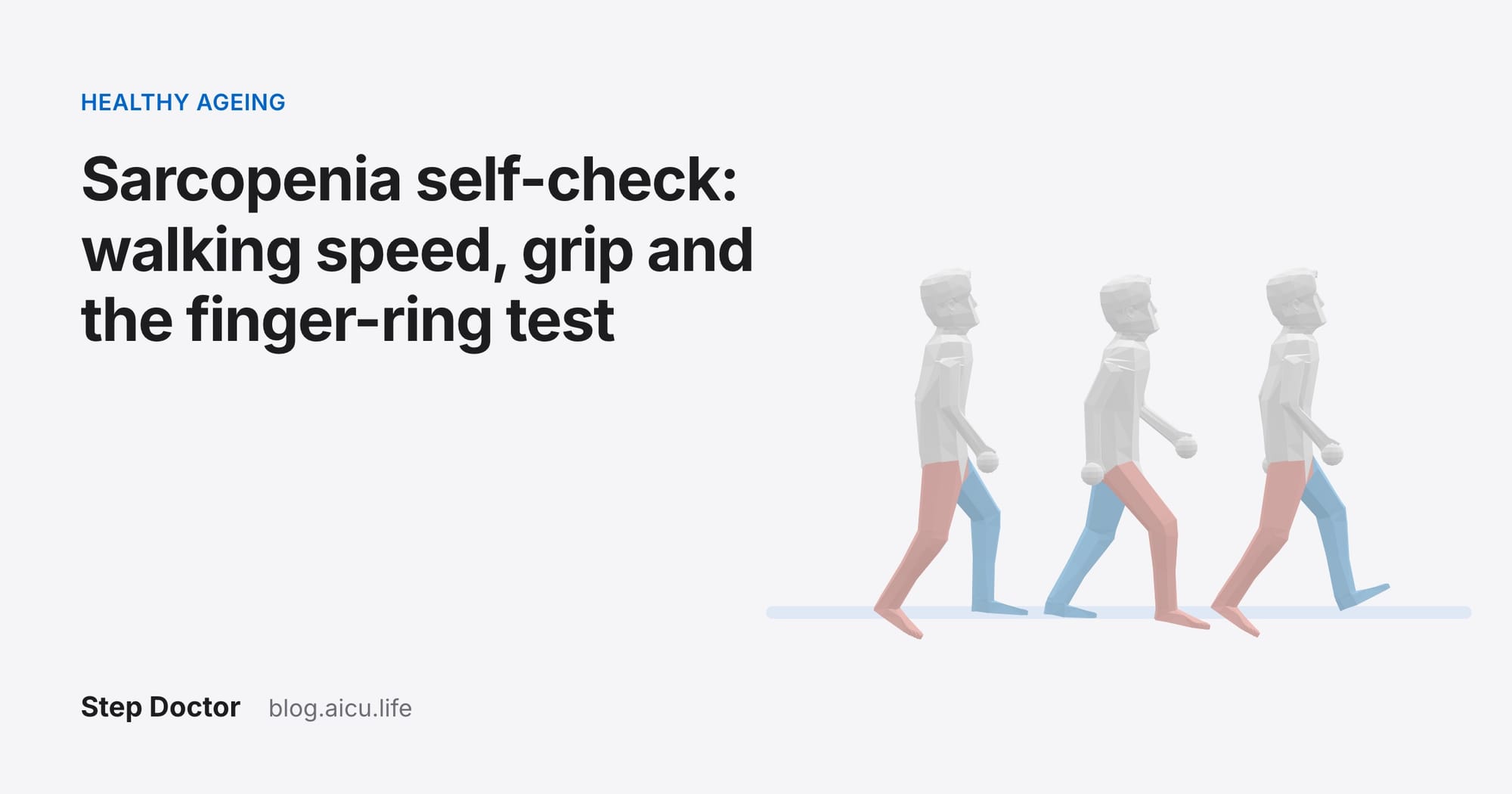
4. Walking speed over 6 m
Walking speed is the performance test AWGS uses in the clinic, and it's the easiest to repeat at home. Mark two lines 6 metres apart with a couple of extra metres at each end. Start walking before the first line, so you're already at your usual pace, and time from the first line to the second.
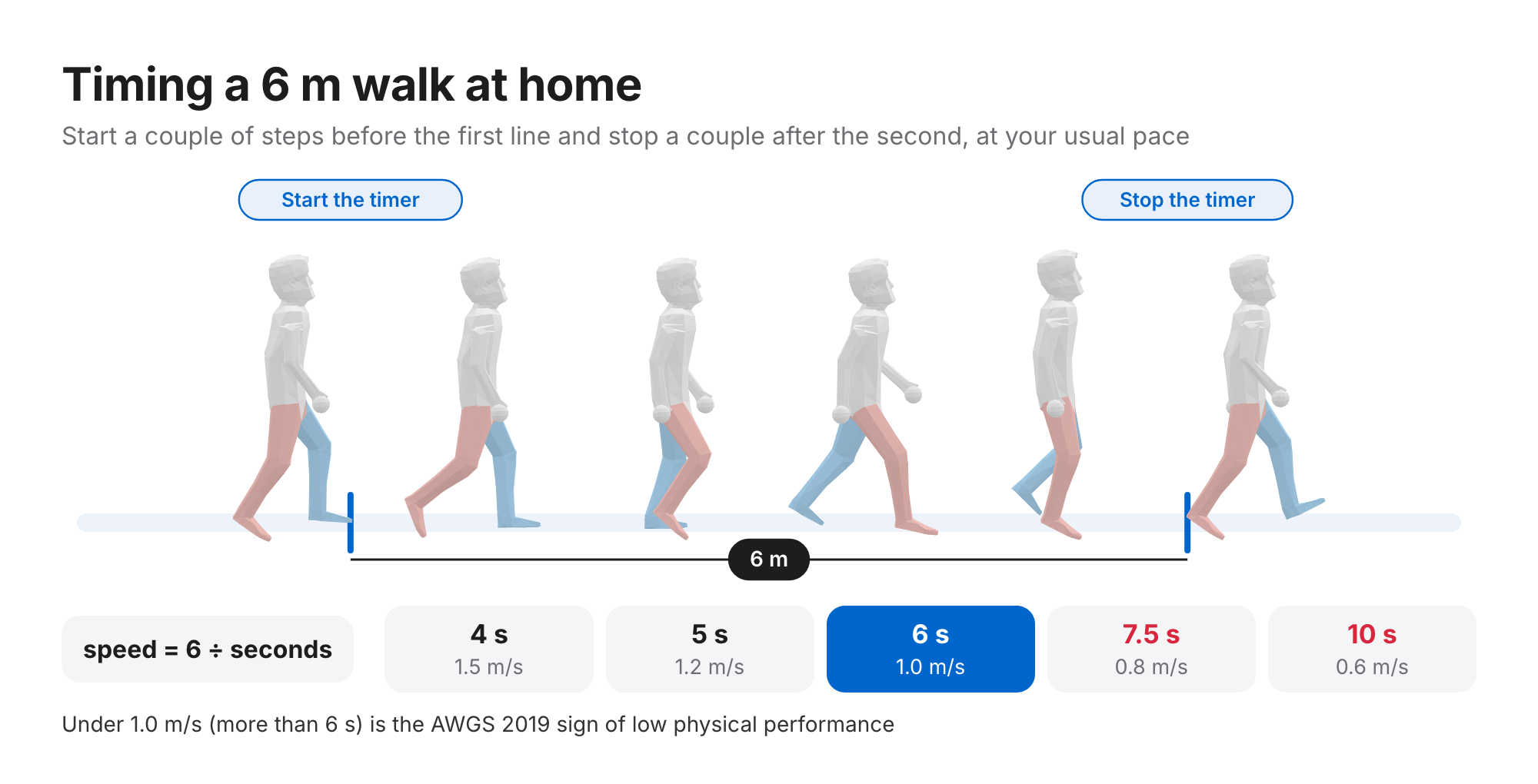
Divide 6 by the time in seconds. Under 1.0 m/s, which is more than 6 seconds for 6 m, is the AWGS sign of low physical performance. Do it twice and average the two, in the same shoes and place each time. Walking speed also says a lot on its own: in older adults it tracks survival across its whole range (Studenski et al., 2011), and a change of about 0.1 m/s between tests is substantial (Perera et al., 2006). See normal walking speed by age.
All the cut-offs in one place
What helps
Sarcopenia can improve. International guidelines strongly recommend resistance training, exercise that makes muscles work against weight, bands or body weight, as the main treatment (Dent et al., 2018). Protein matters too: an expert group recommends at least 1.0–1.2 g of protein per kg of body weight a day for people over 65, more for those who are active or ill, unless kidney disease rules it out (Bauer et al., 2013). Talk to a doctor before starting if you have heart or kidney disease, or if the tests above were well past their cut-offs.
Whatever you change, re-test the same way every few months.
Questions
How can I check for sarcopenia at home? Try the finger-ring test or measure your calf, answer the five SARC-F questions, time five chair stands, and time a 6 m walk at your usual pace. Positive results are a reason to see a doctor, not a diagnosis.
What walking speed suggests sarcopenia? Under 1.0 m/s over 6 metres is the AWGS 2019 cut-off for low physical performance, the same for men and women.
What is the finger-ring test? A self-check from Japan: make a ring with both thumbs and index fingers around the thickest part of the calf. If the calf is smaller than the ring, the risk of sarcopenia is higher (Tanaka et al., 2018).
What SARC-F score means sarcopenia? 4 or more out of 10 makes sarcopenia likely. A lower score doesn't rule it out.
Step Doctor measures walking speed, step length and cadence from a phone video, so you can repeat the same walk every few months and see the trend in a PDF report. Read more about gait analysis in Step Doctor, or get it on the App Store or Google Play.
Step Doctor supports screening and monitoring. It doesn't diagnose, and results should inform, not replace, the judgement of a healthcare professional.