"AI gait analysis" usually means one thing: measuring how someone walks from ordinary video, without markers or sensors on the body. A model finds the body's joints in every frame, and the walk is measured from where those joints go. It's what lets a phone stand in for a camera system that once needed a lab. This article explains how it works, step by step, what research says about its accuracy, and what you can do to get a good measurement.
Marker-based vs markerless motion capture
A traditional gait lab tracks reflective markers stuck to the skin with several infrared cameras. It's precise, and it's the reference other methods are judged against, but it needs a dedicated room, trained staff and time to place the markers.
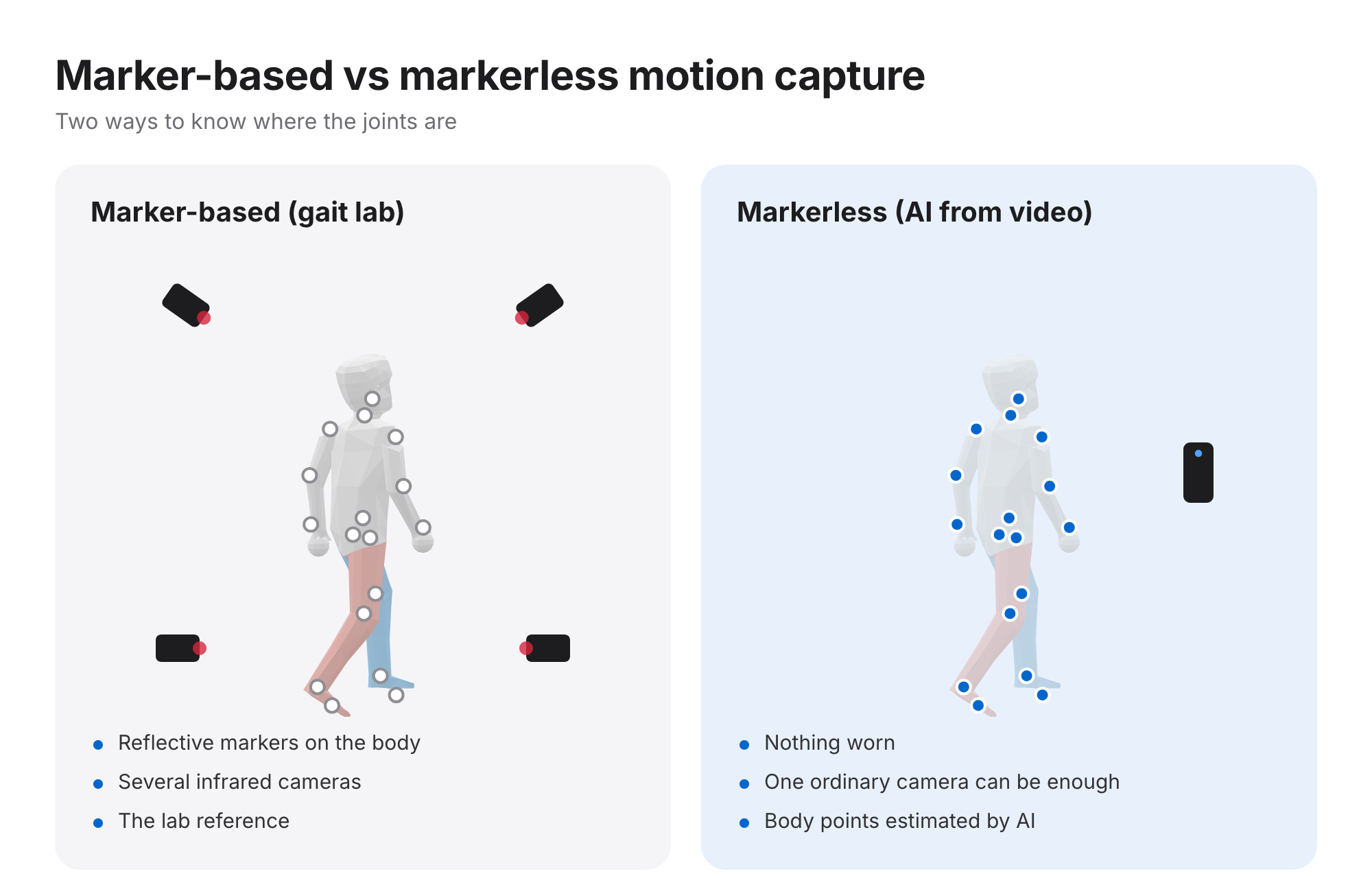
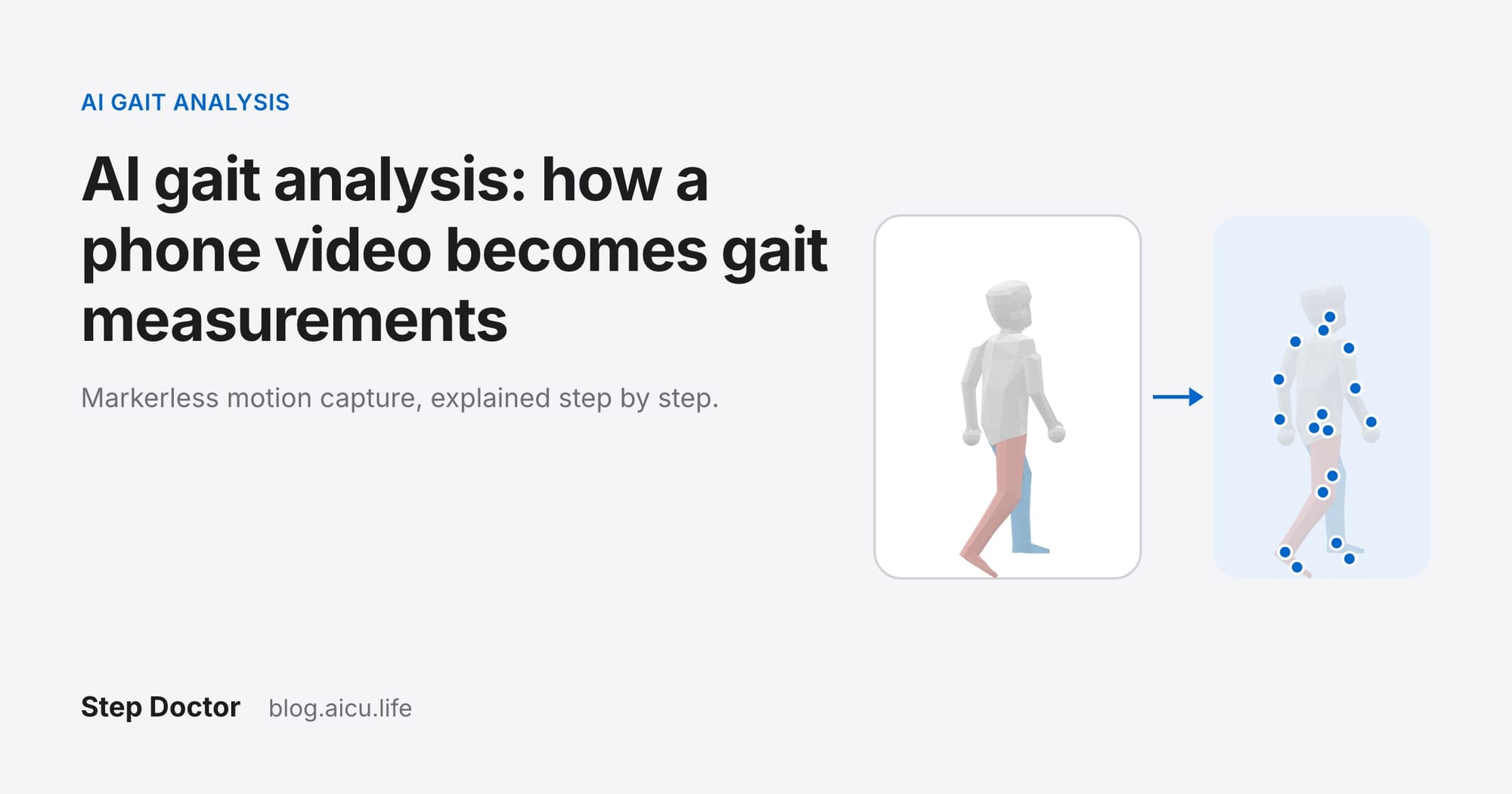
Markerless motion capture skips the markers. A model trained on large sets of annotated images estimates where the joints are, directly from video. With one ordinary camera you lose some detail a lab captures, but you gain something a lab can't offer: a measurement anywhere, as often as you like.
How AI gait analysis works, in five steps
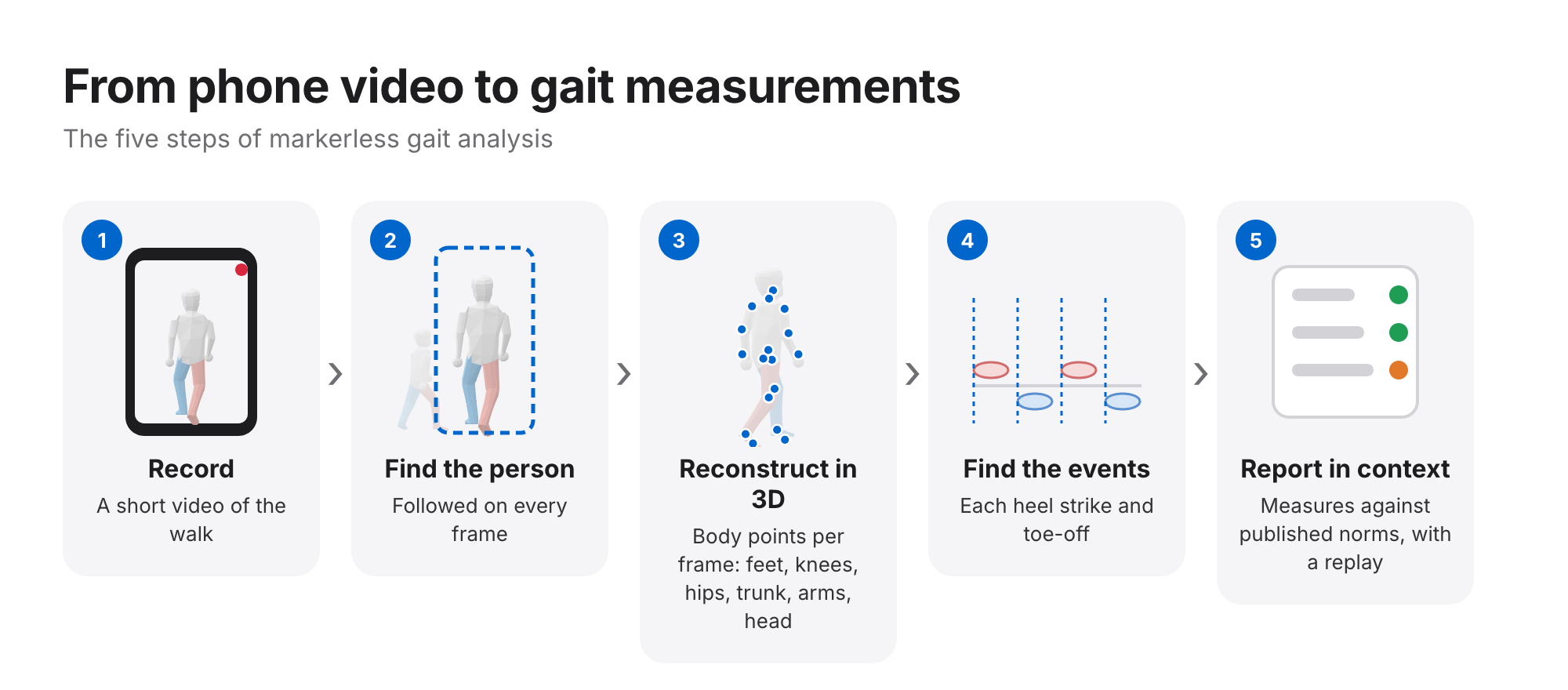
- Record. A short video of the person walking, from a phone standing still.
- Find the person. The person being measured is found and followed on every frame, even if someone else walks into view.
- Reconstruct the body. Body points are estimated on each frame: feet, knees, hips, trunk, arms and head. Step Doctor uses 30 points per frame, in metric 3D.
- Find the events. Each heel strike and toe-off is located in time. These events divide the walk into steps and gait cycles.
- Report in context. The measures are calculated from the steps and compared with published reference values, and the replay shows what was measured.
From heel strikes to measures
Once every heel strike and toe-off is known, the gait measures follow. The time between one heel strike and the next of the same foot is a gait cycle. Within it, the foot is on the floor (stance) for about 60% of the time and in the air (swing) for about 40% at a normal pace (Perry & Burnfield, Gait Analysis: Normal and Pathological Function, 2010).
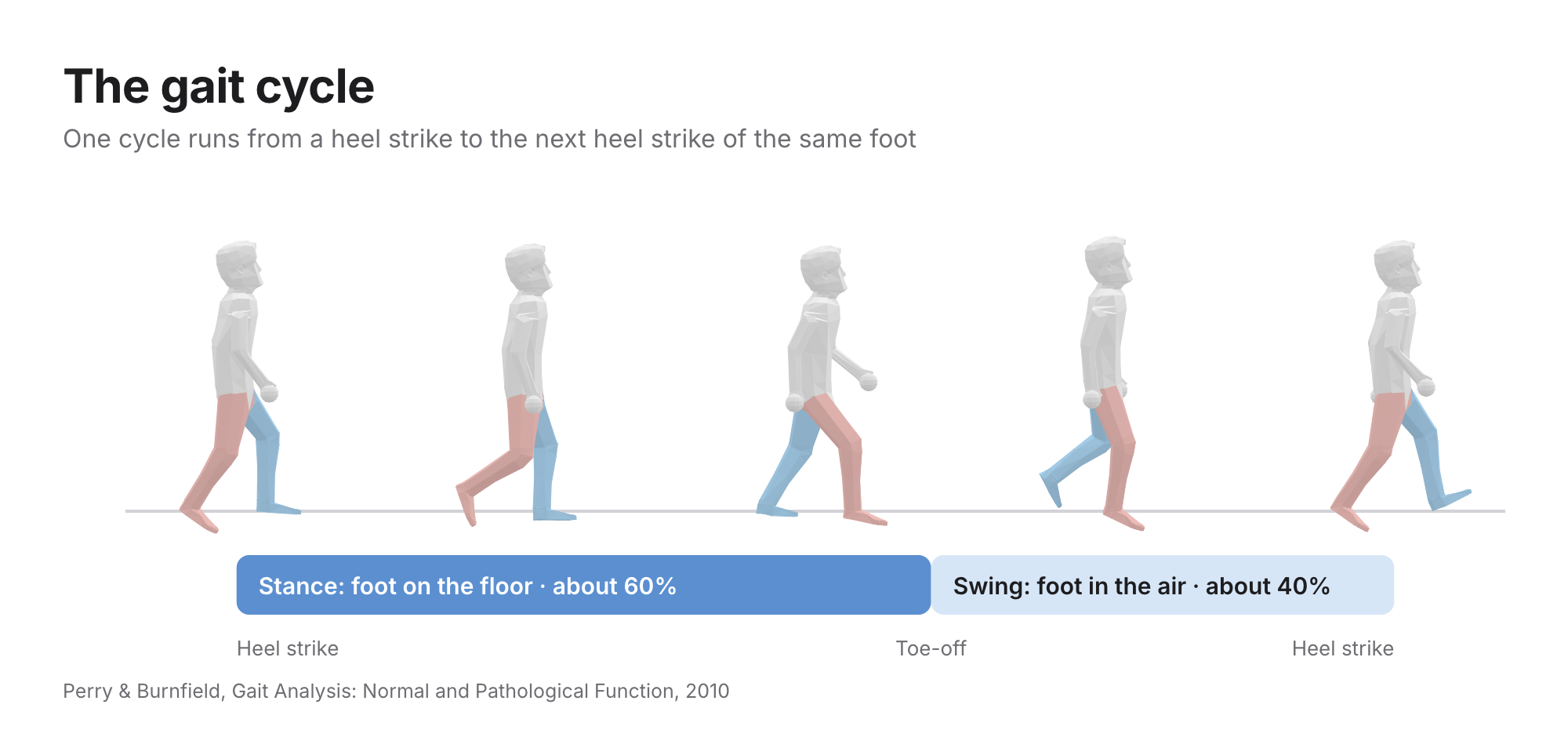
The distance between heel strikes gives step and stride length; steps per minute give cadence; distance over time gives walking speed; and comparing the left and right sides gives balance. Because a camera sees the whole body, it can also show what one sensor can't: trunk lean, arm swing, knee bend.
How accurate is AI gait analysis?
Research on markerless gait analysis is promising, with differences that matter:
- With 2D video and pose estimation in 32 healthy adults, gait speed differed from simultaneous motion capture by 0.03 m/s on average, step length by 0.049 m and knee angle by 5.6° (Stenum et al., 2021).
- With two or more phone videos (OpenCap) in 10 adults, joint angles differed from motion capture by 4.5° on average (Uhlrich et al., 2023; the authors co-founded the company behind it).
- With a single video in children with cerebral palsy, compared with motion capture from the same visit but not recorded at the same time, the mean absolute error in gait speed was 0.13 m/s (Kidziński et al., 2020).
The pattern: in controlled conditions, errors in gait speed can be close to or below the smallest change worth noticing, about 0.05 m/s in older adults (Perera et al., 2006). Harder conditions and less direct comparisons give larger errors. Step Doctor's own comparison with a pressure-sensor walkway is an internal study, not yet peer-reviewed; the science page explains what has and hasn't been validated, and our article on how phone gait analysis is validated explains how to read these numbers.
What makes a camera measurement better or worse
A model can only measure what the camera sees. Most of what decides the quality of a markerless measurement is in your hands when you record:
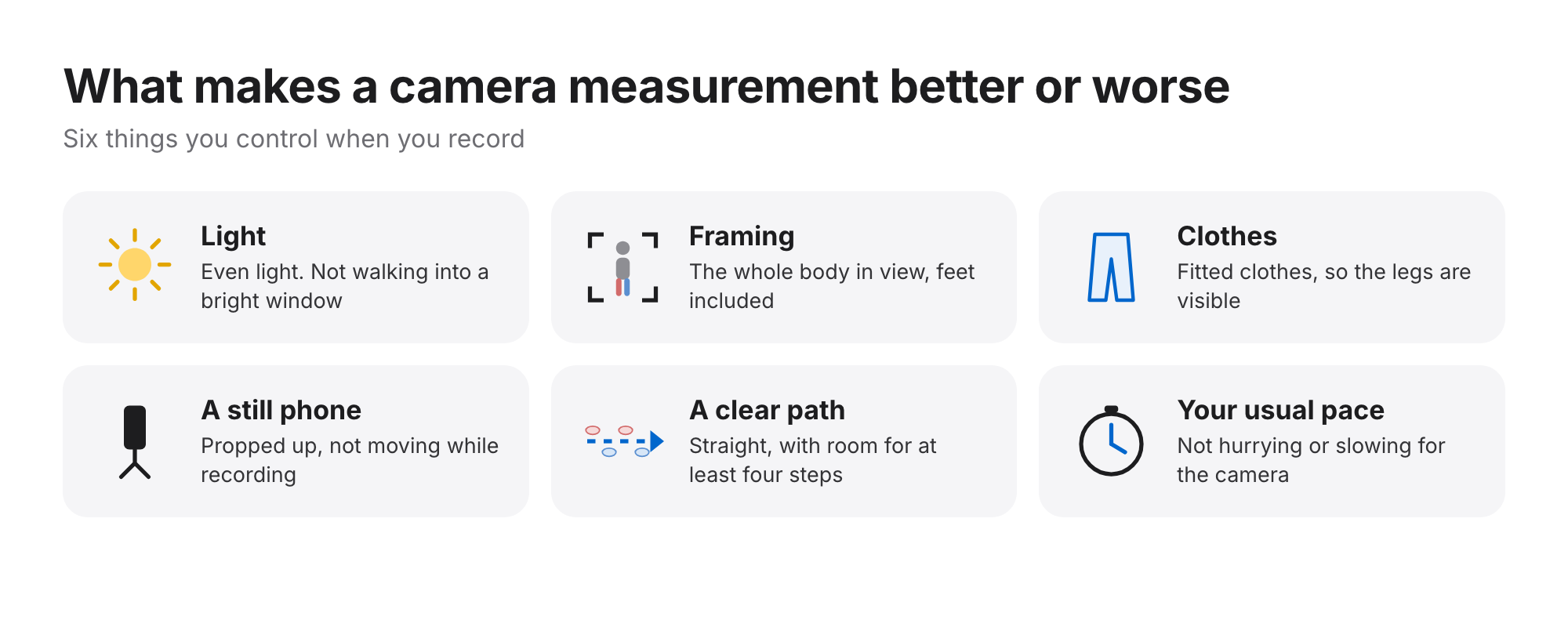
Our guide to doing a gait analysis at home covers the setup step by step.
One camera or several?
More cameras see more of the body at once, which helps with joint angles and turning movements; that's why research tools such as OpenCap use two or more phones. One camera is far simpler to set up and enough for the main gait measures of a walk toward the phone. For screening and following change at home or in a clinic, simplicity is often what decides whether a test gets repeated.
Where does the video go?
Some AI gait apps process video on the phone; others send it to a server, where larger models can run. Either way, check how long the video is kept and whether it's ever shared. In Step Doctor, videos and results are encrypted in transit and at rest; videos are used only to produce your results and are deleted from our servers after about 72 hours, and results are never sold or used for advertising.
Questions
What is AI gait analysis? Measuring how someone walks from ordinary video, using a model that finds the body's joints in every frame. No markers or sensors are worn.
Is markerless gait analysis as accurate as marker-based motion capture? Marker-based capture remains the lab reference. In controlled studies, markerless methods have measured gait speed within a few centimetres per second of it; accuracy depends on the tool, the people and the recording conditions.
Do I need a special camera? No. Phone cameras are enough for the main gait measures, as long as the phone stays still, the light is even and the whole body is in frame.
What does an AI gait analysis app measure? Typically walking speed, step and stride length, cadence, stance and swing, and left–right balance. Because the camera sees the whole body, some apps also show posture, arm swing and knee bend.
Step Doctor is an AI gait analysis app for iPhone and Android: one phone video becomes a 3D replay, walking speed, step length, cadence and left–right balance, and a PDF report. Get it on the App Store or Google Play. It's free to download; each test uses credits, and new accounts get welcome credits.
Step Doctor supports screening and monitoring. It doesn't diagnose, and results should inform, not replace, the judgement of a healthcare professional.