Balance, gait speed and leg strength
Short Physical Performance Battery (SPPB), scored by your phone
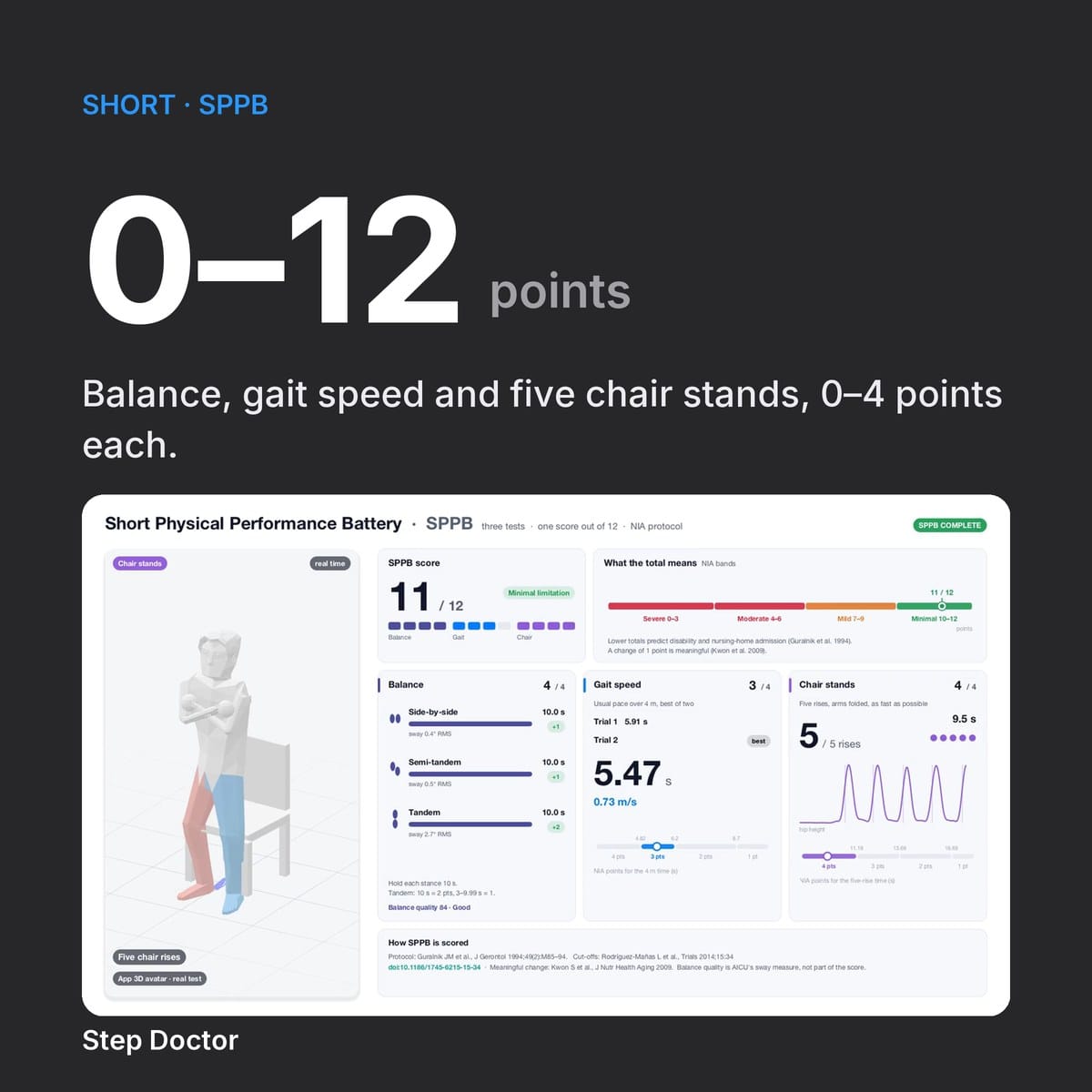
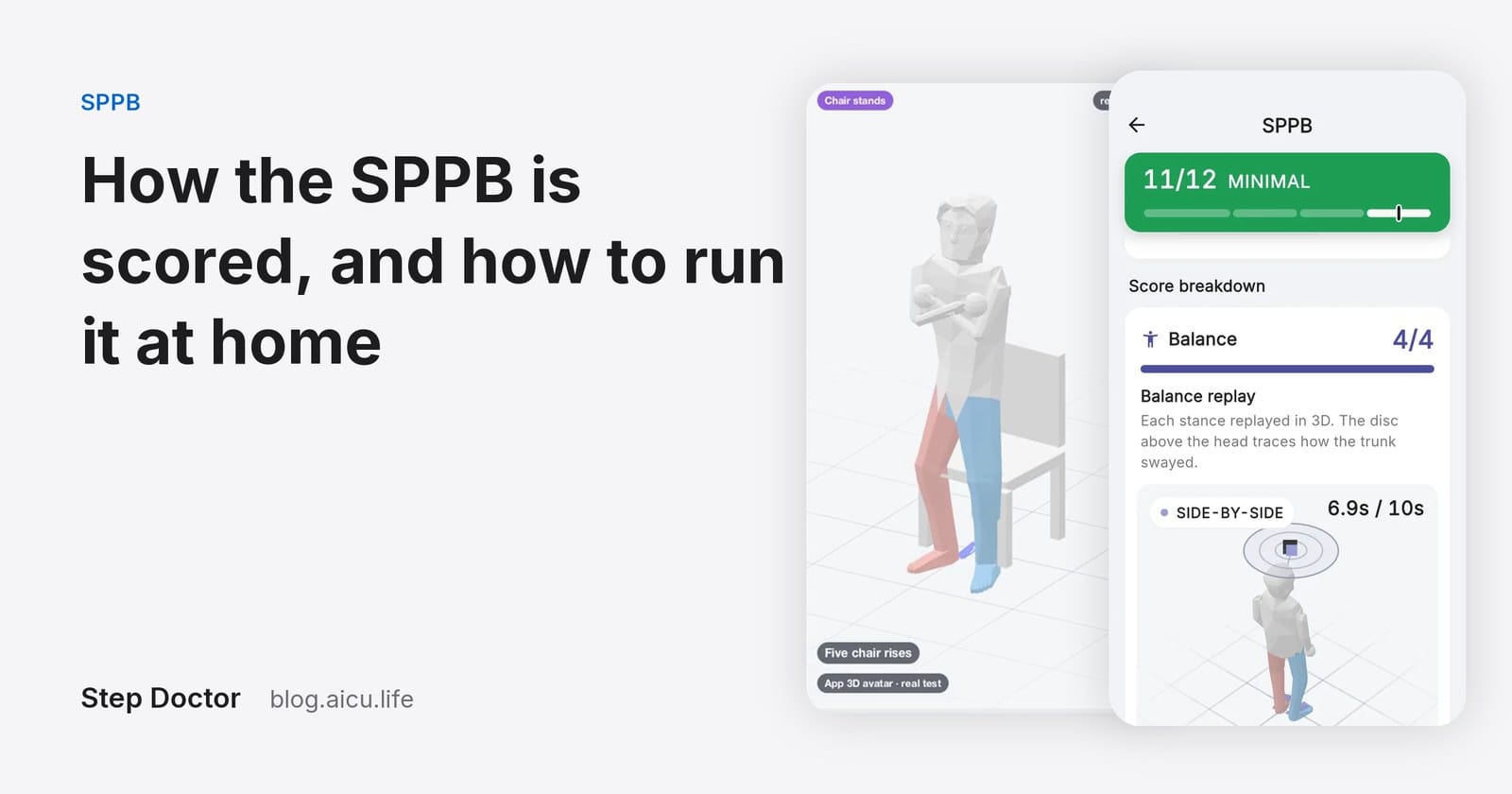
The SPPB is a standard test of lower-body function in older adults: three balance stances, a timed 4-metre walk and five chair stands, each scored 0 to 4 for a total out of 12. Step Doctor runs the whole battery with voice prompts and scores it from one video.
- Time
- About 10 min
- You'll need
- A chair and about 6 m of floor




See it in action
A real SPPB scored 11 of 12: the three balance stances (sped up 3.2×, labelled), both 4-metre walks and five chair stands, with the score building to 12 on the right.
Real tests from Step Doctor, replayed on the app's 3D avatar (no faces are shown).
What it measures
Standing balance (0–4)
Side-by-side, semi-tandem and tandem stance, 10 seconds each. One point each for side-by-side and semi-tandem; two for a full tandem hold, one for 3 to 9.99 seconds.
Gait speed (0–4)
Two 4-metre walks, best time counted: under 4.82 s scores 4, up to 6.20 s scores 3, up to 8.70 s scores 2, slower scores 1.
Chair stands (0–4)
Five stands as fast as you safely can, arms crossed: up to 11.19 s scores 4, up to 13.69 s scores 3, up to 16.69 s scores 2, up to 60 s scores 1.
Balance quality
How much your trunk sways while you hold each stance. It's shown as an extra measure and doesn't change the 0–12 score.
How to do it
Set up
Stand the phone at about hip height facing about 6 metres of clear, straight floor. The app tells you when you're on your mark and fully in view.
Balance
Facing the phone, hold each stance for 10 seconds. The voice guide and the foot diagram on screen show you how to stand.
Two walks
Walk 4 metres away from the phone, turn and wait, then walk 4 metres back. The app calls Stop as you reach the line.
Chair stands
Place a sturdy chair without wheels where you stand, sit with your arms crossed, stand once to check you can, then stand up and sit down five times.
Your score
Your total out of 12, the points for each part, a 3D replay of every part and a PDF report.
Normal values and cut-offs for gait speed, TUG, SPPB and sit-to-stand, with sources
How it's scored
Step Doctor uses the published SPPB scoring (Guralnik et al., 1994), with the same cut-offs as the paper score sheet. The total is read in four bands: 10–12 minimal limitation, 7–9 mild, 4–6 moderate and 0–3 severe. A change of about half a point is considered small but meaningful, and about one point substantial (Perera et al., 2006).
0–3 Severe · 4–6 Moderate · 7–9 Mild · 10–12 Minimal
Step Doctor supports screening and monitoring. It doesn't diagnose, and results should inform, not replace, the judgement of a healthcare professional.
Who it's for
- Older adults and families who want a standard measure of strength and balance at home.
- Geriatric, rehabilitation and research teams who use the SPPB and want it timed and recorded without a stopwatch.
- Anyone following recovery after illness, surgery or a hospital stay, with their care team.
Questions
What's a good SPPB score?
10 to 12 means minimal limitation, 7 to 9 mild, 4 to 6 moderate and 0 to 3 severe. A change of about half a point is small but meaningful; about one point is substantial.
Is it the same as the paper SPPB?
Yes: the same three parts and the standard scoring cut-offs. Step Doctor times everything from the video instead of a stopwatch and adds balance quality as an extra measure that doesn't change the score.
Can I do it on my own?
Yes. The phone stays in one place and the voice guide takes you through every part. For the balance stances, having someone nearby for safety is a good idea.
Why does it test chair stands?
Standing up from a chair five times measures leg strength and power, which matter for walking, climbing stairs and getting up after sitting.
References
- Guralnik JM, et al. A short physical performance battery assessing lower extremity function: association with self-reported disability and prediction of mortality and nursing home admission. J Gerontol. 1994;49(2):M85–M94.
- Perera S, et al. Meaningful change and responsiveness in common physical performance measures in older adults. J Am Geriatr Soc. 2006;54(5):743–749.
- Rodríguez-Mañas L, et al. An evaluation of the effectiveness of a multi-modal intervention in frail and pre-frail older people with type 2 diabetes - the MID-Frail study: study protocol for a randomised controlled trial. Trials. 2014;15:34. (Figure 1: the SPPB protocol Step Doctor follows.)
The other tests in Step Doctor
Walking test
Gait analysis
Walk toward the camera for a few seconds. Step Doctor measures walking speed, cadence, stride length and left–right balance, and gives a 0–100 gait score.
Learn moreMobility and fall risk screening
Timed Up and Go (iTUG)
Stand up from a chair, walk 3 m, turn, walk back and sit down. Step Doctor times the whole test from the video and grades each of its six phases against published reference values. Timed this way, it's an instrumented TUG (iTUG).
Learn moreGet Step Doctor
Free to download on iPhone and Android. Each test uses credits, and new accounts get welcome credits.